 Steel production is a 24-hour-a-day, 365-day-a-year process, dependent on a consistent supply of raw materials and huge amounts of energy. According to the World Steel Association, world crude steel production has increased from 851 million tonnes (Mt) in 2001 to 1,606 Mt in 2013 and world average steel use per capita has steadily increased from 150kg in 2001 to 225 kg in 2013.
High demand for iron ore, coke and scrap steel, increasing energy costs, and industry consolidation have prompted steel producers to develop new methods for gaining efficiency to remain competitive. The production methods using raw materials have improved significantly over the past decade, and scrap-based production is accounting for a larger portion of the total steel supply.
Steel is made primarily in a two-step process. In the primary steelmaking step, liquid iron is converted into steel by the basic oxygen furnace (BOF) process, or by melting scrap steel or direct reduced iron (DRI) in an electric arc furnace. Secondary steelmaking is a refining process in which alloying metals are added and impurities are removed.
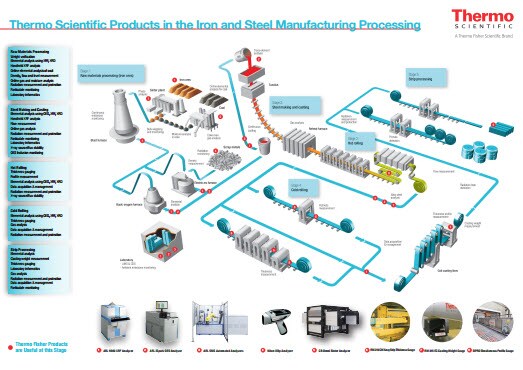
Check out this infographic for an overview of the products that make each stage of the iron and steel manufacturing process possible, from incoming raw materials to the final coating line.
Additional Resources:
- Download our free eBook: A Practical Guide to Improving Steel Manufacturing Processes and Production Methods
- Visit our center for Improving Steel Manufacturing Processes and Production


Here’s a Free Periodic Table for Your Halloween Goody-Bag
No tricks here. Download this handy periodic table and X-ray... Marlene Gasdia-Cochrane, Editor
Read More
Metallic Microneedle Manufacturing
A metallic microneedle manufacturer faces challenges ensurin... Marc Liu
Read More
INFOGRAPHIC: 8 Fun Facts About Copper
What do pennies, asparagus and police officers have in commo...
Read More
Why Sinter Chemistry is Important and How to Get it Right
When sinter chemistry fluctuates, it can significantly impac... Kevin Gordon
Read More

Thanks for the useful information but it could be better if you explain it deeply.
Want to know more about steel, Anu? Start here: What Is Stainless Steel? Part I
Hi, If there have a complete procedure in manufacturing process of steel? Thank you
Hi John– To get some answers about the manufacturing of steel, feel free to download our free ebook: A Practical Guide to Improving Steel Manufacturing Processes and Production Methods
How do I sign up to get the review notifications for these articles?
Hi Tjada– Thank you for asking, and thank you for being a reader of Analyzing Metals! Go to our blog home page (https://www.thermofisher.com/blog/) and on the right hand side you will see a form to ‘subscribe.’ Fill it out, choose the topic and you will be notified every time a new article comes out. Let us know if there are topics you wish we would cover!
Hello there!!! It was wonderful to go through your blog. It is full of information and adds great values to the readers. This kind of blog helps readers like us in many ways and increases our interests. Thank you for sharing and looking forward to reading more of your blogs.
Thanks for sharing information on steel fabricators