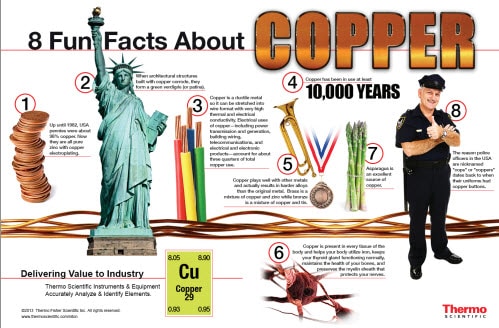
 What do pennies, asparagus and police officers have in common? Copper.
Take a look at this infographic and discover 8 Fun Facts about Copper.
A Little More Info About Copper
Copper is a reddish-brown metal known for its high thermal and electrical conductivity, malleability, and resistance to corrosion. It is one of the oldest metals used by humans, dating back to ancient civilizations. Copper is primarily extracted from ores such as chalcopyrite, bornite, and malachite through mining and refining processes. It is an important element to the metals industry, and to our everyday living.
Uses in the Metals Industry
-
Electrical Wiring and Electronics:
- Copper’s excellent electrical conductivity makes it the preferred material for electrical wiring, cables, and components in electronics. It is used in power generation, transmission, and distribution systems.
-
Plumbing and Heating:
- Copper pipes and fittings are widely used in plumbing systems due to their resistance to corrosion and ability to withstand high temperatures. It is also used in heating systems and air conditioning units.
-
Construction:
- Copper is used in roofing, cladding, and architectural elements due to its durability and aesthetic appeal. It is also used in building materials such as copper alloys for structural components.
-
Industrial Machinery:
- Copper and its alloys (such as bronze and brass) are used in manufacturing industrial machinery and equipment. These materials are valued for their strength, resistance to wear and corrosion, and machinability.
-
Automotive Industry:
- Copper is used in automotive wiring, radiators, and other components due to its thermal and electrical properties. It is also used in electric vehicles for batteries and motor components.
-
Renewable Energy:
- Copper plays a crucial role in renewable energy systems, including wind turbines, solar panels, and energy storage systems. Its conductivity and durability make it essential for efficient energy generation and transmission.
Analyzing Copper
With all these important uses, it is crucial that manufacturers know they are producing quality copper materials and meeting customer requirements, and it starts with the raw materials they are purchasing — especially from scrap recycling companies.
According to the USGS, “Old (post-consumer) scrap, converted to refined metal, alloys, and other forms, provided an estimated 150,000 tons of copper in 2024, and an estimated 720,000 tons of copper was recovered from new (manufacturing) scrap derived from fabricating operations. Brass and wire-rod mills accounted for approximately 85% of the total copper recovered from scrap. Copper recovered from scrap contributed about 35% of the U.S. copper supply.”
Portable x-ray fluorescence (XRF) analyzers are used in elemental analysis in order to identify copper, as well as metals and alloys. X-ray fluorescence (XRF) is a non-destructive analytical technique used to determine the chemical composition of materials. Handheld XRF technology is used extensively to identify the metal and alloys in a scrapyard or verify the content of your raw materials in manufacturing plants.
Summary
So the next time you switch on your lights, grab a drink of water, or start your car, remember that copper is a key component in making that happen.
Additional Resources
- Visit our Handheld XRF Technology Learning Center
- ebook: XRF in the Field: XRF Technology for the Non-Scientist
- Infographic: 8 Fun Facts about Copper.
Editor’s Note: This copper infographic article was originally published in August 2014 but the article has been substantially refreshed with new content.

Indonesia Investigates Caesium 137 Contamination in Shrimp Linked to Scrap Metal Imports
Indonesia has no nuclear weapons or nuclear power plants, so... Johnny Long
Read More
What’s Everyone Reading this Year?
According to Google, here are the Top 10 read articles this ... Marlene Gasdia-Cochrane, Editor
Read More
Using XRF + LIBS Together: When and How It Makes Sense
Introduction In the digital age, technology such as handheld... Mathieu Bauer
Read More
Here’s a Free Periodic Table for Your Halloween Goody-Bag
No tricks here. Download this handy periodic table and X-ray... Marlene Gasdia-Cochrane, Editor
Read More

Leave a Reply