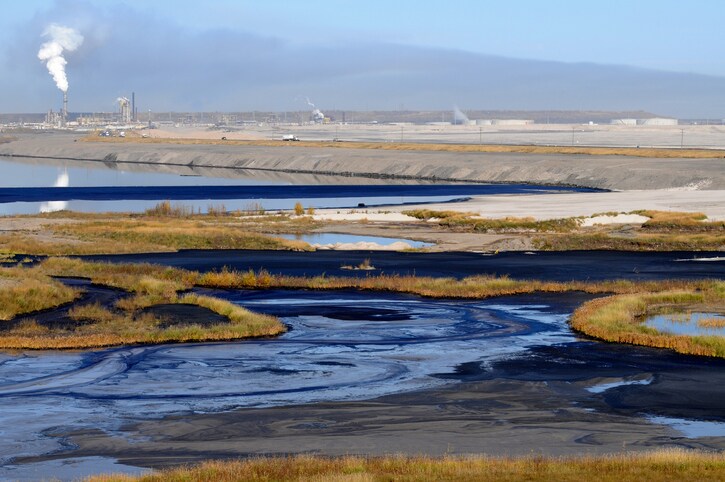
 Tailings—mineral waste products—are a major pollutant produced by mining operations. Because tailings originate in slurry form, they may be dumped in or near water, contaminating the water and destroying aquatic life. Tailings also can be transported by wind or water to contaminate other areas. Mine wastewater containing metals and chemicals can also leach into nearby waterways. Lab and portable technologies for water analysis can help determine the extent of the pollution.
In recent years some mining companies have developed novel reprocessing technologies to extract valuable metals from the waste. As we first described in the post, From Tailings to Treasure? A New Mother Lode, very small diamonds can be recovered from the residue of the original diamond-bearing ore, and the U.S. Geological Survey found that discarded mine tailings may yield significant amounts of rare earth elements.
To accurately identify minerals within tailings, geologists may use analytical technologies including both laboratory and portable X-ray fluorescence (XRF) instruments. Portable XRF analyzers provide fast, accurate analysis of tailings to quickly and easily gauge the efficiency of extraction and enrichment processes. The real-time assay data provided by a portable XRF analyzer allows for timely process adjustments and productivity improvements. To learn more, read Tailings No Longer Trash? An Update on Reprocessing Technologies.
University of Alberta geologists have made a new discovery regarding mine tailings. According to the University of Alberta web site, research confirms new minerals are capturing and storing carbon in mine waste. The minerals, members of the hydrotalcite group, are the first outside of the carbonate family to naturally capture atmospheric CO2 in mine waste, which may have valuable applications in lowering carbon emissions and combating climate change.
“This research confirmed that hydrotalcites are capable of sequestering atmospheric CO2 in mine waste,” said Connor Turvey, who conducted this research during his PhD studies under the supervision of Sasha Wilson, associate professor in the Department of Earth and Atmospheric Sciences and expert in economic geology. “Hydrotalcites are trapping the CO2 deeper into the tailings where carbonate minerals were unable to form.”
When mine tailings are removed from the ground in the mining process and exposed to the atmosphere and to rain water, they can react to form new minerals that trap CO2 from the atmosphere.
The research highlights the potential for improving carbon capture one to two meters beneath the surface of mining wastes, where most sequestration usually occurs. “One thing that this indicates is that the capacity for carbon sequestration at this depth could be improved by providing a more plentiful source of carbon to those depths,” added Wilson.
The study was conducted at Woodsreef Asbestos Mine in New South Wales, Australia.
The paper, “Hydrotalcites and hydrated Mg-carbonates as carbon sinks in serpentinite mineral wastes from the Woodsreef chrysotile mine, New South Wales, Australia: Controls on carbonate mineralogy and efficiency of CO2 air capture in mine tailings,” was published in the International Journal of Greenhouse Gas Control.
VIDEO: Integrated Tailings Solutions in Mineral Beneficiation Plants

A Halloween Treat – Free Periodic Table
No tricks here. Download this handy periodic table and X-ray... Marlene Gasdia-Cochrane, Editor
Read More
INFOGRAPHIC: 9 Fast Facts About Antimony
It’s a silvery, lustrous grey and a semi-metallic toxic el... Marlene Gasdia-Cochrane, Editor
Read More
Did You Miss Our Most Popular Articles? Here are our Top 5 Mining Articles This Year.
Here are the ten most read articles on this mining blog duri...
Read More
Happy Miners Day!
The US Department of Labor Mine Safety and Health Administra...
Read More
Leave a Reply