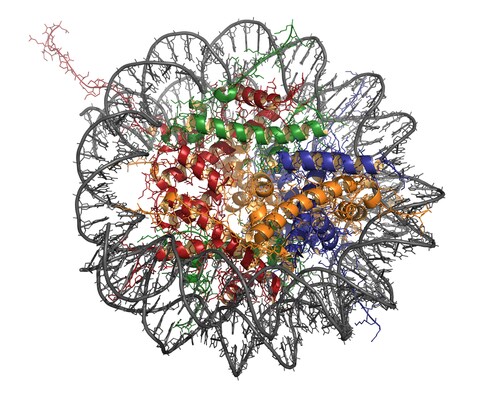
 Histone proteins, key components of chromatin, exhibit some interesting regulatory features involving the N-terminal tail. Sidoli et al. (2015) looked at how researchers examine these features proteomically, comparing middle-down proteomics with bottom-up preparation.1
Post-translational modifications (PTMs) of histone protein N-terminal regions constitute a regulatory feature that controls cell nuclear events such as gene expression and DNA repair. Researchers are therefore interested in characterizing these proteins to discover further information on cell function under different states.
Mass spectrometry-based analytical methods are standard for mass protein characterization; however, examining N-terminal PTMs requires modification of existing protocols. In order to characterize histone N-terminal tails accurately, they must be examined intact. For this reason, researchers have turned to middle-down proteomics because this process produces longer peptide fragments with GluC digestion than does the traditional bottom-up method using trypsin as the protease. The 50 amino-acid residues from middle-down preparation preserve PTMs in situ, as compared to the 20 amino-acid peptides seen with bottom-up digestion.
Despite the use of middle-down proteomics to characterize histone PTMs, however, Sidoli et al. noted that this method is not yet fully evaluated; the reliability of the qualitative and quantitative data obtained is unknown. The research team endeavored to address this uncertainty by comparing results obtained from purified HeLa cell histone H3 proteins using both proteomics approaches.
Using standard procedures, the scientists extracted and purified histone H3 proteins from HeLa cells in culture. Following lysis, the cells underwent proteolytic digestion using trypsin for the bottom-up preparation and GluC for the middle-down preparation. The research team separated the resulting peptide mixtures using appropriate chromatographic separation. For the bottom-up analysis, this involved nano-liquid chromatography (nLC) using an Easy-nLC liquid chromatograph (Thermo Scientific); for middle-down analysis, the team used a WCX-HILIC separation that exploits histone protein physical characteristics for separation.
Following separation, Sidoli et al. used an Orbitrap Fusion Tribrid mass spectrometer (Thermo Scientific) for both proteomic analyses, quantitating PTM data using isoScale slim software to calculate relative abundancies and stoichiometries. The researchers operated the Orbitrap Fusion Tribrid instrument using the same source settings for each proteomic approach to establish consistency. They used a reference library constructed from synthetic proteins representing the most commonly studied histone PTMs resulting from ArgC digestion to prepare the corrected bottom-up data for comparison with those data obtained from middle-down analysis.
Although the team found differences in relative abundances for certain PTMs and found that the calculated stoichiometries exhibited bias according to the method used, the researchers conclude that middle-down proteomic analysis is a reliable mass spectrometric method to characterize histone PTMs. The results show that quantitative results from middle-down analysis are as good as those obtained via bottom-up analysis of purified histone H3 proteins from HeLa cell culture.
Reference
1. Sidoli, S., et al. (2015, March) “Bottom-up and middle-down proteomics have comparable accuracies in defining histone post-translational modification, relative abundance and stoichiometry,” Analytical Chemistry, 87 (pp. 3129−33), doi: 10.1021/acs.analchem.5b00072.
Post Author: Amanda Maxwell. Mixed media artist; blogger and social media communicator; clinical scientist and writer.
A digital space explorer, engaging readers by translating complex theories and subjects creatively into everyday language.

Acetylation of the Malaria Parasite
Lysine acetylation is a ubiquitous post-translational modifi...
Read More
Holocaust Exposure and Intergenerational Impact via FKBP5 Methylation
Scientists know that, in animal models, stress can produce e...
Read More
C-Terminomics: What’s Happening at the End of the Rainbow
Structurally speaking, all proteins have a beginning and an ...
Read More
New Roles for Lysine Demethylase KDM4A
Lysine methyltransferases and lysine demethylases are two ex...
Read More
Leave a Reply