Dr. David Sarracino is the manager of biomarker workflows at the Thermo Fisher Scientific Biomarker Research Initiatives in Mass Spectrometry (BRIMS) Center. With around a decade and a half of experience setting up and managing laboratories, he combines firsthand knowledge with a keen intuitive sense for functional design.
Dave’s approach to maximizing laboratory space can be condensed to one profound maxim: be intentional with each placement. When considering the laboratory spaces themselves, he asserts that it is a mistake to build laboratories with windows. “Instruments don’t need a nice view,” he wryly quips while pointing out that windows make it more difficult to maintain a dust-free, climate controlled environment. Instead, Dave recommends constructing laboratories in the interior of buildings with office space around the perimeter. This allows the heat from the instruments themselves to warm the space in the winter while minimizing the degree to which the laboratory must be cooled during the summer.
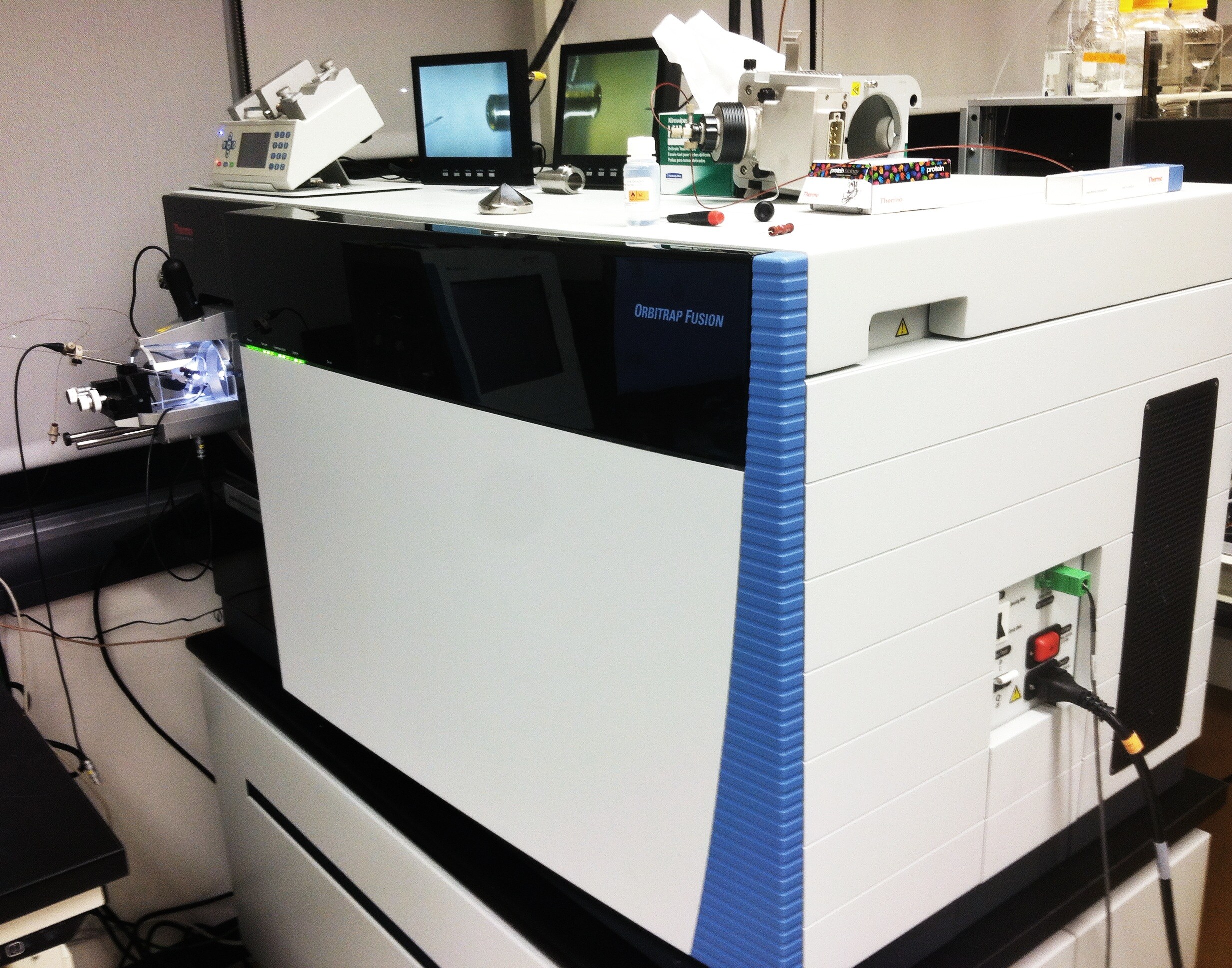
The new Orbitrap Fusion landed at BRIMS– and needed space– earlier this month.
Moving into the laboratory spaces themselves, Dave describes a system that allows the instruments to work flexibly. He combines wheeled, vented lab benches with umbilical drops in the middle of the room. These drops function as powerhouses to supply gasses, electricity, non-wireless internet, and ventilation. By delivering these lines into the center of the lab, researchers gain the ability to wheel instruments to the drop as needed and even install instruments back to back since the heat is vented up and out. He notes that this setup also provides sufficient ambulatory space and minimizes the opportunity for staff and guests to jostle equipment.
Finally, he stresses the importance of a solid backup power system and indicates that relying on a standard generator is usually not enough. Since many instruments need to generate data around the clock in order to “earn their keep” during their first five years of service, a set up that minimizes potential disruptions from issues that arise due to dust or climate-based malfunction or power/supply issues allows a lab to function seamlessly.
When asked for his best piece of advice for laboratory set up and management, Dave chuckles and indicates that a healthy level of present-day paranoia can save a lab manager a great deal of future pain. He asserts, “You can spend it up front or over time, but if you fly cowboy, it isn’t going to work when you need it.” He also points to the age-old maxim “buy once, cry once” and stresses the benefits of setting up a laboratory intentionally from the start.
Post Author: Melissa J. Mayer. Melissa is a freelance writer who specializes in science journalism. She possesses passion for and experience in the fields of proteomics, cellular/molecular biology, microbiology, biochemistry, and immunology. Melissa is also bilingual (Spanish) and holds a teaching certificate with a biology endorsement.
Analysis of Ketosteroids by Girard P Derivatization
Dehydroepiandrosterone (DHEA); 4-androstene-3,17-dione (AD);...
Read More
Profiling Human Islet Cells with Laser Capture Microdissection
Composed mainly of β-cells, human islet cells secrete h...
Read More
Intact Proteins in Native Conditions with Quadrupole-Orbitrap Mass Spectrometry
Successful research focusing on antibody and drug interactio...
Read More
Autophagy Helps Control Endothelial Permeability
A research team in Glasgow has identified autophagy as a str...
Read More
Leave a Reply