Search


Zitierungen und Referenzen (3)
Gibco™
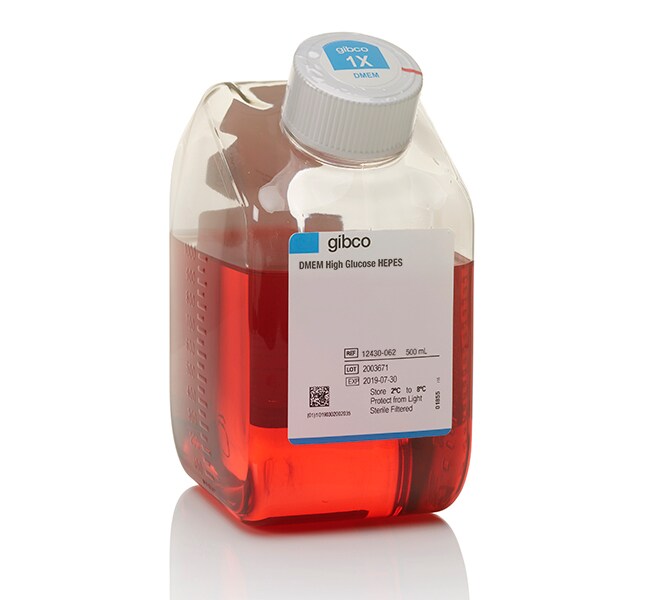
DMEM, hoher Glukosegehalt, HEPES
DMEM (Dulbecco's Modified Eagle Medium) ist ein weit verbreitetes Basismedium zur Wachstumsunterstützung vieler verschiedener Säugetierzellen. Zu den erfolgreich in DMEMWeitere Informationen
| Katalognummer | Menge |
|---|---|
| 12430054 | 500 mL |
Katalognummer 12430054
Preis (EUR)
38,65
Exklusiv online
40,18Ersparnis 1,53
Each
Menge:
500 mL
Preis (EUR)
38,65
Exklusiv online
40,18Ersparnis 1,53
Each
DMEM (Dulbecco's Modified Eagle Medium) ist ein weit verbreitetes Basismedium zur Wachstumsunterstützung vieler verschiedener Säugetierzellen. Zu den erfolgreich in DMEM kultivierten Zellen gehören primäre Fibroblasten, Neuronen, Gliazellen, nicht proliferierende und ausdifferenzierte Nabelschnurzellen (HUVEC) sowie Zellen der glatten Muskulatur sowie Zelllinien wie HeLa, 293, COS-7 und PC-12. Wir führen verschiedene DMEM-Modifikationen für eine Vielzahl an Zellkulturanwendungen. Finden Sie die richtige Zusammensetzung mithilfe des Medien-Auswahlwerkzeuges.
Dieses DMEM wurde wie folgt modifiziert:
Die vollständige Zusammensetzung ist verfügbar.
Verwendung von DMEM
DMEM unterscheidet von anderen Medien durch seine vierfach höhere Konzentration an Aminosäuren und Vitaminen gegenüber dem originalen Eagle's Minimal Essential Medium. Die Formulierung für DMEM wurde ursprünglich mit einer niedrigen Glukosekonzentration (1 g/l) und mit Natriumpyruvat entwickelt, wird aber häufig mit höheren Glukose-Konzentrationen sowie mit oder ohne Natriumpyruvat eingesetzt. DMEM enthält keine Proteine, Lipide oder Wachstumsfaktoren. Aus diesem Grund kann bei DMEM eine Supplementierung, meist mit 10 % fötalem Rinderserum (FBS), erforderlich sein. DMEM verwendet ein Natriumbikarbonat-Puffersystem (3,7 g/l) und erfordert daher eine 5 bis 10%ige CO–2-Umgebung, um den physiologischen pH-Wert aufrechtzuerhalten.
cGMP-konformes Herstellungs- und Qualitätssystem
DMEM wird in einer cGMP-konformen Einrichtung in Grand Island, New York, hergestellt. Die Einrichtung ist von der US-Arzneimittelbehörde FDA als Hersteller von Medizinprodukten zugelassen und nach ISO 13485-zertifiziert. Für eine lückenlose Versorgung bieten wir ein identisches DMEM-Produkt aus unserem Betrieb in Schottland (42430-082). Diese Einrichtung ist von der US-Arzneimittelbehörde FDA als Hersteller von Medizinprodukten zugelassen und ISO 13485-zertifiziert.
Dieses DMEM wurde wie folgt modifiziert:
| Mit | Ohne |
| • Hoher Glukosegehalt | • Natriumpyruvat |
| • L-Glutamin | |
| • HEPES | |
| • Phenolrot |
Die vollständige Zusammensetzung ist verfügbar.
Verwendung von DMEM
DMEM unterscheidet von anderen Medien durch seine vierfach höhere Konzentration an Aminosäuren und Vitaminen gegenüber dem originalen Eagle's Minimal Essential Medium. Die Formulierung für DMEM wurde ursprünglich mit einer niedrigen Glukosekonzentration (1 g/l) und mit Natriumpyruvat entwickelt, wird aber häufig mit höheren Glukose-Konzentrationen sowie mit oder ohne Natriumpyruvat eingesetzt. DMEM enthält keine Proteine, Lipide oder Wachstumsfaktoren. Aus diesem Grund kann bei DMEM eine Supplementierung, meist mit 10 % fötalem Rinderserum (FBS), erforderlich sein. DMEM verwendet ein Natriumbikarbonat-Puffersystem (3,7 g/l) und erfordert daher eine 5 bis 10%ige CO–2-Umgebung, um den physiologischen pH-Wert aufrechtzuerhalten.
cGMP-konformes Herstellungs- und Qualitätssystem
DMEM wird in einer cGMP-konformen Einrichtung in Grand Island, New York, hergestellt. Die Einrichtung ist von der US-Arzneimittelbehörde FDA als Hersteller von Medizinprodukten zugelassen und nach ISO 13485-zertifiziert. Für eine lückenlose Versorgung bieten wir ein identisches DMEM-Produkt aus unserem Betrieb in Schottland (42430-082). Diese Einrichtung ist von der US-Arzneimittelbehörde FDA als Hersteller von Medizinprodukten zugelassen und ISO 13485-zertifiziert.
Für die Verwendung in der Forschung oder die Weiterverarbeitung. Nicht zur Diagnosestellung oder direkten Anwendung bei Menschen oder Tieren geeignet.
Specifications
ZelllinieHeLa, 293, Cos-7 und PC-12
ZelltypPrimäre Fibroblasten, Neuronen, Gliazellen, HUVECs und glatte Muskelzellen
Konzentration1 X
KulturmilieuCO2
Zur Verwendung mit (Anwendung)Säugetierzellkultur
FormatBottle
Glucosekonzentration4500 mg/L
Fertigungsqualität, HerstellungsqualitätcGMP-compliant under the ISO 13485 standard
ProduktlinieGibco
ProdukttypDMEM (Dulbecco's Modified Eagle Medium)
Menge500 mL
Haltbarkeit12 Monate ab Herstellungsdatum
VersandbedingungRaumtemperatur
KlassifikationOhne Stoffe tierischen Ursprungs
Culture TypeMammalian Cell Culture
FormFlüssig
Serum LevelStandard-Serumzugabe
SterilitätSteril gefiltert
Sterilization MethodSterile-filtered
Mit AdditivenHoher Glukosegehalt, Glutamin, HEPES, Phenolrot
Ohne AdditiveOhne Natriumpyruvat
Unit SizeEach
Inhalt und Lagerung
Lagerbedingungen: 2 bis 8 °C, vor Licht schützen
Versandbedingungen: Haltbarkeit bei
Raumtemperatur: 12 Monate ab Herstellungsdatum
Häufig gestellte Fragen (FAQ)
What is the manganese concentration in DMEM? Do you offer manganese-free DMEM?
How long can I keep my media after supplementing with serum?
My medium was shipped at room temperature but it is supposed to be stored refrigerated. Is it okay?
How can I remove mycoplasma contamination from my cell culture medium?
I see a decrease in growth of my culture. What should I do?
Zitierungen und Referenzen (3)
Zitierungen und Referenzen
Abstract
The connecting segment between both epidermal growth factor-like domains in blood coagulation factor IX contributes to stimulation by factor VIIIa and its isolated A2 domain.
Journal:J Biol Chem
PubMed ID:11925427
The light chain of activated factor IX comprises multiple interactions between both epidermal growth factor-like domains that contribute to enzymatic activity and binding of factor IXa to its cofactor factor VIIIa. To investigate the association between factor IXa-specific properties and surface-exposed structure elements, chimeras were constructed in which the interconnection
Thiazolidinedione activation of peroxisome proliferator-activated receptor gamma can enhance mitochondrial potential and promote cell survival.
Journal:J Biol Chem
PubMed ID:12082115
'Thiazolidinediones (TZDs) are widely used for treatment of type 2 diabetes mellitus. Peroxisome proliferator-activated receptor gamma (PPAR gamma) is the molecular target of TZDs and is believed to mediate the apoptotic effects of this class of drugs in a variety of cell types, including B and T lymphocytes. The finding
Activation of the proteolytic activity of ADAMTS4 (aggrecanase-1) by C-terminal truncation.
Journal:J Biol Chem
PubMed ID:11796708
'Proteolysis of the hyalectans (aggrecan, versican, brevican) in vivo appears to result from the activity of ADAMTS4 (aggrecanase-1, herein referred to as an hyalectanase). To examine the mode of activation of ADAMTS4, a human chondrosarcoma cell line, JJ012, has been stably transfected with the full-length c-DNA for human ADAMTS4. The