Search

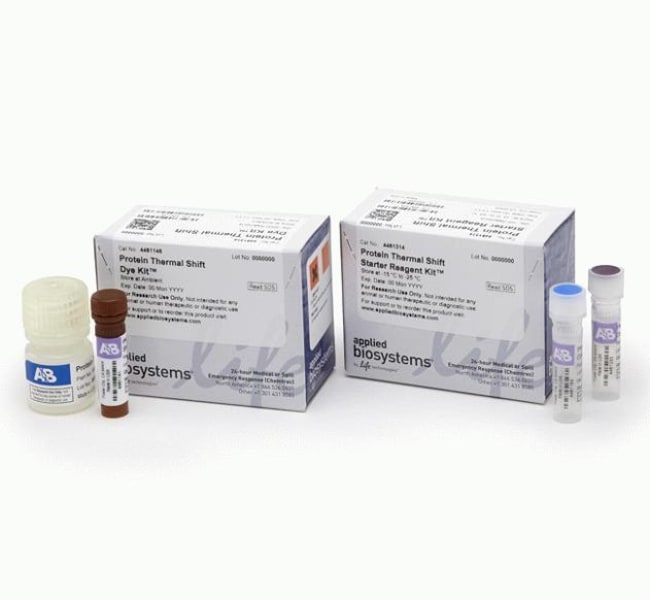
Protein Thermal Shift™ Färbungskit
Applied Biosystems® Protein Thermal Shift™ Kits enthalten einen Farbstoff, der an exponierte hydrophobe Rückstände bindet, um die thermische Stabilität vonWeitere Informationen
| Katalognummer | Menge |
|---|---|
| 4461146 | 1,000 reactions |
Katalognummer 4461146
Preis (EUR)
221,00
Each
Menge:
1,000 reactions
Preis (EUR)
221,00
Each
Applied Biosystems® Protein Thermal Shift™ Kits enthalten einen Farbstoff, der an exponierte hydrophobe Rückstände bindet, um die thermische Stabilität von Proteinen mit einem Echtzeit-PCR-Instrument zu überwachen, Pufferbedingungen zu identifizieren, die das Protein von Interesse stabilisieren, oder Liganden für Verbindungen zu screenen, die das Protein von Interesse binden.
Sparen Sie Zeit und Geld mit Ihrem Probenscreening
Diese Lösung reduziert den Zeit- und Kostenaufwand, der mit dem Screening von Proben im Vergleich zu den derzeit verfügbaren Methoden verbunden ist, erheblich. Protein Thermal Shift™ Produkte, die auf unseren Echtzeit-PCR-Systemen ausgeführt werden, ermöglichen Forschern kostengünstige und effiziente:
• Screening-Proben auf relative thermische Stabilität von Proteinen
• Screening-Moleküle (z. B. Medikamentenkandidaten kleiner Moleküle, fragmentbasierte Bibliotheken und Antikörper) auf Ligandbindung an Proteine auf Hochdurchsatz-Screening
• -Proben auf Stabilitätsänderungen nach Proteinpunktmutationen oder -modifikationen
• Systematische Identifizierung geeigneter⁄optimaler Pufferbedingungen für die Messung von Protein-Ligand-Interaktionen, die Herstellung stabiler Proteinpräparate, Proteinkristallisation und die schnelle Speicherung von Proteinen
• QC-Protein-preps, um Proteinintegrität⁄-reinheit zu gewährleisten
Zwei Kits zur Auswahl
Protein Thermal Shift™ Kits und Puffer für die Durchführung von Protein-Thermal-Shift-Experimenten, ausreichend für bis zu 1000 Reaktionen. Das Protein Thermal Shift™ Starter-Kit enthält das Farb-Kit sowie ein Kontrollprotein und einen Kontrollliganden für Testexperimente und Fehlersuche. Die Bestandteile des Protein Thermal Shift™ Starter-Kits sind in zwei Schachteln verpackt, eine für die Lagerung bei -20 °C und die andere bei 4 °C für maximale Flexibilität bei der Reagenzienformulierung.
Einfache Analysen mit Protein Thermal Shift™ Software
Unsere komplette Protein Thermal Shift™-Lösung umfasst Analysesoftware, die mit den aus fünf unserer Echtzeit-PCR-Systeme generierten Laufdateien kompatibel ist: StepOne™ Real-Time PCR-System, StepOnePlus™ Real-Time PCR-System, 7500 Fast Real-Time-PCR-System und ViiA™7 Real-Time-PCR-System.
Nur für Forschungszwecke. Darf nicht für diagnostische Verfahren eingesetzt werden.
Sparen Sie Zeit und Geld mit Ihrem Probenscreening
Diese Lösung reduziert den Zeit- und Kostenaufwand, der mit dem Screening von Proben im Vergleich zu den derzeit verfügbaren Methoden verbunden ist, erheblich. Protein Thermal Shift™ Produkte, die auf unseren Echtzeit-PCR-Systemen ausgeführt werden, ermöglichen Forschern kostengünstige und effiziente:
• Screening-Proben auf relative thermische Stabilität von Proteinen
• Screening-Moleküle (z. B. Medikamentenkandidaten kleiner Moleküle, fragmentbasierte Bibliotheken und Antikörper) auf Ligandbindung an Proteine auf Hochdurchsatz-Screening
• -Proben auf Stabilitätsänderungen nach Proteinpunktmutationen oder -modifikationen
• Systematische Identifizierung geeigneter⁄optimaler Pufferbedingungen für die Messung von Protein-Ligand-Interaktionen, die Herstellung stabiler Proteinpräparate, Proteinkristallisation und die schnelle Speicherung von Proteinen
• QC-Protein-preps, um Proteinintegrität⁄-reinheit zu gewährleisten
Zwei Kits zur Auswahl
Protein Thermal Shift™ Kits und Puffer für die Durchführung von Protein-Thermal-Shift-Experimenten, ausreichend für bis zu 1000 Reaktionen. Das Protein Thermal Shift™ Starter-Kit enthält das Farb-Kit sowie ein Kontrollprotein und einen Kontrollliganden für Testexperimente und Fehlersuche. Die Bestandteile des Protein Thermal Shift™ Starter-Kits sind in zwei Schachteln verpackt, eine für die Lagerung bei -20 °C und die andere bei 4 °C für maximale Flexibilität bei der Reagenzienformulierung.
Einfache Analysen mit Protein Thermal Shift™ Software
Unsere komplette Protein Thermal Shift™-Lösung umfasst Analysesoftware, die mit den aus fünf unserer Echtzeit-PCR-Systeme generierten Laufdateien kompatibel ist: StepOne™ Real-Time PCR-System, StepOnePlus™ Real-Time PCR-System, 7500 Fast Real-Time-PCR-System und ViiA™7 Real-Time-PCR-System.
Nur für Forschungszwecke. Darf nicht für diagnostische Verfahren eingesetzt werden.
Nur für Forschungszwecke. Nicht zur Verwendung bei diagnostischen Verfahren.
Specifications
Zur Verwendung mit (Geräte)7500 Fast System, 7500 System, StepOne™, StepOnePlus™, ViiA™ 7 System
KittypFarbstoffkit
Anzahl Reaktionen1000 Reaktionen
ProduktlinieProtein Thermal Shift
Menge1,000 reactions
ProbentypProtein
VersandbedingungRaumtemperatur
ZielspezifitätNicht zielspezifisch
VerfahrenFluoreszenzintensitätsmessung
NachweisverfahrenPrimer-Sonde
Zur Verwendung mit (Anwendung)Pharma, Biopharma, Echtzeit-PCR (qPCR)
PCR-MethodeqPCR
Unit SizeEach
Inhalt und Lagerung
Das Protein Thermal Shift™ Dye Kit enthält den Farbstoff und Puffer für die Durchführung von Protein-Thermal-Shift-Experimenten, ausreichend für bis zu 1000 Reaktionen. Bei 18 ° bis 25 °C lagern.
Garantierte Mindesthaltbarkeit 60 Tage (das genaue Verfallsdatum ist auf dem Produkt und COfA aufgedruckt).
Garantierte Mindesthaltbarkeit 60 Tage (das genaue Verfallsdatum ist auf dem Produkt und COfA aufgedruckt).