Search
 Elementsuche
 Struktursuche


Thermo Scientific Chemicals
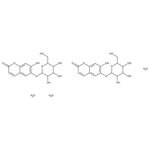
Esculin Sesquihydrat, 97 %, Thermo Scientific Chemicals
CAS: 66778-17-4 | C30H38O21 | 734.613 g/mol
Have Questions?
Ansicht ändern


Katalognummer A11624.22
auch als A11624-22 bezeichnet
Preis (EUR)
435,00
Each
Menge:
100 g
Preis (EUR)
435,00
Each
Chemikalien-Kennzeichnungen
CAS66778-17-4
IUPAC Namebis(7-hydroxy-6-{[3,4,5-trihydroxy-6-(hydroxymethyl)oxan-2-yl]oxy}-2H-chromen-2-one) trihydrate
Molecular FormulaC30H38O21
InChI KeyLGMHQDJZWHRZPO-UHFFFAOYNA-N
SMILESO.O.O.OCC1OC(OC2=C(O)C=C3OC(=O)C=CC3=C2)C(O)C(O)C1O.OCC1OC(OC2=C(O)C=C3OC(=O)C=CC3=C2)C(O)C(O)C1O
Mehr anzeigen
Specifications Datenblatt
DatenblattWater Content (Karl Fischer Titration)5.03-9.57% (1-2 waters)
Optical Rotation-36.0° to -42.0° (c=5 in pyridine)
Appearance (Color)White to cream
FormPowder or crystalline powder
Assay (HPLC)≥96.0%
Mehr anzeigen
Esculin sesquihydrate is used to inhibits chemically induced carcinogenesis in mouse skin and kidney, used in a microbiology laboratory to aid in the identification of bacterial species, a naturally occurring antioxidant.
This Thermo Scientific Chemicals brand product was originally part of the Alfa Aesar product portfolio. Some documentation and label information may refer to the legacy brand. The original Alfa Aesar product / item code or SKU reference has not changed as a part of the brand transition to Thermo Scientific Chemicals.
Anwendungen
Äsculin-Sesquihydrat wird zur Hemmung der chemisch induzierten Karzinogenese in Maushaut und -niere verwendet, die in einem mikrobiologischen Labor zur Identifizierung bakterieller Arten, eines natürlich vorkommenden Antioxidans, eingesetzt wird.
Löslichkeit
Schwer in Wasser löslich.
Hinweise
Luftempfindlich & hygroskopisch. Behälter dicht verschlossen lassen. Kühl und trocken in einem gut versiegelten Behälter lagern.
Äsculin-Sesquihydrat wird zur Hemmung der chemisch induzierten Karzinogenese in Maushaut und -niere verwendet, die in einem mikrobiologischen Labor zur Identifizierung bakterieller Arten, eines natürlich vorkommenden Antioxidans, eingesetzt wird.
Löslichkeit
Schwer in Wasser löslich.
Hinweise
Luftempfindlich & hygroskopisch. Behälter dicht verschlossen lassen. Kühl und trocken in einem gut versiegelten Behälter lagern.
RUO – Research Use Only
Allgemeine Referenzen:
- Matthew C. Allendera.; Daniel B. Raudabaugh.; Frank H. Gleason.; Andrew N. Miller. The natural history, ecology, and epidemiology of Ophidiomyces ophiodiicola and its potential impact on free-ranging snake populations. Fungal Ecology. 2015, 17, 187-196.
- Cedric Tarayre.; Julien Bauwens.; Christel Matteotti.; Catherine Brasseur.; Catherine Millet.; Sebastien Massart.; Jacqueline Destain.; Micheline Vandenbol.; Edwin De Pauw.; Eric Haubruge.; Frederic Francis.; Philippe Thonart.; Daniel Portetelle.; Frank Delvigne. Multiple analyses of microbial communities applied to the gut of the wood-feeding termite Reticulitermes flavipes fed on artificial diets. Symbiosis. 2015, 65, (3), 143-155.
- UV-absorbierend. Reversibler Hemmstoff der Phenylalanin-Hydroxylase.