Search
 Elementsuche
 Struktursuche


Thermo Scientific Chemicals
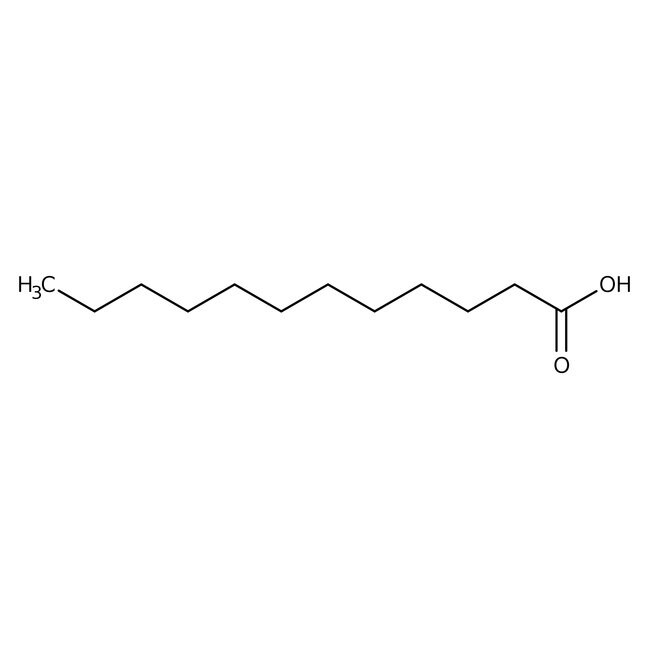
Dodecansäure, 98 %, Thermo Scientific Chemicals
CAS: 143-07-7 | C12H24O2 | 200.322 g/mol
Have Questions?
Ansicht ändern



Katalognummer A11672.0E
auch als A11672-0E bezeichnet
Preis (EUR)
98,90
Each
Menge:
2500 g
Preis (EUR)
98,90
Each
Chemikalien-Kennzeichnungen
CAS143-07-7
IUPAC Namedodecanoic acid
Molecular FormulaC12H24O2
InChI KeyPOULHZVOKOAJMA-UHFFFAOYSA-N
SMILESCCCCCCCCCCCC(O)=O
Mehr anzeigen
Specifications Datenblatt
DatenblattAppearance (Color)White
Assay (Aqueous acid-base Titration)≥97.5 to ≤102.5%
Melting Point (clear melt)42.0-48.0?C
FormCrystals or powder or crystalline powder or flakes
Assay (Silylated GC)≥97.5%
Mehr anzeigen
Dodecanoic acid is used in the preparation of cosmetics, soaps, alkyd resins and wetting agents. It is also used to measure the molar mass of an unknown substance through freezing point depression. It is also used as a food additive and an active component in a treatment for acne. In addition to this, it is a substrate for acylation of certain proteins based on the murine studies.
This Thermo Scientific Chemicals brand product was originally part of the Alfa Aesar product portfolio. Some documentation and label information may refer to the legacy brand. The original Alfa Aesar product / item code or SKU reference has not changed as a part of the brand transition to Thermo Scientific Chemicals.
Anwendungen
Dodecansäure wird bei der Herstellung von Kosmetika, Seifen, Alkydharzen und Benetzungsmitteln verwendet. Sie wird auch zur Messung der molaren Masse einer unbekannten Substanz durch Gefrierpunktserniedrigung verwendet. Sie wird auch als Lebensmittelzusatzstoff und aktiver Bestandteil in einer Aknebehandlung verwendet. Darüber hinaus ist es ein Substrat für die Acylierung bestimmter Proteine auf der Grundlage von Maus-Studien.
Löslichkeit
Löslich in Wasser, Benzol, Aceton, Alkohol, Petrolether, Dimethylsulfoxid und Dimethylformamid. Geringfügig löslich in Chloroform.
Hinweise
Nicht kompatibel mit Basen, Oxidationsmitteln und Reduktionsmitteln.
Dodecansäure wird bei der Herstellung von Kosmetika, Seifen, Alkydharzen und Benetzungsmitteln verwendet. Sie wird auch zur Messung der molaren Masse einer unbekannten Substanz durch Gefrierpunktserniedrigung verwendet. Sie wird auch als Lebensmittelzusatzstoff und aktiver Bestandteil in einer Aknebehandlung verwendet. Darüber hinaus ist es ein Substrat für die Acylierung bestimmter Proteine auf der Grundlage von Maus-Studien.
Löslichkeit
Löslich in Wasser, Benzol, Aceton, Alkohol, Petrolether, Dimethylsulfoxid und Dimethylformamid. Geringfügig löslich in Chloroform.
Hinweise
Nicht kompatibel mit Basen, Oxidationsmitteln und Reduktionsmitteln.
RUO – Research Use Only
Allgemeine Referenzen:
- Touchy, A. S.; Kon, K.; Onodera, W.; Shimizu, K. I. Unprecedented Reductive Esterification of Carboxylic Acids under Hydrogen by Reusable Heterogeneous Platinum Catalysts. Biopolymers 2015, 357 (7), 1499-1506.
- Garcia, A. C.; Serafim, F. A.; Keukeleire, D. D.; Franco, D. W. Evaluation of Glycerol Profiles in Sugarcane Spirits (Cachaças). J. Braz. Chem. Soc. 2015, 26 (1), 57-63.