Search
 Elementsuche
 Struktursuche
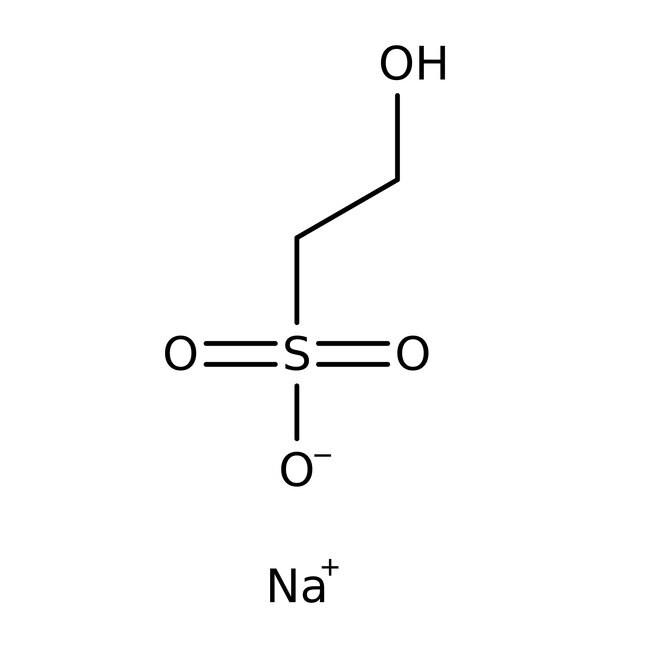

Thermo Scientific Chemicals
Isethionsäure-Natriumsalz, 98 %, Thermo Scientific Chemicals
CAS: 1562-00-1 | C2H5NaO4S | 148.108 g/mol
Have Questions?
Ansicht ändern


Katalognummer A12054.0I
auch als A12054-0I bezeichnet
Preis (EUR)
321,00
Each
Menge:
5000 g
Preis (EUR)
321,00
Each
Chemikalien-Kennzeichnungen
CAS1562-00-1
IUPAC Namesodium 2-hydroxyethane-1-sulfonate
Molecular FormulaC2H5NaO4S
InChI KeyLADXKQRVAFSPTR-UHFFFAOYSA-M
SMILES[Na+].OCCS([O-])(=O)=O
Mehr anzeigen
Specifications Datenblatt
DatenblattAppearance (Color)White
FormPowder or crystalline powder
Assay from Suppliers CofA≥97.5 to ≤102.5%
Identification (FTIR)Conforms
Melting Point (clear melt)190-198°C
Isethionic acid sodium salt is an amphoteric detergent used in detergent bar soaps. It makes a dense lather in addition to the lather made by the soap. It is mild on the skin, and non-drying. It works equally well in soft or hard water. It is also an anti-static agent in shampoos.
This Thermo Scientific Chemicals brand product was originally part of the Alfa Aesar product portfolio. Some documentation and label information may refer to the legacy brand. The original Alfa Aesar product / item code or SKU reference has not changed as a part of the brand transition to Thermo Scientific Chemicals.
Anwendungen
Isethionsäure-Natriumsalz ist ein amphoteres Detergens, das in Seifenstücken verwendet wird. Es bildet einen dichten Schaum zusätzlich zum Schaum, der durch die Seife gebildet wird. Es ist sanft zur Haut und trocknet sie nicht aus. Es funktioniert sowohl in weichem als auch in hartem Wasser. Es wird auch als antistatisches Mittel in Shampoos verwendet.
Löslichkeit
Wasserlöslich.
Hinweise
Kühl lagern. Von Hitze und Oxidationsmitteln fernhalten.
Isethionsäure-Natriumsalz ist ein amphoteres Detergens, das in Seifenstücken verwendet wird. Es bildet einen dichten Schaum zusätzlich zum Schaum, der durch die Seife gebildet wird. Es ist sanft zur Haut und trocknet sie nicht aus. Es funktioniert sowohl in weichem als auch in hartem Wasser. Es wird auch als antistatisches Mittel in Shampoos verwendet.
Löslichkeit
Wasserlöslich.
Hinweise
Kühl lagern. Von Hitze und Oxidationsmitteln fernhalten.
RUO – Research Use Only
Allgemeine Referenzen:
- Kevin D. Barrow.; Robert J. King. Isethionic acid from the marine red alga Ceramium flaccidum. Phytochemie. 1993, 34 (5),1429-1430.
- J. D. Welty.; W. 0. Read.; E. H. Shaw, Jr. Isolation of 2-Hydroxyethanesulfonic Acid (Isethionic Acid) from Dog Heart. The Journal Of Biological Chemistry . 1962, 237 (4),1160-1161.