Search
 Elementsuche
 Struktursuche


Thermo Scientific Chemicals
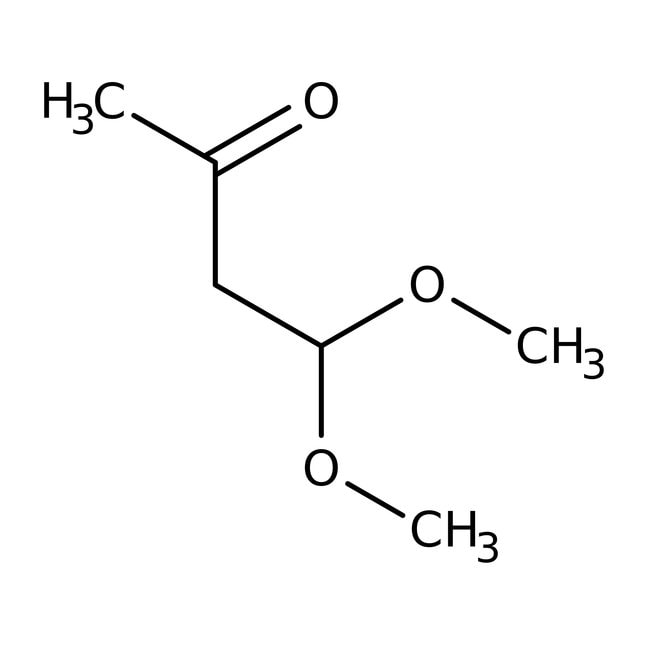
Acetylacetaldehyddimethylacetal, tech. 90 %, Thermo Scientific Chemicals
CAS: 5436-21-5 | C6H12O3 | 132.16 g/mol
Have Questions?
Ansicht ändern



Katalognummer A12058.30
auch als A12058-30 bezeichnet
Preis (EUR)
91,60
Each
Menge:
250 g
Preis (EUR)
91,60
Each
Chemikalien-Kennzeichnungen
CAS5436-21-5
IUPAC Name4,4-dimethoxybutan-2-one
Molecular FormulaC6H12O3
InChI KeyPJCCSZUMZMCWSX-UHFFFAOYSA-N
SMILESCOC(CC(C)=O)OC
Mehr anzeigen
Specifications Datenblatt
DatenblattFormliquid
Refractive Index1.4110 - 1.4190 @20?C
Appearance (Color)Clear, colourless to yellow
Assay (GC)> 88.0%
Acetaldehyde dimethyl acetal is used as a flavoring agent. It is also used in the preparation of (R)-4,4-dimethoxy-2-butanol, pyrazoles and pyrimidines. Further, it is used in the preparation of N,N-diethyl-[2-(4-fluorophenyl)-5-methylpyrazolo[1,5-a]-pyrimidin-3-yl]acetamide and acetoacetaldehyde.
This Thermo Scientific Chemicals brand product was originally part of the Alfa Aesar product portfolio. Some documentation and label information may refer to the legacy brand. The original Alfa Aesar product / item code or SKU reference has not changed as a part of the brand transition to Thermo Scientific Chemicals.
Anwendungen
Acetaldehyd Dimethylacetal wird als Aromastoff verwendet. Es wird auch bei der Herstellung von (R)-4,4-Dimethoxy-2-Butanol, Pyrazolen und Pyrimidinen verwendet. Darüber hinaus wird es bei der Herstellung von N,N-Diethyl-[2-(4-fluorophenyl)-5-methylpyrazolo[1,5-a]-pyrimidin-3-yl]Acetamid und Acetoacetaldehyd verwendet.
Löslichkeit
Mischbar mit Alkohol. Nicht mit Wasser mischbar.
Hinweise
Nicht kompatibel mit Säuren und starken Oxidationsmitteln
Acetaldehyd Dimethylacetal wird als Aromastoff verwendet. Es wird auch bei der Herstellung von (R)-4,4-Dimethoxy-2-Butanol, Pyrazolen und Pyrimidinen verwendet. Darüber hinaus wird es bei der Herstellung von N,N-Diethyl-[2-(4-fluorophenyl)-5-methylpyrazolo[1,5-a]-pyrimidin-3-yl]Acetamid und Acetoacetaldehyd verwendet.
Löslichkeit
Mischbar mit Alkohol. Nicht mit Wasser mischbar.
Hinweise
Nicht kompatibel mit Säuren und starken Oxidationsmitteln
RUO – Research Use Only
Allgemeine Referenzen:
- Geschützte Form des Keto-Aldehyds, nützlich für die heterocyclische Synthese, z. B. (Formamid bis 4-methylpyrimidin): Org. Synth. Coll., 5, 794 (1973).
- Taheri, A.; Liu, C.; Lai, B.; Cheng, C.; Pan, X.; Gu, Y. Brønsted acid ionic liquid catalyzed facile synthesis of 3-vinylindoles through direct C3 alkenylation of indoles with simple ketones. Green Chem. 2014, 16 (8), 3715-3719.
- Acosta, O. B. G.; Hardt, N.; Schink, B. Carbonylation as a key reaction in anaerobic acetone activation by Desulfococcus biacutus. Appl. Environ. Microbiol. 2013, 79 (20), 6228-6235.