Search
 Elementsuche
 Struktursuche
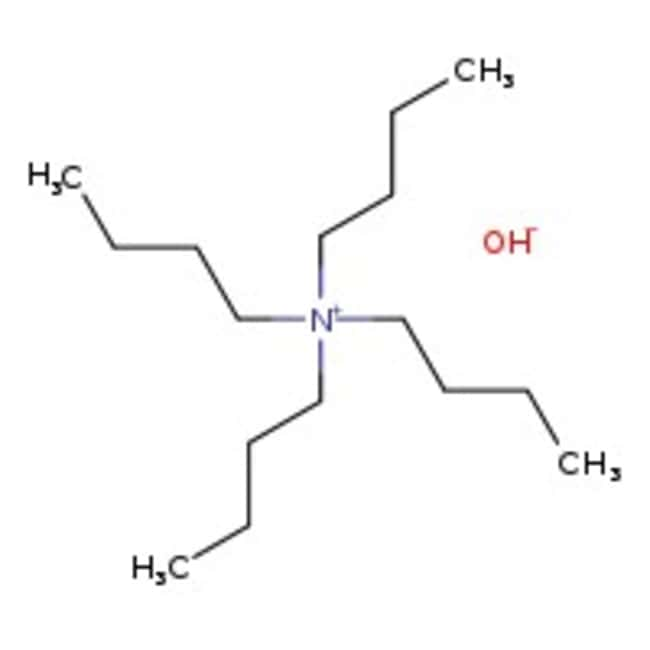


Thermo Scientific Chemicals
Tetra-n-Butylammoniumhydroxid, 40 % w/w in Methanol, Thermo Scientific Chemicals
CAS: 2052-49-5 | C16H37NO | 259.48 g/mol
Have Questions?
Ansicht ändern





Katalognummer A12626.AE
auch als A12626-AE bezeichnet
Preis (EUR)
57,90
Each
Menge:
100 mL
Preis (EUR)
57,90
Each
Chemikalien-Kennzeichnungen
CAS2052-49-5
IUPAC Nametetrabutylazanium hydroxide
Molecular FormulaC16H37NO
InChI KeyVDZOOKBUILJEDG-UHFFFAOYSA-M
SMILES[OH-].CCCC[N+](CCCC)(CCCC)CCCC
Mehr anzeigen
Specifications Datenblatt
DatenblattAppearance (Color)Clear to slightly hazy colorless to pale yellow
Assay (Non-aqueous acid-base Titration)39.5-45.0% (w/w)
FormLiquid
Identification (FTIR)Conforms
Tetra-n-butylammonium hydroxide, 40% w/w in methanol is used as a phase-transfer catalyst in organic synthesis especially for alkylation and condensation reactions. It is also used as a curing accelerator for epoxy resins.
This Thermo Scientific Chemicals brand product was originally part of the Alfa Aesar product portfolio. Some documentation and label information may refer to the legacy brand. The original Alfa Aesar product / item code or SKU reference has not changed as a part of the brand transition to Thermo Scientific Chemicals.
Anwendungen
Tetra-n-butylammoniumhydroxid, 40 % w/w. in Methanol wird als Phasentransferkatalysator in der organischen Synthese insbesondere für Alkylierungs- und Kondensationsreaktionen eingesetzt. Es wird auch als Aushärtebeschleuniger für Epoxidharze verwendet.
Löslichkeit
Mischbar mit gängigen organischen Lösungsmitteln.
Hinweise
Luftempfindlich und hygroskopisch. Nicht kompatibel mit starken Säuren und korrodiert Metall.
Tetra-n-butylammoniumhydroxid, 40 % w/w. in Methanol wird als Phasentransferkatalysator in der organischen Synthese insbesondere für Alkylierungs- und Kondensationsreaktionen eingesetzt. Es wird auch als Aushärtebeschleuniger für Epoxidharze verwendet.
Löslichkeit
Mischbar mit gängigen organischen Lösungsmitteln.
Hinweise
Luftempfindlich und hygroskopisch. Nicht kompatibel mit starken Säuren und korrodiert Metall.
RUO – Research Use Only
Allgemeine Referenzen:
- Bauer, M.; Spange, S. Enhancing the Reactivity of an Electrophilic Barbiturate Dye by Cooperative Hydrogen Bonding. Eur. J. Org. Chem. 2010, 2010 (2), 259-264.
- Clark, D. C.; Baker, W. E.; Russell, K. E.; Whitney, R. A. Dual monomer grafting of styrene and maleic anhydride onto model hydrocarbon substrates. J. Polym. Sci. A Polym. Chem. 2000, 38 (13), 2456-2468.