Search
 Elementsuche
 Struktursuche


Thermo Scientific Chemicals
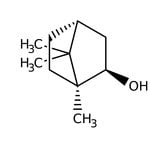
(-)-Borneol, ≥ 97 %, Thermo Scientific Chemicals
CAS: 464-45-9 | C10H18O | 154.25 g/mol
Have Questions?
Ansicht ändern



Katalognummer A12684.18
auch als A12684-18 bezeichnet
Preis (EUR)
32,70
Each
Menge:
50 g
Preis (EUR)
32,70
Each
Chemikalien-Kennzeichnungen
CAS464-45-9
IUPAC Name(1S,2R,4R)-1,7,7-trimethylbicyclo[2.2.1]heptan-2-ol
Molecular FormulaC10H18O
InChI KeyDTGKSKDOIYIVQL-NQMVMOMDSA-N
SMILESCC1(C)[C@@H]2CC[C@]1(C)[C@H](O)C2
Mehr anzeigen
Specifications Datenblatt
DatenblattAssay (GC)≥97.0%
Identification (FTIR)Conforms
Optical Rotation-30.0 ± 10.0° (C=5 in ethanol)
Appearance (Color)White
FormCrystals or powder or crystalline powder or lumps
(-)-Borneol is used to prepare its esters by reacting with acids. Its derivatives are used as chiral ligands in asymmetric synthesis. It is also used in flavors and perfumes. Further, it is used in traditional Chinese medicine as moxa. In addition to this, it is used as a component of many essential oils and also used as a natural insect repellent.
This Thermo Scientific Chemicals brand product was originally part of the Alfa Aesar product portfolio. Some documentation and label information may refer to the legacy brand. The original Alfa Aesar product / item code or SKU reference has not changed as a part of the brand transition to Thermo Scientific Chemicals.
Anwendungen
(-)-Borneol wird zur Herstellung der zugehörigen Ester durch Reaktion mit Säuren verwendet. Seine Derivate werden als chirale Liganden in der asymmetrischen Synthese verwendet. Kommt auch in Aromen und Parfums zum Einsatz. Wird zudem in der traditionellen chinesischen Medizin als Moxa verwendet. Ist Bestandteil vieler ätherischer Öle und wird als natürliches Insektenschutzmittel verwendet.
Löslichkeit
Löslich in Chloroform, Ethanol, Aceton, Ether, Benzol, Toluol, Decalin und Tetralin. Unlöslich in Wasser.
Hinweise
Nicht kompatibel mit starken Oxidationsmitteln.
(-)-Borneol wird zur Herstellung der zugehörigen Ester durch Reaktion mit Säuren verwendet. Seine Derivate werden als chirale Liganden in der asymmetrischen Synthese verwendet. Kommt auch in Aromen und Parfums zum Einsatz. Wird zudem in der traditionellen chinesischen Medizin als Moxa verwendet. Ist Bestandteil vieler ätherischer Öle und wird als natürliches Insektenschutzmittel verwendet.
Löslichkeit
Löslich in Chloroform, Ethanol, Aceton, Ether, Benzol, Toluol, Decalin und Tetralin. Unlöslich in Wasser.
Hinweise
Nicht kompatibel mit starken Oxidationsmitteln.
RUO – Research Use Only
Allgemeine Referenzen:
- Christoforides, E.; Mentzafos, D.; Bethanis, K. Structural studies of the inclusion complexes of the (+)- and (-)-borneol enantiomers in alpha- and beta-cyclodextrin. J. Incl. Phenom. Macro. Chem. 2015, 81 (1), 193-203.
- Marumoto, S.; Okuno, Y.; Miyamoto, Y.; Miyazawa, M. Biotransformation of (+)-(1R,2S,4R)-borneol and (-)-(1S,2R,4S)-borneol by Spodoptera litura (common cutworm) larvae. J. Mol. Catal. B: Enzym. 2015, 115, 160-167.