Search
 Elementsuche
 Struktursuche


Thermo Scientific Chemicals
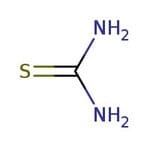
Thioharnstoff, 99 %, Thermo Scientific Chemicals
CAS: 62-56-6 | CH4N2S | 76.12 g/mol
Have Questions?
Ansicht ändern





Katalognummer A12828.0C
auch als A12828-0C bezeichnet
Preis (EUR)
405,65
Exklusiv online
451,00Ersparnis 45,35 (10%)
Each
Menge:
10,000 g
Preis (EUR)
405,65
Exklusiv online
451,00Ersparnis 45,35 (10%)
Each
Chemikalien-Kennzeichnungen
CAS62-56-6
IUPAC Namethiourea
Molecular FormulaCH4N2S
InChI KeyUMGDCJDMYOKAJW-UHFFFAOYSA-N
SMILESNC(N)=S
Mehr anzeigen
Specifications Datenblatt
DatenblattAppearance (Color)White
FormCrystals or crystalline powder
Assay(by Sulfur EA) : ≥ 98.5 to ≤ 101.5% (dry weight basis)
Assay (unspecified)(by Sulfur EA) : ≥ 98.5 to ≤ 101.5% (dry weight basis)
Elemental AnalysisCarbon content 15.48-16.08% (dry weight basis)
Mehr anzeigen
Reagent for organic synthesisUsed as a reagent for organic synthesis. Thiourea is a photographic fixative, and used in manufacture of resins. It acts as a catalyst for asymmetric reactions. It plays an essential role as a catalyst for highly enantio- and diastereoselective additions reaction of oxindoles to nitroolefins. It is also useful to improve the productivity of mung bean.
This Thermo Scientific Chemicals brand product was originally part of the Alfa Aesar product portfolio. Some documentation and label information may refer to the legacy brand. The original Alfa Aesar product / item code or SKU reference has not changed as a part of the brand transition to Thermo Scientific Chemicals.
Anwendungen
Reagenz für organische Synthese. Eingesetzt als Reagenz für die organische Synthese. Thiourea ist ein Fixiermittel in der Fotografie und wird bei der Herstellung von Harzen verwendet. Es wirkt als Katalysator für asymmetrische Reaktionen. Es spielt eine wesentliche Rolle als Katalysator für die stark enantio- und diastereoselektive Additionsreaktion von Oxindolen zu Nitroolefinen. Es ist auch nützlich zur Erhöhung der Produktivität von Mungbohne.
Löslichkeit
Wasserlöslich.
Hinweise
Stabil. Nicht kompatibel mit starken Säuren. Kühl lagern. Behälter an einem trockenen und gut belüfteten Ort dicht verschlossen halten. Handhabung und Lagerung unter Inertgas.
Reagenz für organische Synthese. Eingesetzt als Reagenz für die organische Synthese. Thiourea ist ein Fixiermittel in der Fotografie und wird bei der Herstellung von Harzen verwendet. Es wirkt als Katalysator für asymmetrische Reaktionen. Es spielt eine wesentliche Rolle als Katalysator für die stark enantio- und diastereoselektive Additionsreaktion von Oxindolen zu Nitroolefinen. Es ist auch nützlich zur Erhöhung der Produktivität von Mungbohne.
Löslichkeit
Wasserlöslich.
Hinweise
Stabil. Nicht kompatibel mit starken Säuren. Kühl lagern. Behälter an einem trockenen und gut belüfteten Ort dicht verschlossen halten. Handhabung und Lagerung unter Inertgas.
RUO – Research Use Only
Allgemeine Referenzen:
- Reagenz für die Umwandlung von Alkylhalogeniden in Thiole durch Basenhydrolyse der Isothiouroniumsalze; siehe auch N-Acetyl Thioharnstoff, B21198. Die Spaltung von Isothiouronium-Salzen mit Basen und Alkylierung des resultierenden Thiolats wurde als praktische Synthese von unsymmetrischen Sulfiden verwendet: Synth. Commun., 14, 209 (1984).
- Epoxide werden in Episulfide umgewandelt: J. Org. Chem., 26, 3467 (1961). Die 2,3-Epoxyalkohole, die aus der enantioselektiven Sharpless-Epoxidierung resultieren, können mit Ti(O-i-Pr)4 als Vermittler in die entsprechenden Episulfide mit Retention ann beiden Zentren umgewandelt werden: J. Org. Chem., 53, 4114 (1988).
- Weit verbreitet in heterozyklischen Synthesen, z. B. von Thiazolen und Pyrimidinen.
- Wurde in einer praktischen Synthese von Isothiocyanaten aus Oximen über das Stickstoffmonoxid verwendet: Tetrahedron Lett., 34, 8283 (1993); siehe auch Benzaldoxime, A12053:
- Bui, T.; Syed, S.; Barbas, C. F. Thiourea-Catalyzed Highly Enantio- and Diastereoselective Additions of Oxindoles to Nitroolefins: Application to the Formal Synthesis of (+) -Physostigmine. J. Am. Chem. Soc. 2009, 131 (25), 8758-8759.
- Takemoto, Y. Development of Chiral Thiourea Catalysts and Its Application to Asymmetric Catalytic Reactions. Chem. Pharm. Bull. 2010, 58 (5), 593-601.