Search
 Elementsuche
 Struktursuche



Thermo Scientific Chemicals
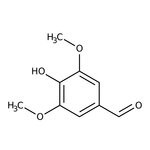
Syringaldehyd, 98+ %, Thermo Scientific Chemicals
CAS: 134-96-3 | C9H10O4 | 182.18 g/mol
Have Questions?
Ansicht ändern



Katalognummer A12933.06
auch als A12933-06 bezeichnet
Preis (EUR)
29,00
Each
Menge:
5 g
Preis (EUR)
29,00
Each
Chemikalien-Kennzeichnungen
CAS134-96-3
IUPAC Name4-hydroxy-3,5-dimethoxybenzaldehyde
Molecular FormulaC9H10O4
InChI KeyKCDXJAYRVLXPFO-UHFFFAOYSA-N
SMILESCOC1=CC(C=O)=CC(OC)=C1O
Mehr anzeigen
Specifications Datenblatt
Appearance (Color)White to pale cream to pale brown or pale pink
FormCrystals or powder or crystalline powder
Assay (GC)≥98.0%
Identification (FTIR)Conforms
Melting Point (clear melt)109.0-115.0?C
Syringaldehyde has bioactive properties and is, therefore, used in pharmaceuticals, food, cosmetics, textiles, pulp and paper industries.
This Thermo Scientific Chemicals brand product was originally part of the Alfa Aesar product portfolio. Some documentation and label information may refer to the legacy brand. The original Alfa Aesar product / item code or SKU reference has not changed as a part of the brand transition to Thermo Scientific Chemicals.
Anwendungen
Syringaldehyd hat bioaktive Eigenschaften und wird daher in der Pharma-, Lebensmittel-, Kosmetik-, Textil-, Zellstoff- und Papierindustrie verwendet.
Löslichkeit
Sehr schwer löslich in Wasser.
Hinweise
Behälter an einem trockenen und gut belüfteten Ort dicht verschlossen halten. Bei Raumtemperatur lagern. Es ist luftempfindlich. Nicht kompatibel mit starken Oxidationsmitteln und Basen.
RUO – Research Use Only
Allgemeine Referenzen:
- Mohamad Nasir.; Mohamad Ibrahim. A CONCISE REVIEW OF THE NATURAL EXISTANCE, SYNTHESIS, PROPERTIES, AND APPLICATIONS OF SYRINGALDEHYDE. BioResources. 1983, 7 (3), 4377-4399.
- Veena Jain.; Nisha Garg.; Himmat S. Nainawatee. Einfluss der Rhizosphäre-Anwendung von Syringaldehyd auf Rhizobia - Mungbohne (Vigna radiata)-Symbiose. Biochemie und Physiologie der Pflanzen. 1991, 187 (4), 331-336.