Search
 Elementsuche
 Struktursuche



Thermo Scientific Chemicals
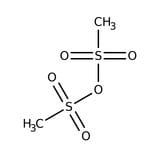
Methansulfonanhydrid, 97 %, Thermo Scientific Chemicals
CAS: 7143-01-3 | C2H6O5S2 | 174.19 g/mol
Have Questions?
Ansicht ändern



Katalognummer A13328.14
auch als A13328-14 bezeichnet
Preis (EUR)
78,90
Each
Menge:
25 g
Preis (EUR)
78,90
Each
Chemikalien-Kennzeichnungen
CAS7143-01-3
IUPAC Namemethanesulfonyl methanesulfonate
Molecular FormulaC2H6O5S2
InChI KeyIZDROVVXIHRYMH-UHFFFAOYSA-N
SMILESCS(=O)(=O)OS(C)(=O)=O
Mehr anzeigen
Specifications Datenblatt
Appearance (Color)White to grey to brown
Identification (FTIR)Conforms
FormPowder or crystals and/or chunks
Assay (Titration ex Anhydride)≥96.0 to ≤104.0%
Melting Point (clear melt)58-72°C
Methanesulfonic anhydride is used to prepare methylsulfonyl esters called as mesylates. It finds application in the reaction of aromatic alkylation. It reacts with dimethylsulfoxide to get sulfoxonium complex, which is a useful oxidizing agent.
This Thermo Scientific Chemicals brand product was originally part of the Alfa Aesar product portfolio. Some documentation and label information may refer to the legacy brand. The original Alfa Aesar product / item code or SKU reference has not changed as a part of the brand transition to Thermo Scientific Chemicals.
Anwendungen
Methansulfonanhydrid wird zur Herstellung von als „Mesylate“ bezeichnete Methylsulfonyl-Estern verwendet. Findet Anwendung in der Reaktion der aromatischen Alkylierung. Reagiert mit Dimethylsulfoxid zu einem Sulfoxoniumkomplex, ein nützliches Oxidationsmittel.
Löslichkeit
Löslich in organischen Lösungsmitteln.
Hinweise
Feuchtigkeitsempfindlich. Hygroskopisch. Behälter an einem trockenen und gut belüfteten Ort dicht verschlossen halten. Nicht kompatibel mit starken Oxidationsmitteln.
RUO – Research Use Only
Allgemeine Referenzen:
- Leistungsfähigeres Sulfonylierungsreagenz als Sulfonylchlorid, vermeidet zudem eine mögliche Verdrängung von Sulfonat durch Halogenid. Eine katalytische Menge der Säure wirkt auf die Mesylierung deaktivierter Aromaten wie 1,3-Dichlorbenzol: Chem. Lett., 395 (1988); Mesylchlorid ist ineffektiv.
- Primäre und sekundäre Alkohole können durch sulfonische Anhydride in DMSO zu Carbonylgruppen oxidiert werden: J. Org. Chem., 39, 1977 (1974). Weitere Informationen zu verwandten Methoden finden Sie unter Dimethyl Sulfoxid, A13280.
- Liu, W.; Tilley, T. D.: Sterically Controlled Functionalization of Carbon Surfaces with- C6H4CH2X (X= OSO2Me or N3) Groups for Surface Attachment of Redox-Active Molecules. Langmuir 2015, 31 (3), 1189-1195.
- Hu, Y.; Zhang, F.; Zhang, C.; Zhang, M.: Anti-inflammatory Properties of an Active Sesquiterpene Lactone and its Structure-Activity Relationship. Med chem 2015, 5, 354-360.