Search
 Elementsuche
 Struktursuche


Thermo Scientific Chemicals
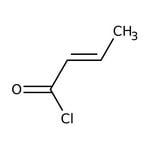
Crotonylchlorid, 90+ %, Rest hauptsächlich cis-Isomer, Thermo Scientific Chemicals
CAS: 625-35-4 | C4H5ClO | 104.533 g/mol
Have Questions?
Ansicht ändern




Katalognummer A13710.14
auch als A13710-14 bezeichnet
Preis (EUR)
34,50
Each
Menge:
25 g
Preis (EUR)
34,50
Each
Chemikalien-Kennzeichnungen
CAS625-35-4
IUPAC Name(2E)-but-2-enoyl chloride
Molecular FormulaC4H5ClO
InChI KeyRJUIDDKTATZJFE-NSCUHMNNSA-N
SMILESC\C=C\C(Cl)=O
Mehr anzeigen
Specifications Datenblatt
DatenblattAppearance (Color)Clear colorless to yellow
CommentRemainder mainly cis-isomer
Identification (FTIR)Conforms
Refractive Index1.4560-1.4640 @ 20?C
Assay (GC)≥88.0%
Mehr anzeigen
Crotonyl chloride is used in agrochemical, pharmaceutical and dyestuff field. Crotonoyl chloride was used in the synthesis of α,β-unsaturated ester.
This Thermo Scientific Chemicals brand product was originally part of the Alfa Aesar product portfolio. Some documentation and label information may refer to the legacy brand. The original Alfa Aesar product / item code or SKU reference has not changed as a part of the brand transition to Thermo Scientific Chemicals.
Anwendungen
Crotonylchlorid wird in agrochemischen, pharmazeutischen und Färbemittelbereichen verwendet. Crotonoylchlorid wurde bei der Synthese von α,β-ungesättigtem Ester verwendet.
Löslichkeit
Es reagiert mit Wasser.
Hinweise
Feuchtigkeitsempfindlich. Lagerung bei 4 °C. Von Hitze und Feuchtigkeit fernhalten. Inkompatibel mit
Crotonylchlorid wird in agrochemischen, pharmazeutischen und Färbemittelbereichen verwendet. Crotonoylchlorid wurde bei der Synthese von α,β-ungesättigtem Ester verwendet.
Löslichkeit
Es reagiert mit Wasser.
Hinweise
Feuchtigkeitsempfindlich. Lagerung bei 4 °C. Von Hitze und Feuchtigkeit fernhalten. Inkompatibel mit
RUO – Research Use Only
Allgemeine Referenzen:
- Toshitsugu Ozeki; Masakatsu Kusaka. Studies on the Isomerization Esterification of Crotonoyl Chloride to Vinylacetic Acid Ester. III. The Reactions of Branched Crotonoyl Chlorides.Bulletin of the Chemical Society of Japan.1967, 40 2686-2688.
- Davies SG, et al. Double asymmetric induction as a mechanistic probe: the doubly diastereoselective conjugate addition of enantiopure lithium amides to enantiopure α,β-unsaturated esters and enantiopure α,β-unsaturated hydroxamates.Tetrahedron.2011,67(34), 6382-6403.