Search
 Elementsuche
 Struktursuche


Thermo Scientific Chemicals
Hydrazin-Monohydrat, 98+ %, Thermo Scientific Chemicals
CAS: 7803-57-8 | H6N2O | 50.06 g/mol
Have Questions?
Ansicht ändern



Katalognummer A14005.18
auch als A14005-18 bezeichnet
Preis (EUR)
-
Menge:
50 g
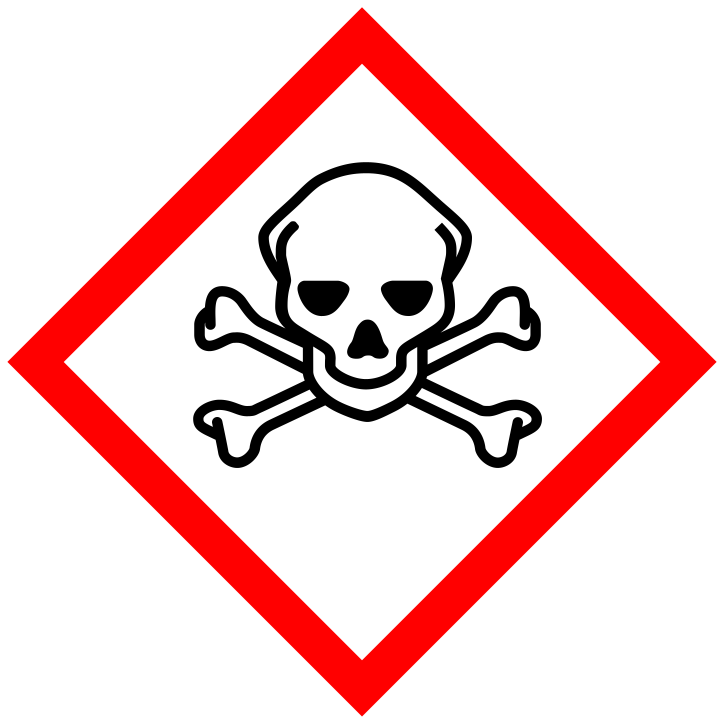
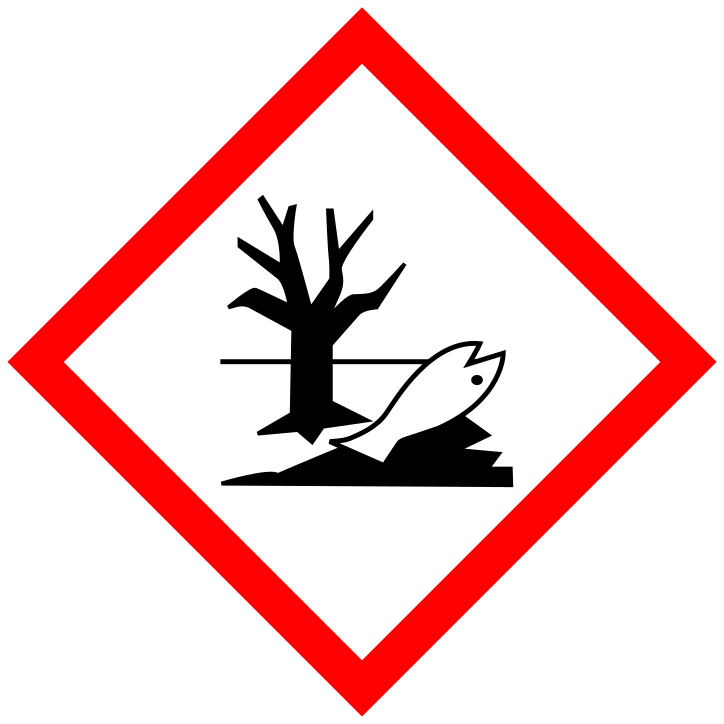
Chemikalien-Kennzeichnungen
CAS7803-57-8
Specifications Datenblatt
DatenblattAppearance (Color)Clear colorless
FormLiquid
Assay (Hydrazine)≥98.0 to ≤102.0% (non-U.S. specification)
Assay from Suppliers CofA≥98.0% (U.S. specifiactionl)
CommentSpecification differs for U.S. and non-U.S. material where indicated
Mehr anzeigen
Hydrazine monohydrate is used as a reducing agent. It is also used in water treatment, especially effluents and industrial boilers, metal treatment and mine extraction process, and synthesis of active ingredients in the pharmaceutical industry like 3-amino-1,2,4-triazole cefazolin, rizatriptan, anastrozole, fluconazole, metazachlor metamitron pyrazole, metribuzin, paclobutrazol, diclobutrazole, propiconazole, and triadimefon. It is involved in the preparation of heterocycles like pyrazoles and pyridazines. It is actively involved in the Wolff-Kishner reduction, which converts the carbonyl group of a ketone into a methylene bridge through a hydrazone intermediate. Further, it is used to cleave N-alkylated phthalimide derivatives. In the Einhorn-Brunner reaction, it reacts with imides to get triazoles.
This Thermo Scientific Chemicals brand product was originally part of the Alfa Aesar product portfolio. Some documentation and label information may refer to the legacy brand. The original Alfa Aesar product / item code or SKU reference has not changed as a part of the brand transition to Thermo Scientific Chemicals.
Anwendungen
Hydrazin-Monohydrat wird als Reduktionsmittel verwendet. Es wird auch in der Wasseraufbereitung, insbesondere bei Abwässern und Industriekesseln, bei der Metallbehandlung und im Bergbau sowie bei der Synthese von Wirkstoffen in der pharmazeutischen Industrie wie 3-amino-1,2,4-Triazol-Cefazolin, Rizatriptan, Anastrozol,Fluconazol, Metazachlormetamitron-Pyrazol, Metribuzin, Paclobutrazol, Diclobutrazol, Propiconazol und Triadimefon verwendet. Es ist an der Herstellung von Heterozyklen wie Pyrazolen und Pyridazinen beteiligt. Es ist ein aktiver Bestandteil der Wolff-Kishner-Reduktion, die die Carbonylgruppe eines Ketons durch ein Hydrazonintermediär in eine Methylenbrücke umwandelt. Darüber hinaus wird es zur Spaltung von N-alkylierten Phthalimid-Derivaten verwendet. In der Einhorn-Brunner-Reaktion reagiert es mit Imiden, um Triazole zu erhalten.
Löslichkeit
Mischbar mit Wasser und Alkohol. Nicht mischbar mit Chloroform, Kohlenwasserstoffen und Äther.
Hinweise
Besondere Vorsichtsmaßnahmen bei der Handhabung erforderlich. Bitte sehen Sie sich die MSDS vor dem Kauf an. MSDS sind online unter www.alfa.comInbompatible mit Oxidationsmitteln, Sauerstoff, Kupfer, organischen Materialien und Zink verfügbar.
Hydrazin-Monohydrat wird als Reduktionsmittel verwendet. Es wird auch in der Wasseraufbereitung, insbesondere bei Abwässern und Industriekesseln, bei der Metallbehandlung und im Bergbau sowie bei der Synthese von Wirkstoffen in der pharmazeutischen Industrie wie 3-amino-1,2,4-Triazol-Cefazolin, Rizatriptan, Anastrozol,Fluconazol, Metazachlormetamitron-Pyrazol, Metribuzin, Paclobutrazol, Diclobutrazol, Propiconazol und Triadimefon verwendet. Es ist an der Herstellung von Heterozyklen wie Pyrazolen und Pyridazinen beteiligt. Es ist ein aktiver Bestandteil der Wolff-Kishner-Reduktion, die die Carbonylgruppe eines Ketons durch ein Hydrazonintermediär in eine Methylenbrücke umwandelt. Darüber hinaus wird es zur Spaltung von N-alkylierten Phthalimid-Derivaten verwendet. In der Einhorn-Brunner-Reaktion reagiert es mit Imiden, um Triazole zu erhalten.
Löslichkeit
Mischbar mit Wasser und Alkohol. Nicht mischbar mit Chloroform, Kohlenwasserstoffen und Äther.
Hinweise
Besondere Vorsichtsmaßnahmen bei der Handhabung erforderlich. Bitte sehen Sie sich die MSDS vor dem Kauf an. MSDS sind online unter www.alfa.comInbompatible mit Oxidationsmitteln, Sauerstoff, Kupfer, organischen Materialien und Zink verfügbar.
RUO – Research Use Only
Allgemeine Referenzen:
- Bildet stabile, wasserfreie Feststoffkomplexe, die aus einem Hydrazinmolekül bestehen, das mit einem Molekül Hydrochinon oder zwei Molekülen 4-Methoxyphenol assoziiert ist. Diese sind ein potenzieller Ersatz für das sehr gefährliche wasserfreie Hydrazin z. B. in der Feststoffreaktion mit Estern zu reinen Hydraziden: J. Chem. Soc., Chem. Commun., 1531, (1995).
- Diimid-Vorstufe: Zur Erzeugung von Diimid durch Oxidation mit O2 und zur selektiven Reduktion einer Doppelbindung in Gegenwart eines Cyclopropan-Ringes siehe: J. Chem. Soc., Chem. Commun., 525 (1973). Eine Übersicht über Diimid-Reduktionen: Org. React., 40, 91 (1991). Siehe auch Hydroxyl amin-O-sulfonsäure, A12560.
- In der Wolff-Kishner-Carbonyl-Methylen-Reduktion (Erwärmung mit Hydrazin und Alkalihydroxid) ist Diethylenglykol heute das übliche Lösungsmittel (die Huang-Minlon-Modifikation): J. Am. Chem. Soc., 68, 2487 (1946); Org. Synth. Coll., 4, 510 (1963). Die Reduktion wurde auch bei Umgebungstemperatur durch den Einsatz von KO-t-Bu in DMSO durchgeführt: J. Am. Chem. Soc., 84, 1734 (1962). Siehe auch Isatin, A12468 für eine analoge Reduktion.
- In Gegenwart von Rh auf Kohlenstoff wird Nitrobenzol selektiv zu Phenylhydroxylamin reduziert: Org. Synth. Coll., 8, 16 (1993).
- Eine kurze Beschreibung der Verwendung des Reagenz in der Synthese finden Sie unter: Synlett, 2445 (2004).
- Shiraishi, Y.; Hirakawa, H.; Hirai, T. Photocatalytic Hydrogenation of Nitroaromatics to Anilines on Silica-Supported Iron Oxides with Hydrazine Monohydrate as a Reductant. J. Chem. Eng. Jpn. 2015, 48 (2), 141-146.
- Sun, J. K.; Xu, Q. Metal Nanoparticles Immobilized on Carbon Nanodots as Highly Active Catalysts for Hydrogen Generation from Hydrazine in Aqueous Solution. Chem. Cat. Chem. 2015, 7 (3), 526-531.