Search
 Elementsuche
 Struktursuche


Thermo Scientific Chemicals
3-Bromthiophen, 97 %, Thermo Scientific Chemicals
CAS: 872-31-1 | C4H3BrS | 163.03 g/mol
Have Questions?
Ansicht ändern

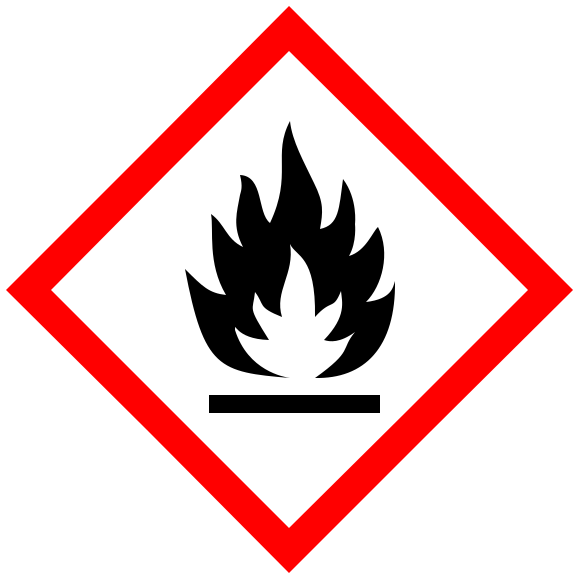

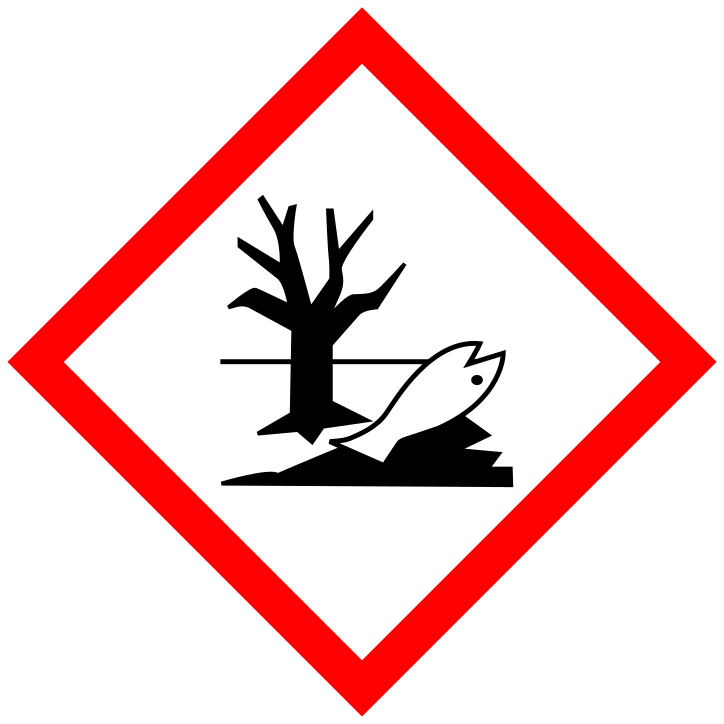

Katalognummer A14022.18
auch als A14022-18 bezeichnet
Preis (EUR)
124,00
Each
Menge:
50 g
Preis (EUR)
124,00
Each
Chemikalien-Kennzeichnungen
CAS872-31-1
IUPAC Name3-bromothiophene
Molecular FormulaC4H3BrS
InChI KeyXCMISAPCWHTVNG-UHFFFAOYSA-N
SMILESBrC1=CSC=C1
Mehr anzeigen
Specifications Datenblatt
DatenblattRefractive Index1.5895-1.5945 @ 20?C
Assay (GC)≥96.0%
FormLiquid
Appearance (Color)Clear colorless to pale yellow
Identification (FTIR)Conforms
3-Bromothiophene is used in the preparation of derivatives such as thienylenic alpha, μ-diformyl-alpha-oligothiophenes and 3-lithiothiophene. It is also used in the synthesis of 3-lithiothiophene by reacting with n-butyllithium.
This Thermo Scientific Chemicals brand product was originally part of the Alfa Aesar product portfolio. Some documentation and label information may refer to the legacy brand. The original Alfa Aesar product / item code or SKU reference has not changed as a part of the brand transition to Thermo Scientific Chemicals.
Anwendungen
3-Bromothiophen wird bei der Herstellung von Derivaten wie Alpha-Thienylen, µ-diformyl-alpha-oligothiophen und 3-lithiothiophen verwendet. Wird auch bei der Synthese von 3-Lithiothiophen durch Reaktion mit n-Butyllithium verwendet.
Löslichkeit
Nicht mit Wasser mischbar.
Hinweise
Lichtempfindlich. Nicht kompatibel mit starken Oxidationsmitteln, starken Reduktionsmitteln und starken Basen.
3-Bromothiophen wird bei der Herstellung von Derivaten wie Alpha-Thienylen, µ-diformyl-alpha-oligothiophen und 3-lithiothiophen verwendet. Wird auch bei der Synthese von 3-Lithiothiophen durch Reaktion mit n-Butyllithium verwendet.
Löslichkeit
Nicht mit Wasser mischbar.
Hinweise
Lichtempfindlich. Nicht kompatibel mit starken Oxidationsmitteln, starken Reduktionsmitteln und starken Basen.
RUO – Research Use Only
Allgemeine Referenzen:
- Zwischenprodukt für die Herstellung von3 -substituierten Thiophenen mithilfe der Grignard-Route: Arkiv. Kemi., 13, 295 (1959). Gleichermaßen in der Synthese von Poly(3-alkylthiophenen) als leitende Polymere verwendet: J. Org. Chem., 58, 904 (1993). Es wurden Bedingungen für die Bildung von 3-lithiothiophen beschrieben, die zuvor nur unter kryogenen Bedingungen als stabil angesehen wurden. Es wurde festgestellt, dass es bei Umgebungstemperatur stabil in Hexan-Lösung ist: Tetrahedron Lett., 35, 3673 (1994). Die anschließende Reaktion mit Elektrophilen führt zu einer Vielzahl von 3-substituierten Thiophenen.
- Tang, T.; Lin, T.; Wang, F.; He, C. Origin of Near-Infrared Absorption for Azulene-Containing Conjugated Polymers upon Protonation or Oxidation. J. Phys. Chem. B 2014, 119 (25), 8176-8183.
- Skhiri, A.; Beladhria, A.; Yuan, K.; Soule, J.; Salem, R. B.; Doucet, H. Pd-Catalysed Direct Arylation of Heteroaromatics Using (Poly)halobenzenesulfonyl Chlorides as Coupling Partners: One Step Access to (Poly)halo-Substituted Bi(hetero)aryls. Eur. J. Org. Chem. 2015, 2015 (20), 4428-4436.