Search
 Elementsuche
 Struktursuche


Thermo Scientific Chemicals
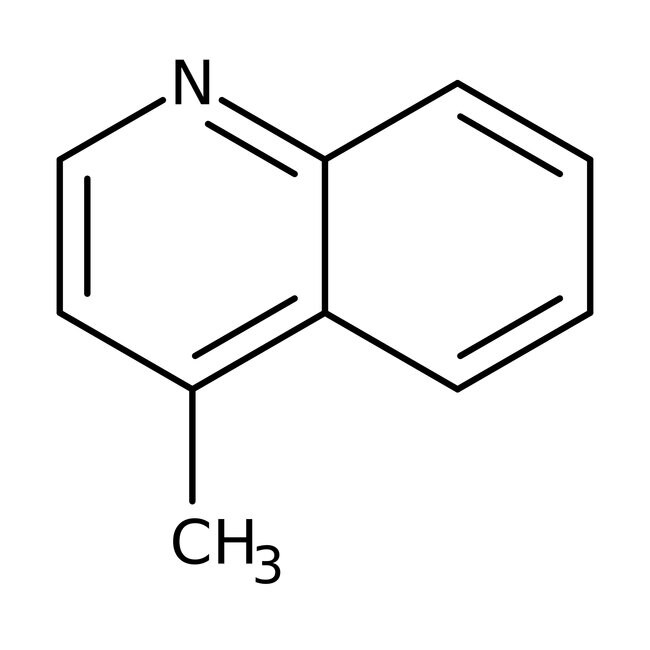
Lepidin, 98 %, Thermo Scientific Chemicals
CAS: 491-35-0 | C10H9N | 143.189 g/mol
Have Questions?
Ansicht ändern




Katalognummer A14040.09
auch als A14040-09 bezeichnet
Preis (EUR)
37,10
Each
Menge:
10 g
Preis (EUR)
37,10
Each
Chemikalien-Kennzeichnungen
CAS491-35-0
IUPAC Name4-methylquinoline
Molecular FormulaC10H9N
InChI KeyMUDSDYNRBDKLGK-UHFFFAOYSA-N
SMILESCC1=C2C=CC=CC2=NC=C1
Mehr anzeigen
Specifications Datenblatt
DatenblattRefractive Index1.6155-1.6205 @ 20?C
FormLiquid
Assay (GC)≥96.0%
Identification (FTIR)Conforms
Appearance (Color)Clear colorless to yellow
Lepidine is used in the preparation of certain dyes.
This Thermo Scientific Chemicals brand product was originally part of the Alfa Aesar product portfolio. Some documentation and label information may refer to the legacy brand. The original Alfa Aesar product / item code or SKU reference has not changed as a part of the brand transition to Thermo Scientific Chemicals.
Anwendungen
Lepidin wird bei der Herstellung bestimmter Farbstoffe verwendet.
Löslichkeit
Schwer in Wasser löslich.
Hinweise
Lichtempfindlich. Nicht kompatibel mit Oxidationsmitteln. Nicht kompatibel mit Oxidationsmitteln.
Lepidin wird bei der Herstellung bestimmter Farbstoffe verwendet.
Löslichkeit
Schwer in Wasser löslich.
Hinweise
Lichtempfindlich. Nicht kompatibel mit Oxidationsmitteln. Nicht kompatibel mit Oxidationsmitteln.
RUO – Research Use Only
Allgemeine Referenzen:
- K.R.Justin Thomas; Marappan Velusamy; Jiann T.Lin ; Chin-Hsiung Chien; Yu-Tai Tao; Yuh S.Wen; Ya-Hui Hu; Pi-Tai Chou. Efficient red-emitting cyclometalated iridium(III) complexes containing lepidine-based ligands. Inorg. Chem. 2005, 44,(16), 5677-5685
- Martin J.Weiss; Charles R.Hauser. The acylation and carbethoxylation of quinaldine, lepidine and α-picoline using sodium amide or potassium amide. J. Am. Chem. Soc. 1949, 71,(6), 2023-2026.
- Lepidin und ähnliche Verbindungen können an der 2-Position durch freie Radikale alkyliert werden, die durch die Wirkung von t-Butylhydroperoxid und einem Salz von Fe(II) auf ein primäres oder sekundäres Alkyliodid erzeugt werden: Acta Chem. Scand., 43, 995 (1989). Ebenso kann 2-Formylierung bei hoher Ausbeute mit 1,3,5-Trioxan in Anwesenheit von TFA, t-BuOH und FeSO4 in Acetonitril erzielt werden: J. Org. Chem., 51, 536 (1986).