Search
 Elementsuche
 Struktursuche


Thermo Scientific Chemicals
1,5-Diphenylcarbazid, 97+ %, Thermo Scientific Chemicals
CAS: 140-22-7 | C13H14N4O | 242.282 g/mol
Have Questions?
Ansicht ändern



Katalognummer A14060.22
auch als A14060-22 bezeichnet
Preis (EUR)
192,00
Each
Menge:
100 g
Preis (EUR)
192,00
Each
Chemikalien-Kennzeichnungen
CAS140-22-7
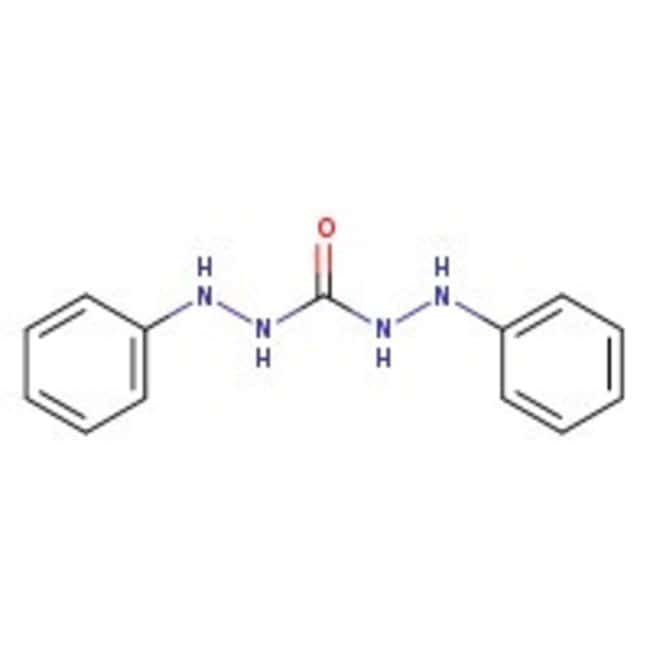
IUPAC Name1,3-bis(phenylamino)urea
Molecular FormulaC13H14N4O
InChI KeyKSPIHGBHKVISFI-UHFFFAOYSA-N
SMILESO=C(NNC1=CC=CC=C1)NNC1=CC=CC=C1
Mehr anzeigen
Specifications Datenblatt
DatenblattFormCrystals or powder or crystalline powder
Appearance (Color)White to cream or pale yellow or pale pink or pale grey
Melting Point (clear melt)170-176?C
Assay (HPLC)≥97.0%
Identification (FTIR)Conforms
1,5-Diphenylcarbazide is used in the colorimteric determination of chromium, osmium as well as in the detection of cadmium, mercury, magnesium, emetine and aldehydes.
This Thermo Scientific Chemicals brand product was originally part of the Alfa Aesar product portfolio. Some documentation and label information may refer to the legacy brand. The original Alfa Aesar product / item code or SKU reference has not changed as a part of the brand transition to Thermo Scientific Chemicals.
Anwendungen
1,5-Diphenylcarbazid wird bei der kolorimterischen Bestimmung von Chrom, Osmium sowie beim Nachweis von Cadmium, Quecksilber, Magnesium, Emetin und Aldehyden verwendet.
Löslichkeit
Löslich in Eisessigsäure, Alkohol und Aceton. Schwer in Wasser löslich.
Hinweise
Luft- und lichtempfindlich. Den Behälter an einem trockenen und gut belüfteten Ort fest verschlossen aufbewahren. Nicht kompatibel mit starken Oxidationsmitteln.
1,5-Diphenylcarbazid wird bei der kolorimterischen Bestimmung von Chrom, Osmium sowie beim Nachweis von Cadmium, Quecksilber, Magnesium, Emetin und Aldehyden verwendet.
Löslichkeit
Löslich in Eisessigsäure, Alkohol und Aceton. Schwer in Wasser löslich.
Hinweise
Luft- und lichtempfindlich. Den Behälter an einem trockenen und gut belüfteten Ort fest verschlossen aufbewahren. Nicht kompatibel mit starken Oxidationsmitteln.
RUO – Research Use Only
Allgemeine Referenzen:
- Li, M.; Cao, R.; Nilghaz, A.; Guan, L.; Zhang, X.; Shen, W. Periodic-Table-Style Paper Device for Monitoring Heavy Metals in Water. Anal. Chem. 2015, 87 (5), 2555-2559.
- Machida, H.; Yamada, H.; Fujioka, Y.; Yamamoto, S. Insight into Core-Shell Dependent Anoxic Cr(VI) Removal with Fe@Fe2O3 Nanowires: Indispensable Role of Surface Bound Fe(II). ACS Appl. Mater. Interfaces 2015, 7 (3), 1997-2005.