Search
 Elementsuche
 Struktursuche


Thermo Scientific Chemicals
Cinnamylchlorid, 95 %, stab. mit Natriumcarbonat, Thermo Scientific Chemicals
CAS: 2687-12-9 | C9H9Cl | 152.62 g/mol
Have Questions?
Ansicht ändern

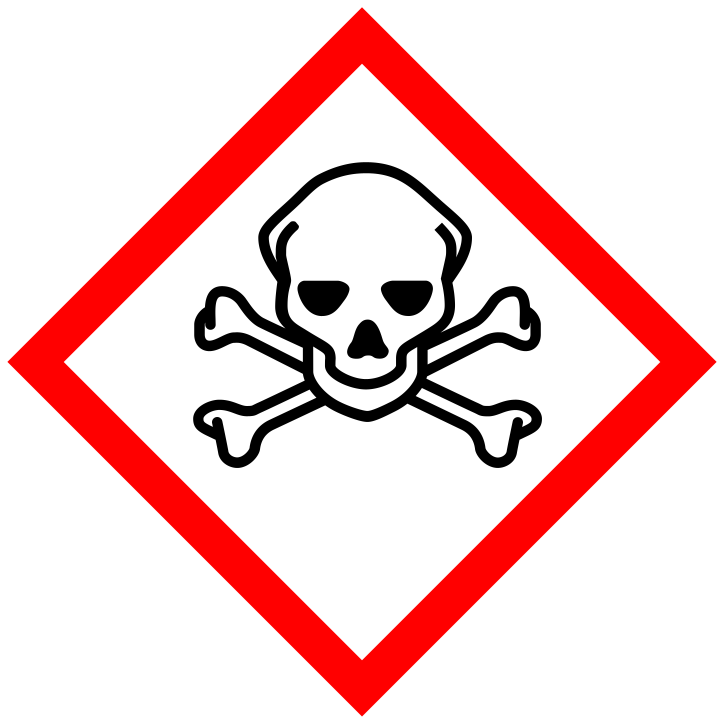

Katalognummer A14408.0B
auch als A14408-0B bezeichnet
Preis (EUR)
510,00
Each
Menge:
1000 g
Preis (EUR)
510,00
Each
Chemikalien-Kennzeichnungen
CAS2687-12-9
IUPAC Name[(1E)-3-chloroprop-1-en-1-yl]benzene
Molecular FormulaC9H9Cl
InChI KeyIWTYTFSSTWXZFU-QPJJXVBHSA-N
SMILESClC\C=C\C1=CC=CC=C1
Mehr anzeigen
Specifications Datenblatt
DatenblattFormLiquid
Appearance (Color)Clear colorless to yellow to yellow-brown
Identification (FTIR)Conforms
Refractive Index1.5810-1.5870 @ 20?C
Assay (GC)≥94.0%
Cinnamyl chloride is used in the enantioselective total synthesis of helioporins C and E, bioactive marine diterpenes.
This Thermo Scientific Chemicals brand product was originally part of the Alfa Aesar product portfolio. Some documentation and label information may refer to the legacy brand. The original Alfa Aesar product / item code or SKU reference has not changed as a part of the brand transition to Thermo Scientific Chemicals.
Anwendungen
Cinnamylchlorid wird bei der enantioselektiven Gesamtsynthese der bioaktiven marinen Deterpene Helioporinen C und E verwendet.
Löslichkeit
Wasserlöslich (0.2 g/l bei 20 °C).
Hinweise
Kühl lagern. Behälter an einem trockenen und gut belüfteten Ort dicht verschlossen halten. Geöffnete Behälter müssen sorgfältig abgedichtet und aufrecht gehalten werden, um ein Auslaufen zu vermeiden. Empfohlene Lagertemperatur: 2 bis 8 °C
Cinnamylchlorid wird bei der enantioselektiven Gesamtsynthese der bioaktiven marinen Deterpene Helioporinen C und E verwendet.
Löslichkeit
Wasserlöslich (0.2 g/l bei 20 °C).
Hinweise
Kühl lagern. Behälter an einem trockenen und gut belüfteten Ort dicht verschlossen halten. Geöffnete Behälter müssen sorgfältig abgedichtet und aufrecht gehalten werden, um ein Auslaufen zu vermeiden. Empfohlene Lagertemperatur: 2 bis 8 °C
RUO – Research Use Only
Allgemeine Referenzen:
- Kenji Uneyama.; Hiromi Nanbu.; Sigeru Torii. Reductive generation of active zero-valent in SnCl2Al system and its use for highly diastereoselective reaction of cinnamyl chloride and aldehydes. Tetrahedron Letters. 1986, 27 (21), 2395-2396.
- Henry Gilman and Stanton A. Harris. The preparation of cinnamyl chloride and its grignard reagent. Recueil des Travaux Chimiques des Pays-Bas. 1931, 50 (12), 1052-1055.