Search
 Elementsuche
 Struktursuche

Thermo Scientific Chemicals
Pyridinhydrobromid Perbromid, Tech. 90 %, Thermo Scientific Chemicals
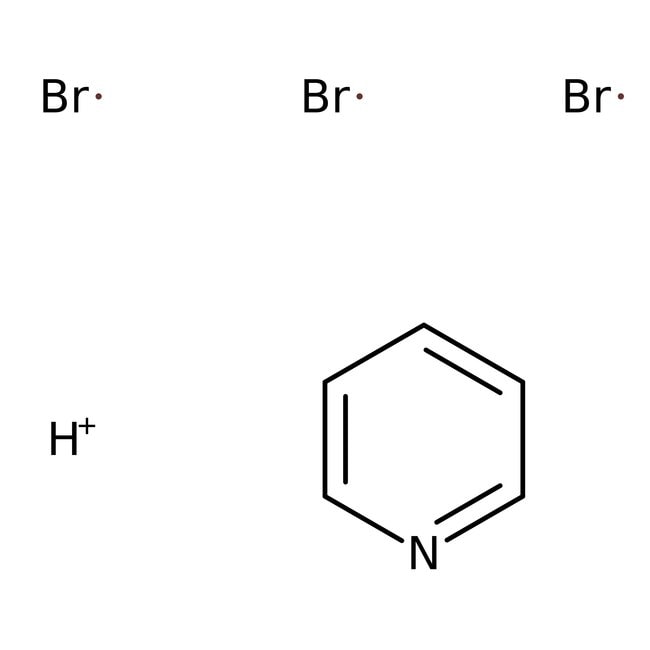
CAS: 39416-48-3 | C5H5N·HBr3
Have Questions?
Ansicht ändern




Katalognummer A15684.14
auch als A15684-14 bezeichnet
Preis (EUR)
44,70
Each
Menge:
25 g
Preis (EUR)
44,70
Each
Chemikalien-Kennzeichnungen
CAS39416-48-3
Molecular FormulaC5H6Br3N
InChI KeyGWJBDYRGIFGTOG-UHFFFAOYSA-O
SMILES[H+].[Br].[Br].[Br].C1=CC=NC=C1
Molecular Weight (g/mol)319.82
Specifications Datenblatt
DatenblattAppearance (Color)Yellow to orange to red to red-brown to brown
FormCrystals or powder or crystalline powder or fused/lumpy solid or chunks
Assay (Iodometric Titration)≥88.0% (non-U.S. specification)
Assay≥88.0% (U.S. specification)
CommentSpecification differs for U.S. and non-U.S. material where indicated
Mehr anzeigen
Pyridine hydrobromide perbromide is used as a brominating reagent in alfa-bromination and alfa-thiocyanation of ketones, phenols, unsaturated and aromatic ethers. It is used as a raw material in the preparation of beta-adrenergic blocking agents. Furthermore, it is used as an analytical reagent.
This Thermo Scientific Chemicals brand product was originally part of the Alfa Aesar product portfolio. Some documentation and label information may refer to the legacy brand. The original Alfa Aesar product / item code or SKU reference has not changed as a part of the brand transition to Thermo Scientific Chemicals.
Anwendungen
Pyridinhydrobromid-Perbromid wird als bromierendes Reagenz bei der alfa-Bromierung und alfa-Thiocyanation von Ketonen, Phenolen, ungesättigten und aromatischen Ethern verwendet. Wird als Rohstoff bei der Herstellung von beta-adrenergen Blockern verwendet. Wird darüber hinaus als analytisches Reagenz verwendet.
Löslichkeit
Löslich in Methanol, Essigsäure, Ethanol, n-Butanol und Terahydrofuran. Unlöslich in Wasser, Tetrachlorkohlenstoff, Ethylbromid, Benzol, Toluol, Ligroin, Petrolether.
Hinweise
Kühl lagern. Nicht kompatibel mit starken Oxidationsmitteln und starken Basen.
Pyridinhydrobromid-Perbromid wird als bromierendes Reagenz bei der alfa-Bromierung und alfa-Thiocyanation von Ketonen, Phenolen, ungesättigten und aromatischen Ethern verwendet. Wird als Rohstoff bei der Herstellung von beta-adrenergen Blockern verwendet. Wird darüber hinaus als analytisches Reagenz verwendet.
Löslichkeit
Löslich in Methanol, Essigsäure, Ethanol, n-Butanol und Terahydrofuran. Unlöslich in Wasser, Tetrachlorkohlenstoff, Ethylbromid, Benzol, Toluol, Ligroin, Petrolether.
Hinweise
Kühl lagern. Nicht kompatibel mit starken Oxidationsmitteln und starken Basen.
RUO – Research Use Only
Allgemeine Referenzen:
- Stabile, kristalline, leicht zu handhabende Bromquelle, die für eine breite Palette von Brominationen, einschließlich ɑ-Bromierung von Ketonen nützlich ist: J. Am. Chem. Soc., 70, 417 (1948) und Umwandlung von Alkenen zu VIC Dibromiden. Siehe zum Beispiel: Org. Synth. Coll., 5, 604 (1973), Note 2. Die Additionsrate zu Alkenen steigt bei erhöhter Substitution deutlich an, sodass eine selektive Bromierung der stärker substituierten von zwei Doppelbindungen erreicht werden kann: Synthesis, 966 (1979).
- In Pyridin werden Cyclopentenone direkt in ihre ɑ-Bromderivate umgewandelt (Additionselimination): Synth. Commun., 18, 1323 (1988).
- Die selektive Monobromierung von Anilinen, vorwiegend an der Paraposition, kann in THF erfolgen: Synth. Commun., 23, 855 (1993). In wässrigem AcOH werden Alkylarylether mit hoher Ausbeute p-bromiert: Synth. Commun., 28, 499 (1998), wohingegen Arylmethylether bei der Erhitzung in Xylol demethyliert werden: Indian J. Chem., 33B, 288 (1994). Spaltet Thioacetale bei Vorhandensein von TBAB: J. Org. Chem., 46, 1745 (1981).
- Hu, Y.; Ju, L.; Lu, L.; Ma, H.; Yu, X. Stereoselective alpha-indolylation of enals via an organocatalytic formal cross-coupling with indoles. Org. Biomol. Chem. 2015, 13 (33), 8869-8874.
- Amaya, T.; Hirao, T. Chemistry of Sumanene. Chem Rec 2015, 15 (1), 310-321.