Search
 Elementsuche
 Struktursuche


Thermo Scientific Chemicals
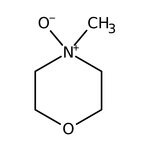
4-Methylmorpholin-N-Oxid-Monohydrat, +98 %, Thermo Scientific Chemicals
CAS: 70187-32-5 | C5H13NO3 | 135.163 g/mol
Have Questions?
Ansicht ändern



Preis (EUR)
194,00
Each
Chemikalien-Kennzeichnungen
CAS70187-32-5
IUPAC Name4-methylmorpholin-4-ium-4-olate
Molecular FormulaC5H11NO2
InChI KeyLFTLOKWAGJYHHR-UHFFFAOYSA-N
SMILESC[N+]1([O-])CCOCC1
Mehr anzeigen
Specifications Datenblatt
DatenblattAssay (Non-aqueous acid-base Titration)≥98.0 to ≤102.0% (dry wt. basis)
Water Content (Karl Fischer Titration)10-16% (0.7-1.2 waters of hydration)
Appearance (Color)White to cream
FormCrystalline powder and/or Lumps
Solution TestClear colorless (ethanol, 5%)
4-Methylmorpholine N-oxide monohydrate is used as a solvent to prepare cellulose fibers. It is an oxidant and involved in the catalytic OsO4 oxidation of olefins to cis-1,2-diols. It is also involved in ruthenium catalyzed oxidation of alcohols to aldehydes and ketones.
This Thermo Scientific Chemicals brand product was originally part of the Alfa Aesar product portfolio. Some documentation and label information may refer to the legacy brand. The original Alfa Aesar product / item code or SKU reference has not changed as a part of the brand transition to Thermo Scientific Chemicals.
Anwendungen
4-Methylmorpholin-N-Oxid-Monohydrat wird als Lösungsmittel zur Herstellung von Cellulosefasern verwendet. Ist ein Oxidationsmittel und an der katalytischen OsO4-Oxidation von Olefinen zu Cis-1,2-diolen beteiligt. Ist auch an der Ruthenium-katalysierten Oxidation von Alkoholen zu Aldehyden und Ketonen beteiligt.
Löslichkeit
Wasserlöslich.
Hinweise
Hygroskopisch. Kühl lagern. Den Behälter dicht verschlossen halten. Nicht kompatibel mit starken Oxidationsmitteln.
4-Methylmorpholin-N-Oxid-Monohydrat wird als Lösungsmittel zur Herstellung von Cellulosefasern verwendet. Ist ein Oxidationsmittel und an der katalytischen OsO4-Oxidation von Olefinen zu Cis-1,2-diolen beteiligt. Ist auch an der Ruthenium-katalysierten Oxidation von Alkoholen zu Aldehyden und Ketonen beteiligt.
Löslichkeit
Wasserlöslich.
Hinweise
Hygroskopisch. Kühl lagern. Den Behälter dicht verschlossen halten. Nicht kompatibel mit starken Oxidationsmitteln.
RUO – Research Use Only
Allgemeine Referenzen:
- Stöchiometrisches Oxidationsmittel, das die Verwendung von Osmium(VIII) -Oxid ermöglicht, 12103, katalytisch in der Cis-Hydroxylierung von Alkenen: Tetrahedron Lett., 1973 (1976): Org. Synth. Coll., 6, 342 (1988). Zur Verwendung bei der asymmetrischen Dihydroxylierung (ADH)-Reaktion, katalysiert durch Osmium(VIII) -Oxid, 12103, siehe: J. Am. Chem. Soc., 110, 1968 (1988); Org. Synth. Coll., 9, 383 (1998).
- Bei Vorhandensein von Ru-Katalysatoren wie RuCl3 oder Dichlorotris(Triphenyl Phosphin) Ruthenium(II) , L00373, oxidiert verschiedene Alkoholarten zu Carbonylverbindungen: Tetrahedron Lett., 2503 (1976). Siehe auch Tetra-n-propyl -Ammonium-Perruthenat(VII) , B24511.
- Bei Vorhandensein von 4A-Molekularsieben in Acetonitril können aktivierte Halogenide (z. B. Benzylhalogenide) zu Aldehyden und Ketonen oxidiert werden: Synth. Commun., 22, 1967 (1992).
- Boronester, die durch Behandlung von Arylbromiden im THF mit n-BuLi, gefolgt von Trimethylborat, gebildet werden, können in situ zu Phenolen ohne Isolierung der Boronsäure oxidiert werden: Synlett, 931 (1995).
- Chapelat, J.; Hengartner, U.; Chougnet, A.; Liu, K.; Huebbe, P.; Rimbach, G.; Woggon, W. D. Asymmetric Synthesis and Biological Activity of nor-α-Tocopherol, a New Vitamin E Analogue. ChemBioChem 2011, 12 (1), 118-124.
- Tong, L. H.; Guenee, L.; Williams, A. F. Pentasubstituted Ferrocene and Dirhodium(II) Tetracarboxylate as Building Blocks for Discrete Fullerene-Like and Extended Supramolecular Structures. Inorg. Chem. 2011, 50 (6), 2450-2457.