Search
 Elementsuche
 Struktursuche


Thermo Scientific Chemicals
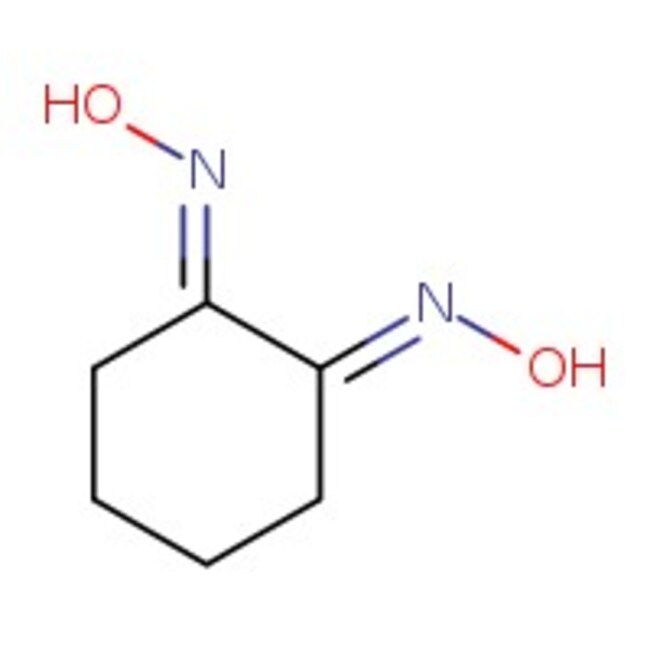
1,2-Cyclohexandiondioxim, 97 %, Thermo Scientific Chemicals
CAS: 492-99-9 | C6H10N2O2 | 142.16 g/mol
Have Questions?
Ansicht ändern


Katalognummer A16788.22
auch als A16788-22 bezeichnet
Preis (EUR)
910,00
Each
Menge:
100 g
Preis (EUR)
910,00
Each
Chemikalien-Kennzeichnungen
CAS492-99-9
IUPAC NameN-[(1E,2E)-2-(hydroxyimino)cyclohexylidene]hydroxylamine
Molecular FormulaC6H10N2O2
InChI KeyCUNNCKOPAWXYDX-KQQUZDAGSA-N
SMILESO\N=C1/CCCC/C/1=N\O
Mehr anzeigen
Specifications Datenblatt
DatenblattElemental AnalysisC: 50.69 ? 2%
Elemental AnalysisN: 19.71 ? 0.7%
Formpowder
Appearance (Color)White to pale brown
1,2-Cyclohexanedione dioxime acts as a chelating ligand forming complexes with many transition metal ions like Co, Fe and Ni. It is used in photometric detection of metal ions.
This Thermo Scientific Chemicals brand product was originally part of the Alfa Aesar product portfolio. Some documentation and label information may refer to the legacy brand. The original Alfa Aesar product / item code or SKU reference has not changed as a part of the brand transition to Thermo Scientific Chemicals.
Anwendungen
1,2-Cyclohexandiondioxim dient als Chelatligand und bildet Komplexe mit vielen Übergangsmetallionen wie Co, Fe und Ni. Es wird für den photometrischen Nachweis von Metallionen verwendet.
Löslichkeit
Wasserlöslich.
Hinweise
Kühl und trocken in einem gut abgedichteten Behälter lagern. Von Oxidationsmitteln entfernt aufbewahren
1,2-Cyclohexandiondioxim dient als Chelatligand und bildet Komplexe mit vielen Übergangsmetallionen wie Co, Fe und Ni. Es wird für den photometrischen Nachweis von Metallionen verwendet.
Löslichkeit
Wasserlöslich.
Hinweise
Kühl und trocken in einem gut abgedichteten Behälter lagern. Von Oxidationsmitteln entfernt aufbewahren
RUO – Research Use Only
Allgemeine Referenzen:
- W. C. Johnson und M. Simmons. 1:2-Cyclohexanedione-dioxime (‘Nioxime’) as a reagent for nickel. Analyst.1946, 71 (1), 554-556.
- Chelatliganden, die Komplexe mit vielen Übergangsmetallionen bilden: J. Inorg. Nucl. Chem., 36, 1601 (1974); J. Am. Chem. Soc., 97, 932 (1975).