Search
 Elementsuche
 Struktursuche



Thermo Scientific Chemicals
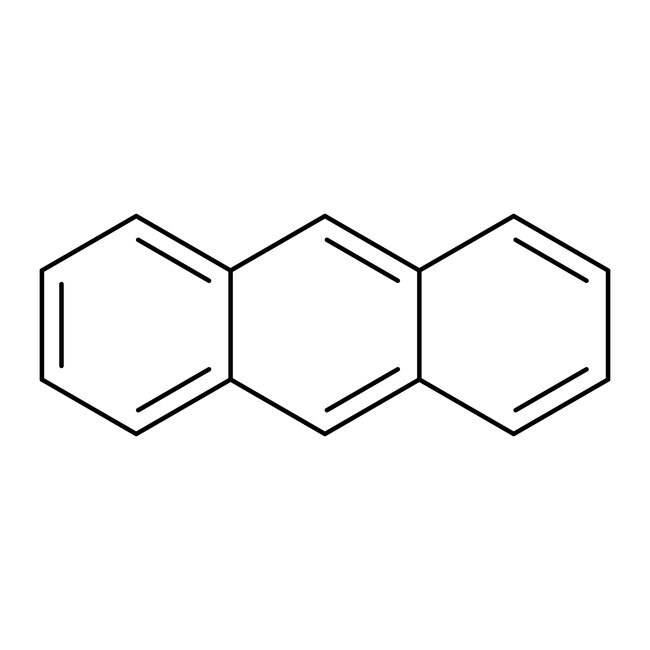
Anthracen, 97 %
CAS: 120-12-7 | C14H10 | 178.23 g/mol
Have Questions?
Ansicht ändern



Katalognummer A17261.0I
auch als A17261-0I bezeichnet
Preis (EUR)
790,00
Each
Menge:
5000 g
Preis (EUR)
790,00
Each
Chemikalien-Kennzeichnungen
CAS120-12-7
IUPAC Nameanthracene
Molecular FormulaC14H10
InChI KeyMWPLVEDNUUSJAV-UHFFFAOYSA-N
SMILESC1=CC2=CC3=CC=CC=C3C=C2C=C1
Mehr anzeigen
Specifications Datenblatt
Appearance (Color)Pale cream to cream to yellow to green to pale brown to black
FormCrystals or powder or crystalline powder
Assay (HPLC)≥96.0%
Identification (FTIR)Conforms
Melting Point (clear melt)213.0-222.0?C
This Thermo Scientific Chemicals brand product was originally part of the Alfa Aesar product portfolio. Some documentation and label information may refer to the legacy brand. The original Alfa Aesar product / item code or SKU reference has not changed as a part of the brand transition to Thermo Scientific Chemicals.
Suitable for battery materials development.
Anwendungen
Anthracen wird als Quelle von Farbstoffen verwendet und an der Herstellung von rotem Farbstoff Alizarin beteiligt. Es handelt sich um einen organischen Halbleiter, der als Szintillator für Detektoren von Photonen mit hoher Energie, Elektronen und Alfa-Partikeln verwendet wird. Es wird mit Polyvinyltoluol dotiert, um Kunststoffszintillationsgerät herzustellen. Darüber hinaus wird es bei der Herstellung von Anthrachinon, Holzkonservierungsmitteln, Beschichtungsmaterialien und Pigmenten verwendet. Darüber hinaus wird es zur Herstellung von 1-Hydroxyanthracol, 2-Hydroxyanthracol und in 9,10-Dihydroxyanthracol verwendet.
Löslichkeit
Löslich in Methanol, Benzol, Chloroform, Ether, Kohlenstoffdisulfid, Kohlenstofftetrachlorid und Toluol. Schwer löslich in Aceton. Unlöslich in Wasser.
Hinweise
Lichtempfindlich. Nicht kompatibel mit starken Oxidationsmitteln und Hypochloriten.
RUO – Research Use Only
Allgemeine Referenzen:
- Malkondu, S.; Turhan, D.; Kocak, A. Copper(II)-directed static excimer formation of an anthracene-based highly selective fluorescent receptor. Tetrahedron Lett. 2015, 56 (1), 162-167.
- Ma, Z.; Yang, F.; Wang, Z.; Jia, X. Mechanically induced color change based on the chromophores of anthracene and rhodamine 6G. Tetrahedron Lett. 2015, 56 (2), 393-396.