Search
 Elementsuche
 Struktursuche

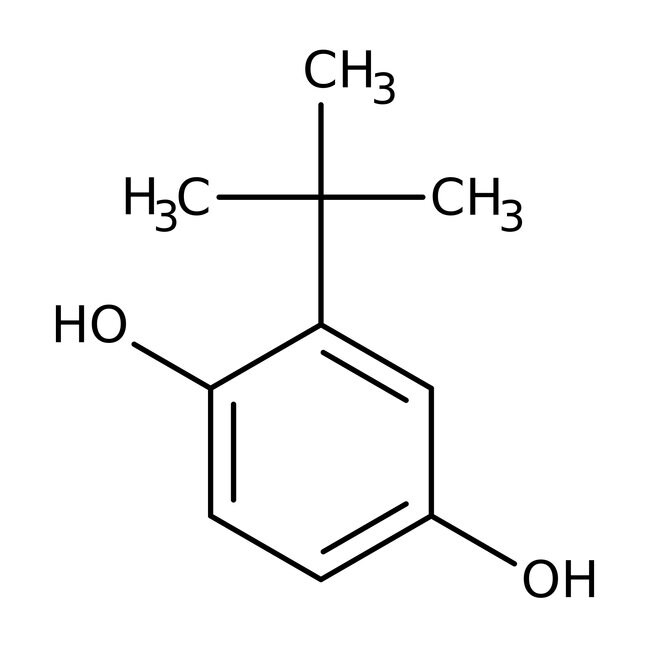

tert-Butylhydrochinon 97 %, Thermo Scientific Chemicals
Have Questions?
Ansicht ändern



Katalognummer A19206.36
auch als A19206-36 bezeichnet
Preis (EUR)
118,00
Each
Menge:
500 g
Preis (EUR)
118,00
Each
Chemikalien-Kennzeichnungen
CAS1948-33-0
IUPAC Name2-tert-butylbenzene-1,4-diol
Molecular FormulaC10H14O2
InChI KeyBGNXCDMCOKJUMV-UHFFFAOYSA-N
SMILESCC(C)(C)C1=CC(O)=CC=C1O
Mehr anzeigen
Specifications Datenblatt
Assay (GC)≥96.0% (UK-sourced material)
Appearance (Color)White to cream
CommentMaterial sourced in UK and US
Identification (FTIR)Conforms (UK-sourced material)
FormCrystals or powder or crystalline powder
Mehr anzeigen
This Thermo Scientific Chemicals brand product was originally part of the Alfa Aesar product portfolio. Some documentation and label information may refer to the legacy brand. The original Alfa Aesar product / item code or SKU reference has not changed as a part of the brand transition to Thermo Scientific Chemicals.
Suitable for battery materials development.
Anwendungen
TBHQ wurde zur Untersuchung der Inaktivierung von barotoleranten Stämmen von Listeria monocytogenes und Escherichia coli verwendet. Umweltfreundliche Elektrodenmaterialien für Superkondensatoren wurden durch die Beschichtung der Oberfläche von Graphen-Nanosheets mit TBHQ erreicht. TBHQ wird häufig als Konservierungsmittel für Lebensmittel verwendet. Hemmt die oxidative Ranzigkeit in gefrorenen gekochten Fischflocken durch tert-Butylhydrochinon. Die Aktivierung des nukleären Faktor E2-bezogenen Faktors 2-abhängigen Antioxidans-Response-Elements erfolgt durch tert-Butylhydrochinone, das bevorzugt in Astrozyt-Zuständen auftritt.
Löslichkeit
Schwer löslich in Wasser (10 g/l).
Hinweise
Kühl lagern. Behälter an einem trockenen und gut belüfteten Ort dicht verschlossen halten. Von starken Oxidationsmitteln fernhalten.
RUO – Research Use Only
Allgemeine Referenzen:
- Andrew D. Kraft,; Delinda A. Johnson,; Jeffrey A. Johnson. Nuclear Factor E2-Related Factor 2-Dependent Antioxidant Response Element Activation by tert-Butylhydroquinone and Sulforaphane Occurring Preferentially in Astrocytes Conditions Neurons against Oxidative Insult . Zeitschriftenname. 2004 , 24(5), 1101-1112.
- Yoon-Kyung Chung,; Ahmed E Yousef. Inactivation of barotolerant strains of Listeria monocytogenes and Escherichia coli O157:H7 by ultra high pressure and tert-butylhydroquinone combination.. Journal of Microbiology. 2008, 46 (3), 289-294.