Search
 Elementsuche
 Struktursuche


Thermo Scientific Chemicals
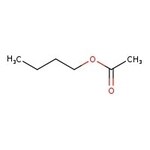
n-Butylacetat, 99%, Thermo Scientific Chemicals
CAS: 123-86-4 | C6H12O2 | 116.16 g/mol
Have Questions?
Ansicht ändern



Katalognummer A19412.0F
auch als A19412-0F bezeichnet
Preis (EUR)
49,65
Exklusiv online
55,50Ersparnis 5,85 (11%)
Each
Menge:
2500 mL
Preis (EUR)
49,65
Exklusiv online
55,50Ersparnis 5,85 (11%)
Each
Chemikalien-Kennzeichnungen
CAS123-86-4
IUPAC Namebutyl acetate
Molecular FormulaC6H12O2
InChI KeyDKPFZGUDAPQIHT-UHFFFAOYSA-N
SMILESCCCCOC(C)=O
Mehr anzeigen
Specifications Datenblatt
DatenblattAssay (GC)≥99.0%
Appearance (Color)Clear colorless
Identification (FTIR)Conforms
FormLiquid
Refractive Index1.3930 -1.3960 @ 20?C
n-Butyl acetate is widely used as a solvent for cellulose nitrate, resins, polymers, oils and fats. It is used in paints, coatings, printing inks, aerosol sprays and cosmetics. It is used as a synthetic fruit flavoring agent in foods like candy, ice cream, cheeses and baked food items. In pharmaceutical and petroleum industries, it is used for extraction and as a processing solvent. It is an ingredient of cleaners, essences and fragrances. It is used as an analytical reagent to verify thalium, stannum and tungsten as well as in the determination of molybdenum and rhenium.
This Thermo Scientific Chemicals brand product was originally part of the Alfa Aesar product portfolio. Some documentation and label information may refer to the legacy brand. The original Alfa Aesar product / item code or SKU reference has not changed as a part of the brand transition to Thermo Scientific Chemicals.
Anwendungen
n-Butylacetat wird häufig als Lösungsmittel für Cellulosenitrat, Harze, Polymere, Öle und Fette verwendet. Wird in Farben, Beschichtungen, Druckfarben, Aerosolsprays und Kosmetika verwendet. Wird als synthetisches Fruchtaromamittel in Lebensmitteln wie Süßigkeiten, Speiseeis, Käse und Backwaren verwendet. In der Pharma- und Petroleumindustrie Verwendung zur Extraktion und als Verarbeitungslösungsmittel verwendet. Ist ein Bestandteil von Reinigungsmitteln, Geschmacksstoffen und Duftstoffen. Es wird als analytisches Reagenz zur Verifizierung von Thalium, metallischem Zinn und Wolfram sowie zur Bestimmung von Molybdän und Rhenium verwendet.
Löslichkeit
Mischbar mit Ethanol, Ethylether, Alkohol, Aceton, Chloroform und den meisten Kohlenwasserstoffen. Leicht mit Wasser mischbar.
Hinweise
Nicht kompatibel mit starken Oxidationsmitteln, starken Reduktionsmitteln und starken Basen.
n-Butylacetat wird häufig als Lösungsmittel für Cellulosenitrat, Harze, Polymere, Öle und Fette verwendet. Wird in Farben, Beschichtungen, Druckfarben, Aerosolsprays und Kosmetika verwendet. Wird als synthetisches Fruchtaromamittel in Lebensmitteln wie Süßigkeiten, Speiseeis, Käse und Backwaren verwendet. In der Pharma- und Petroleumindustrie Verwendung zur Extraktion und als Verarbeitungslösungsmittel verwendet. Ist ein Bestandteil von Reinigungsmitteln, Geschmacksstoffen und Duftstoffen. Es wird als analytisches Reagenz zur Verifizierung von Thalium, metallischem Zinn und Wolfram sowie zur Bestimmung von Molybdän und Rhenium verwendet.
Löslichkeit
Mischbar mit Ethanol, Ethylether, Alkohol, Aceton, Chloroform und den meisten Kohlenwasserstoffen. Leicht mit Wasser mischbar.
Hinweise
Nicht kompatibel mit starken Oxidationsmitteln, starken Reduktionsmitteln und starken Basen.
RUO – Research Use Only
Allgemeine Referenzen:
- Luis, P.; Van der Bruggen, B.: The driving force as key element to evaluate the pervaporation performance of multicomponent mixtures. Sep. Purif. Technol. 2015, 148, 94-102.
- Mochalski, P.; Theurl, M.; Sponring, A.; Unterkofler, K.; Kirchmair, R.; Amann, A. Analysis of Volatile Organic Compounds Liberated and Metabolised by Human Umbilical Vein Endothelial Cells (HUVEC) In Vitro. Cell Biochem. Biophys. 2015, 71 (1), 323-329.