Search

Applied Biosystems™
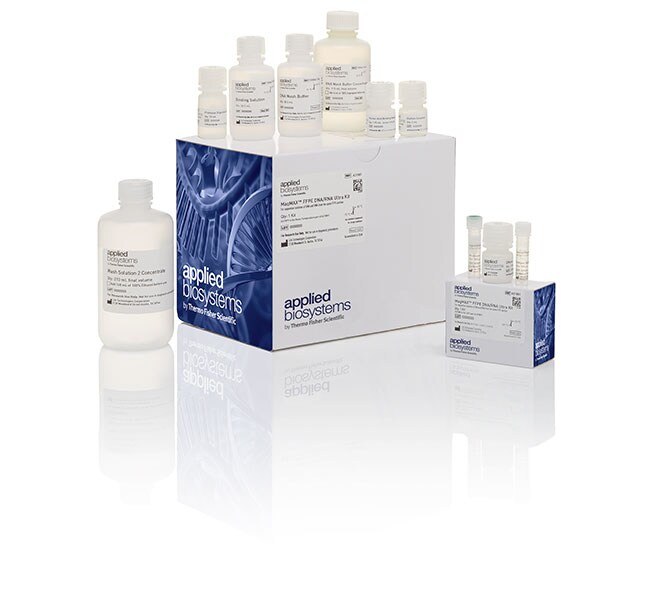
MagMAX™ FFPE DNA/RNA Ultra Kit
The MagMAX™ FFPE DNA/RNA Ultra Kit is designed for sequential isolation of DNA and RNA from the same formaldehyde- orRead more
| Catalog Number | Quantity |
|---|---|
| A31881 | 1 kit |
Catalog number A31881
Price (USD)
894.00
Each
Quantity:
1 kit
Price (USD)
894.00
Each
The MagMAX™ FFPE DNA/RNA Ultra Kit is designed for sequential isolation of DNA and RNA from the same formaldehyde- or paraformaldehyde-fixed paraffin-embedded (FFPE) tissue sample. The DNA and RNA are recovered in separate eluates, and both are compatible with a broad range of applications, including real-time PCR and next-generation sequencing. The isolation of RNA and DNA from the same FFPE sample makes this kit an ideal method of sample preparation for Oncomine™ Comprehensive and Oncomine™ Focus assays.
Features of the MagMAX FFPE DNA/RNA Ultra Kit include:
• Flexible design that permits both manual and automated isolation of RNA and DNA
• Minimal requirement of 5 μm section or curl input
• Capable of processing 40 μm FFPE sections or curls; greater than 40 μm sections can be processed with an alternative protocol
• Compatible with targeted RNA and DNA sequencing panels
• Contains Dynabeads™ MyOne™ Silane for consistent isolation of RNA, microRNA, and DNA
• Alternative protocols for the isolation of RNA or DNA only
Unlocking the information contained in FFPE samples is essential to cancer research. Common nucleic acid isolation methods require you to choose which nucleic acid to recover from a given sample, with loss of the other nucleic acid (and any information that may have resulted from its analysis). Alternatively, the DNA and RNA are co-purified, or the sample is split in half so that each can be purified.
More information from less sample input
The MagMAX FFPE DNA/RNA Ultra Kit protocol addresses these issues by first isolating DNA from the FFPE sample and then recovering the RNA from the DNA-depleted supernatant. The nucleic acids are prepared as separate eluates and are then ready for downstream analysis. This allows for a fuller analysis of precious samples, including investigation of important biomarkers, such as hotspot mutations, CNVs, gene fusions, and indels.
Benefits of MagMAX magnetic bead–based purification
The magnetic bead–based purification format of the kit allows for easy scaling of the number of samples processed either manually with a magnetic stand or with a magnetic particle processor such as the KingFisher™ Duo Prime or KingFisher™ Flex processor.
Magnetic beads offer many benefits compared to other technologies for isolating nucleic acids. Beads bind the RNA and DNA more efficiently than glass fiber filters, resulting in higher and more consistent yields. Additionally, because filters and vacuum manifolds are not used, there is no risk of undigested tissue particulates clogging these items during the extraction process. This clogging issue is of particular concern with fibrous FFPE tissue samples that that are not fully digested during the proteinase K treatment.
Optimized bead surface chemistry
The Dynabeads MyOne Silane utilized in the MagMAX FFPE DNA/RNA Ultra Kit have an optimized silica-like surface chemistry with high specific surface area that allows efficient kinetics and high sensitivity in nucleic acid capture. These aspects make Dynabeads MyOne Silane ideal for the recovery of both RNA and DNA targets found in FFPE samples. Once captured, both of these nucleic acids are then eluted separately in volumes of 50 μL and are ready for downstream applications.
Features of the MagMAX FFPE DNA/RNA Ultra Kit include:
• Flexible design that permits both manual and automated isolation of RNA and DNA
• Minimal requirement of 5 μm section or curl input
• Capable of processing 40 μm FFPE sections or curls; greater than 40 μm sections can be processed with an alternative protocol
• Compatible with targeted RNA and DNA sequencing panels
• Contains Dynabeads™ MyOne™ Silane for consistent isolation of RNA, microRNA, and DNA
• Alternative protocols for the isolation of RNA or DNA only
Unlocking the information contained in FFPE samples is essential to cancer research. Common nucleic acid isolation methods require you to choose which nucleic acid to recover from a given sample, with loss of the other nucleic acid (and any information that may have resulted from its analysis). Alternatively, the DNA and RNA are co-purified, or the sample is split in half so that each can be purified.
More information from less sample input
The MagMAX FFPE DNA/RNA Ultra Kit protocol addresses these issues by first isolating DNA from the FFPE sample and then recovering the RNA from the DNA-depleted supernatant. The nucleic acids are prepared as separate eluates and are then ready for downstream analysis. This allows for a fuller analysis of precious samples, including investigation of important biomarkers, such as hotspot mutations, CNVs, gene fusions, and indels.
Benefits of MagMAX magnetic bead–based purification
The magnetic bead–based purification format of the kit allows for easy scaling of the number of samples processed either manually with a magnetic stand or with a magnetic particle processor such as the KingFisher™ Duo Prime or KingFisher™ Flex processor.
Magnetic beads offer many benefits compared to other technologies for isolating nucleic acids. Beads bind the RNA and DNA more efficiently than glass fiber filters, resulting in higher and more consistent yields. Additionally, because filters and vacuum manifolds are not used, there is no risk of undigested tissue particulates clogging these items during the extraction process. This clogging issue is of particular concern with fibrous FFPE tissue samples that that are not fully digested during the proteinase K treatment.
Optimized bead surface chemistry
The Dynabeads MyOne Silane utilized in the MagMAX FFPE DNA/RNA Ultra Kit have an optimized silica-like surface chemistry with high specific surface area that allows efficient kinetics and high sensitivity in nucleic acid capture. These aspects make Dynabeads MyOne Silane ideal for the recovery of both RNA and DNA targets found in FFPE samples. Once captured, both of these nucleic acids are then eluted separately in volumes of 50 μL and are ready for downstream applications.
For Research Use Only. Not for use in diagnostic procedures.
Specifications
For Use With (Application)Next-Generation Sequencing, RT-PCR (Endpoint), Real-Time PCR, PCR, microRNA Analysis
High-throughput CompatibilityHigh Throughput Compatibility
Product LineMagMAX
Product TypeFFPE DNA/RNA Ultra Kit
Quantity1 kit
Sample TypeFFPE, Fixed Samples
Shipping ConditionApproved for shipment at Room Temperature or on Wet or Dry Ice
TargetTotal RNA, miRNA, Total Nucleic Acids, Genomic DNA, mRNA, Transcriptome RNA
FormatKit
Isolation TechnologyMagnetic Bead
Unit SizeEach
Contents & Storage
• 1 x 385 μL Protease, Store at -5 to -30°C
• 1 x 10 mL Protease Digestion Buffer, Store at Room Temperature
• 1 x 38.5 mL Binding Solution, Store at Room Temperature
• 1 x 1.95 mL Nucleic Acid Binding Beads, Store at 2°C to 8°C
• 1 x 38.5 mL DNA Wash Buffer, Store at Room Temperature
• 1 x 210 mL Wash Solution 2 Concentrate, Store at Room Temperature
• 1 x 5 mL Elution Solution, Store at Room Temperature
• 1 x 115 mL RNA Wash Buffer Concentrate, Store at Room Temperature
• 1 x 1.92 mL DNase, Store at -5 to -30°C
• 1 x 960 μL DNase Buffer, Store at -5 to -30°C
• 1 x 10 mL Protease Digestion Buffer, Store at Room Temperature
• 1 x 38.5 mL Binding Solution, Store at Room Temperature
• 1 x 1.95 mL Nucleic Acid Binding Beads, Store at 2°C to 8°C
• 1 x 38.5 mL DNA Wash Buffer, Store at Room Temperature
• 1 x 210 mL Wash Solution 2 Concentrate, Store at Room Temperature
• 1 x 5 mL Elution Solution, Store at Room Temperature
• 1 x 115 mL RNA Wash Buffer Concentrate, Store at Room Temperature
• 1 x 1.92 mL DNase, Store at -5 to -30°C
• 1 x 960 μL DNase Buffer, Store at -5 to -30°C