Search
 Elementsuche
 Struktursuche



Thermo Scientific Chemicals
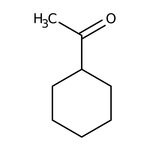
Cyclohexylmethylketon, 95 %, Thermo Scientific Chemicals
CAS: 823-76-7 | C8H14O | 126.199 g/mol
Have Questions?
Ansicht ändern



Katalognummer B21000.14
auch als B21000-14 bezeichnet
Preis (EUR)
121,00
Each
Menge:
25 g
Preis (EUR)
121,00
Each
Chemikalien-Kennzeichnungen
CAS823-76-7
IUPAC Name1-cyclohexylethan-1-one
Molecular FormulaC8H14O
InChI KeyRIFKADJTWUGDOV-UHFFFAOYSA-N
SMILESCC(=O)C1CCCCC1
Mehr anzeigen
Specifications Datenblatt
Refractive Index1.4480-1.4540 @ 20?C
Assay (GC)≥94.0%
Appearance (Color)Clear colorless to pale yellow
FormLiquid
Identification (FTIR)Conforms
It can be used to produce acetoxycyclohexane. It is also used as a pharmaceutical intermediate.
This Thermo Scientific Chemicals brand product was originally part of the Alfa Aesar product portfolio. Some documentation and label information may refer to the legacy brand. The original Alfa Aesar product / item code or SKU reference has not changed as a part of the brand transition to Thermo Scientific Chemicals.
Anwendungen
Es kann zur Herstellung von Acetoxycyclohexan verwendet werden. Es wird auch als pharmazeutisches Zwischenprodukt verwendet.
Löslichkeit
Nicht mischbar oder schwer in Wasser mischbar.
Hinweise
Nicht in der Nähe von Oxidationsmitteln und Basen lagern. Halten Sie den Behälter dicht verschlossen und stellen Sie ihn an einen kühlen, trockenen und gut belüfteten Ort.
RUO – Research Use Only
Allgemeine Referenzen:
- Bach RD. The role of acid catalysis in the Baeyer-Villiger reaction. A theoretical study.J Org Chem.201277(16), 6801-15.
- Thomas M. Bare and Herbert O. House. Methyl Ketones from Carboxylic Acids: Cyclohexyl Methyl Ketone.Org. Synth.
- Die Monobromierung von unsymmetrischen Ketonen am weniger substituierten Kohlenstoffatom in Methanol liefert Ergebnisse, die parallel zur Keimung des entsprechenden Acetals verlaufen, und führt in diesem Fall zu einer exklusiven Reaktion an der Methylgruppe: Org. Synth. Coll., 6, 193 (1988).