Search
 Elementsuche
 Struktursuche


Thermo Scientific Chemicals
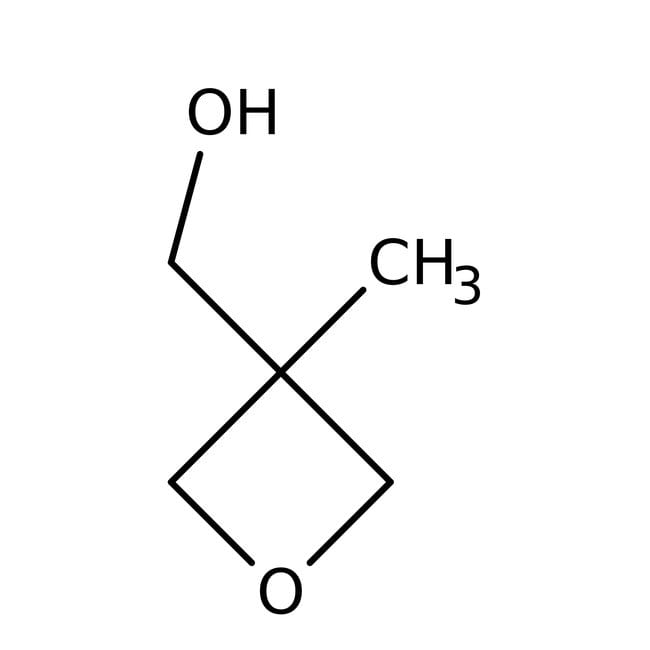
3-Methyl-3-oxetanmethanol, 97 %, Thermo Scientific Chemicals
CAS: 3143-02-0 | C5H10O2 | 102.133 g/mol
Have Questions?
Ansicht ändern



Katalognummer B25111.14
auch als B25111-14 bezeichnet
Preis (EUR)
64,30
Each
Menge:
25 g
Preis (EUR)
64,30
Each
Chemikalien-Kennzeichnungen
CAS3143-02-0
IUPAC Name(3-methyloxetan-3-yl)methanol
Molecular FormulaC5H10O2
InChI KeyNLQMSBJFLQPLIJ-UHFFFAOYSA-N
SMILESCC1(CO)COC1
Mehr anzeigen
Specifications Datenblatt
DatenblattAppearance (Color)Clear colorless
FormLiquid
Assay (GC)≥96.0%
Identification (FTIR)Conforms
Refractive Index1.4435-1.4485 @ 20?C
3-Methyl-3-oxetanemethanol has been used in the preparation of star-shaped copolymer consisting of a hyperbranched poly(3-methyl-3-oxetanemethanol) core and polytetrahydrofuran arms, pyridyl disulfide-functionalized cyclic carbonate monomer, required for the synthesis of of functional poly(ε-caprolactone) containing pendant pyridyl disulphide groups and δ-lactams. It is used to synthesize octahydroindole alkaloids and γ-butenolides.
This Thermo Scientific Chemicals brand product was originally part of the Alfa Aesar product portfolio. Some documentation and label information may refer to the legacy brand. The original Alfa Aesar product / item code or SKU reference has not changed as a part of the brand transition to Thermo Scientific Chemicals.
Anwendungen
3-Methyl-3-oxetanmethanol wurde zur Herstellung von sternförmigem Copolymer verwendet, das aus einem hochverzweigten Poly(3-methyl-3-oxetanmethanol)-Kern und Polytetrahydrofuran-Armen und Pyridyldisulfid-funktionalisiertem zyklischen Carbonatmonomer besteht, das für die Synthese von funktionellem Poly(ε-Caprolacton) erforderlich ist, das anhängende Pyridyl-Disulfidgruppen und δLactamgruppen enthält. Es wird zur Synthese von Oktahydroindol-Alkaloiden und γ-Butenoliden verwendet.
Löslichkeit
Löslich in Chloroform, Methanol.
Hinweise
Vor Wärme schützen. Von Oxidationsmitteln entfernt aufbewahren Bei 4 °C aufbewahren.
3-Methyl-3-oxetanmethanol wurde zur Herstellung von sternförmigem Copolymer verwendet, das aus einem hochverzweigten Poly(3-methyl-3-oxetanmethanol)-Kern und Polytetrahydrofuran-Armen und Pyridyldisulfid-funktionalisiertem zyklischen Carbonatmonomer besteht, das für die Synthese von funktionellem Poly(ε-Caprolacton) erforderlich ist, das anhängende Pyridyl-Disulfidgruppen und δLactamgruppen enthält. Es wird zur Synthese von Oktahydroindol-Alkaloiden und γ-Butenoliden verwendet.
Löslichkeit
Löslich in Chloroform, Methanol.
Hinweise
Vor Wärme schützen. Von Oxidationsmitteln entfernt aufbewahren Bei 4 °C aufbewahren.
RUO – Research Use Only
Allgemeine Referenzen:
- Jian Hou und Deyue Yan. Synthesis of a Star-Shaped Copolymer with a Hyperbranched Poly(3-methyl-3-oxetanemethanol) Core and Tetrahydrofuran Arms by One-Pot Copolymerization. Macromolecular Rapid Communications.2002, 23, 456-459.
- Bhooma Raghavan; Rodney L Johnson. Short stereoselective synthesis of alpha-substituted gamma-lactams. Journal of Organic Chemistry .2006, 71, (5), 2151-2154.
- Reagiert mit Nukleophilen, um 2-substituiertes 2-Methyl-1,3-propandiole zu liefern; z. B. liefern Dialkylamine bei Erwärmung unter Druck bei 180° 2-(N,N-Dialkylaminomethyl)-2 -methylpropan-1,3-diole und wässrige Wasserstoffhalogenide ergeben die entsprechenden 2-Halomethyl-Verbindungen: Liebigs Ann. Chem., 365 (1973).
- Wertvolles Schutzmittel für Carbonsäuren, eingeführt von Corey. Der Oxetanester, der aus dem Säurenchlorid gebildet wird, ordnet sich mit BF3-Etherat am gebrückten 2,6,7-Trioxabicyclo[2.2.2]oktan-[OBO]-Orthester, stabilen bis starken Basen und Nukleophilen, z. B. Grignards, neu an, wird jedoch problemlos durch leichte Säure und anschließender Verseifung des Esters gespalten: J. Am. Chem. Soc., 103, 4618 (1991); 106, 2735 (1984); Tetrahedron Lett., 23, 1651 (1982); 24, 5571 (1983); 27, 2199 (1986):