Search


Citations & References (7)
Invitrogen™
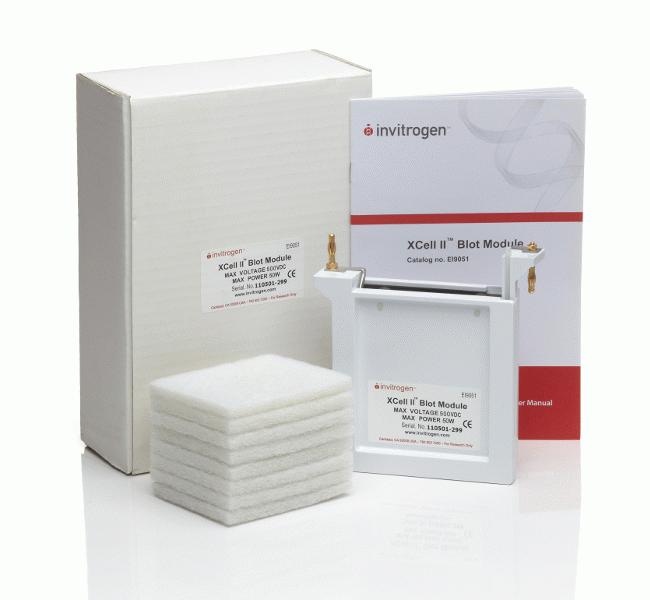
XCell II™ Blot Module
The XCell II Blot Module is a mini-gel wet-transfer module for the XCell SureLock or XCell II systems. The XCellRead more
| Catalog Number | Quantity |
|---|---|
| EI9051 | 1 unit |
Catalog number EI9051
Price (USD)
722.00
Each
Quantity:
1 unit
Price (USD)
722.00
Each
The XCell II Blot Module is a mini-gel wet-transfer module for the XCell SureLock or XCell II systems. The XCell II Blot Module allows you to easily transfer proteins or nucleic acids for western, southern, and northern transfers from mini gels to membranes with less than 200 mL of transfer buffer. Tough platinized titanium and stainless steel electrodes create a uniform electrical field without clamps or hinged gel holders. Maximum blot size is 9 cm x 9 cm.
See all available transfer systems ›
See all available transfer systems ›
For Research Use Only. Not for use in diagnostic procedures.
Specifications
CapacityUp to 2 mini-gels
For Use With (Equipment)XCell SureLock™ Mini and Mini Gel Tank
Gel SizeMini (8 cm x 8 cm)
Mode of TransferWet
Quantity1 unit
Running DimensionVertical
Shipping ConditionRoom Temperature
Gel CompatibilityBolt Bis-Tris Plus Gel, NuPAGE Gel, Novex Mini Gel
Product LineXCell II
Product TypeBlot Module
Unit SizeEach
Contents & Storage
The XCell II™ Blot Module includes anode core, cathode core, sponge pads (8/pack), and instruction manual.
Frequently asked questions (FAQs)
Are Bolt gels compatible with transfer devices from other suppliers?
How can I improve transfer efficiency for larger proteins during western blotting?
Do I have to run the XCell Blot Module under cold conditions?
How can I remove residual build-up in the XCell II Blot Module?
How can residual build-up in the XCell II Blot Module be removed?
Citations & References (7)
Citations & References
Abstract
Cercarial Elastase Is Encoded by a Functionally Conserved Gene Family across Multiple Species of Schistosomes.
Journal:J Biol Chem
PubMed ID:11986325
Water borne cercaria(ae) of the trematode genus Schistosoma rapidly penetrate host skin. A single serine protease activity, cercarial elastase, is deposited in advance of the invading parasite by holocytosis of vesicles from ten large acetabular gland cells. Cercarial elastase activity is a composite of multiple isoforms. Genes coding for the
Definition of genetically distinct attenuation mechanisms in naturally virulence-attenuated Listeria monocytogenes by comparative cell culture and molecular characterization.
Journal:Appl Environ Microbiol
PubMed ID:16000803
'Listeria monocytogenes is a foodborne pathogen able to cause serious disease in humans and animals. Not all isolates are equally pathogenic, however, and several isolates have been characterized as naturally virulence attenuated. We sought to identify the genetic basis of natural virulence attenuation using cell culture assays and molecular techniques.
Combined effect of epinephrine and exercise on calpain/calpastatin and cathepsin B and L activity in porcine longissimus muscle.
Journal:J Anim Sci
PubMed ID:10492449
The objective of the study was to improve the understanding of the relationship between the effect of epinephrine plus exercise and meat tenderness. The calpain, calpastatin, and cathepsin B + L activities and postmortem proteolysis in porcine longissimus muscle were studied. The muscle glycogen stores were depleted in five pigs
Regulation of the mitogen-activated protein kinase p44 ERK activity during anoxia/recovery in rainbow trout hypodermal fibroblasts.
Journal:J Exp Biol
PubMed ID:16621957
It is well known from various mammalian cells that anoxia has a major impact on the mitogen-activated protein kinase ERK, but a possible similar effect in fish cells has not been investigated. Here we characterise a p44ERK-like protein in the rainbow trout cell line RTHDF and study the effect of
Separate basic region motifs within the adeno-associated virus capsid proteins are essential for infectivity and assembly.
Journal:J Virol
PubMed ID:16699000
Adeno-associated virus (AAV) is gaining momentum as a gene therapy vector for human applications. However, there remain impediments to the development of this virus as a vector. One of these is the incomplete understanding of the biology of the virus, including nuclear targeting of the incoming virion during initial infection,