Search
 Elementsuche
 Struktursuche



Thermo Scientific Chemicals
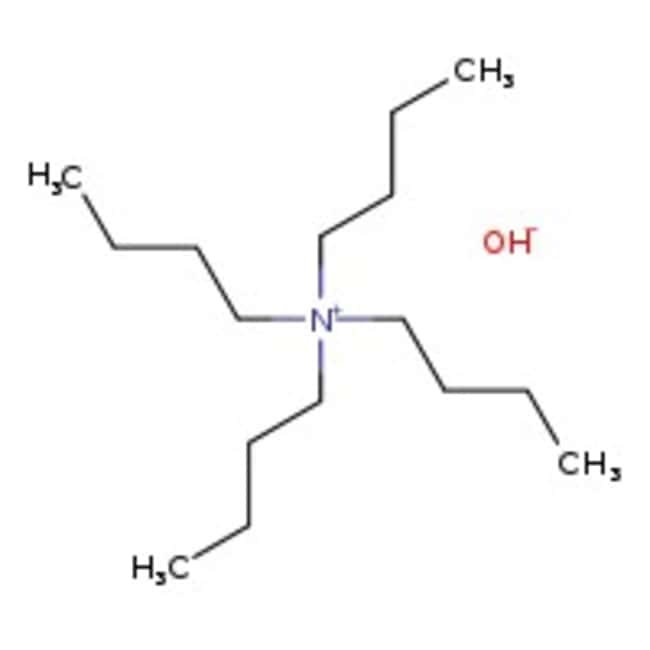
Tetra-n-Butylammoniumhydroxid, 1.0M in Methanol, Thermo Scientific Chemicals
CAS: 2052-49-5 | C16H37NO | 259.48 g/mol
Have Questions?
Ansicht ändern






Katalognummer L08164.AE
auch als L08164-AE bezeichnet
Preis (EUR)
77,30
Each
Menge:
100 mL
Preis (EUR)
77,30
Each
Chemikalien-Kennzeichnungen
CAS2052-49-5
IUPAC Nametetrabutylazanium hydroxide
Molecular FormulaC16H37NO
InChI KeyVDZOOKBUILJEDG-UHFFFAOYSA-M
SMILES[OH-].CCCC[N+](CCCC)(CCCC)CCCC
Mehr anzeigen
Specifications Datenblatt
Refractive Index1.3790-1.3890 @ 20°C
Appearance (Color)Clear colorless to yellow
Assay (Aqueous acid-base Titration)0.9 to 1.1M solution
FormLiquid
Tetra-n-butylammonium hydroxide, 1.0M in methanol is used as a strong base in organic chemistry. It is utilized under phase-transfer conditions to effect alkylation and deprotonation.
This Thermo Scientific Chemicals brand product was originally part of the Alfa Aesar product portfolio. Some documentation and label information may refer to the legacy brand. The original Alfa Aesar product / item code or SKU reference has not changed as a part of the brand transition to Thermo Scientific Chemicals.
Anwendungen
Tetra-n-Butylammoniumhydroxid,1.0 M in Methanol wird als starke Base in der organischen Chemie verwendet. Es wird unter Phasenübertragungsbedingungen zur Alkylierung und Deprotonierung eingesetzt.
Löslichkeit
Mischbar mit gängigen organischen Lösungsmitteln.
Hinweise
Luftempfindlich und hygroskopisch. Nicht kompatibel mit starken Säuren und korrodiert Metall.
RUO – Research Use Only
Allgemeine Referenzen:
- Li, S. H.; Li, Z. J.; Nakagawa, T.; Ryan, J. W.; Matsuo, Y.; Gao, X. Approach to High Open-Circuit Voltage in Organic Solar Cells Utilizing a Structural Change of the Oxazolino-C70 Derivative. Chem. Eur. J. 2015, 21 (5), 1894-1899.
- Ou, Z.; Meng, D.; Yuan, M.; Huang, W.; Fang, Y.; Kadish, K. M. Deprotonation Reactions and Electrochemistry of Substituted Open-Chain Pentapyrroles and Sapphyrins in Basic Nonaqueous Media. J. Phys. Chem. B 2013, 117 (43), 13646-13657.