Search
 Elementsuche
 Struktursuche


Thermo Scientific Chemicals
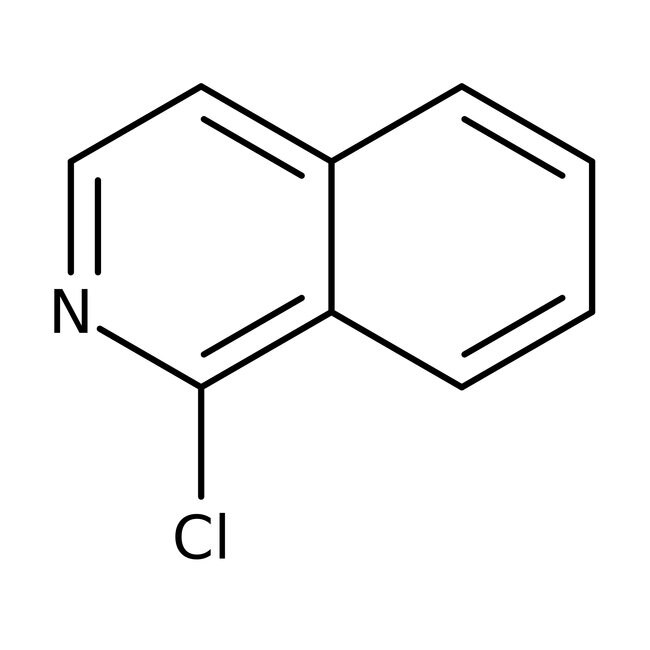
1-Chlorisochinolin, 95 %, Thermo Scientific Chemicals
CAS: 19493-44-8 | C9H6ClN | 163.604 g/mol
Have Questions?
Ansicht ändern



Katalognummer L17831.06
auch als L17831-06 bezeichnet
Preis (EUR)
107,00
Each
Menge:
5 g
Preis (EUR)
107,00
Each
Chemikalien-Kennzeichnungen
CAS19493-44-8
IUPAC Name1-chloroisoquinoline
Molecular FormulaC9H6ClN
InChI KeyMSQCQINLJMEVNJ-UHFFFAOYSA-N
SMILESClC1=C2C=CC=CC2=CC=N1
Mehr anzeigen
Specifications Datenblatt
DatenblattAppearance (Color)Pale yellow to yellow to orange to brown
Assay (GC)≥94.0%
Melting Point (clear melt)27.0-39.0?C
FormCrystals or powder or crystalline powder or fused solid
The product has been used in a Mn-catalyzed cross-coupling with aryl- and alkylmagnesium halides. It has also been used in a Pd-catalyzed cross-coupling with heteroaryl boronic acids and esters. Furthermore, it has been used in a homocoupling reaction to yield bis-isoquinoline, each enantiomer of which might be very useful as a chiral ligand for asymmetric synthesis. 1-Chloroisoquinone is used in the preparation of new aminoisoquinolinylurea derivatives which show antiproliferative activity against melanoma cell lines. It can also be applied to the control of storage age and stability of unstable boronic acids.
This Thermo Scientific Chemicals brand product was originally part of the Alfa Aesar product portfolio. Some documentation and label information may refer to the legacy brand. The original Alfa Aesar product / item code or SKU reference has not changed as a part of the brand transition to Thermo Scientific Chemicals.
Anwendungen
Das Produkt wurde in einer Mn-katalysierten Kreuzkopplung mit Aryl- und Alkylmagnesiumhalogeniden eingesetzt. Wurde auch in einer Pd-katalysierten Kreuzkopplung mit Heteroarylboronsäuren und Estern verwendet. Wurde darüber hinaus in einer Homokupplungsreaktion zur Ausbeute von Bis-Isochinolin verwendet, von denen jedes Enantiomer als chiraler Ligand für die asymmetrische Synthese sehr nützlich sein könnte. 1-Chloroisochinon wird bei der Herstellung neuer Aminoisochinolinylharnstoff-Derivate verwendet, die eine antiproliferative Aktivität gegen Melanomzelllinien aufweisen. Kann auch zur Kontrolle des Lagerungsalters und der Stabilität instabiler Boronsäuren eingesetzt werden.
Löslichkeit
Unlöslich in Wasser.
Hinweise
Von Oxidationsmitteln entfernt aufbewahren Halten Sie den Behälter dicht verschlossen und stellen Sie ihn an einen kühlen, trockenen und gut belüfteten Ort.
Das Produkt wurde in einer Mn-katalysierten Kreuzkopplung mit Aryl- und Alkylmagnesiumhalogeniden eingesetzt. Wurde auch in einer Pd-katalysierten Kreuzkopplung mit Heteroarylboronsäuren und Estern verwendet. Wurde darüber hinaus in einer Homokupplungsreaktion zur Ausbeute von Bis-Isochinolin verwendet, von denen jedes Enantiomer als chiraler Ligand für die asymmetrische Synthese sehr nützlich sein könnte. 1-Chloroisochinon wird bei der Herstellung neuer Aminoisochinolinylharnstoff-Derivate verwendet, die eine antiproliferative Aktivität gegen Melanomzelllinien aufweisen. Kann auch zur Kontrolle des Lagerungsalters und der Stabilität instabiler Boronsäuren eingesetzt werden.
Löslichkeit
Unlöslich in Wasser.
Hinweise
Von Oxidationsmitteln entfernt aufbewahren Halten Sie den Behälter dicht verschlossen und stellen Sie ihn an einen kühlen, trockenen und gut belüfteten Ort.
RUO – Research Use Only
Allgemeine Referenzen:
- Kelvin Billingsley and Stephen L Buchwald. Highly efficient monophosphine-based catalyst for the palladium-catalyzed suzuki-miyaura reaction of heteroaryl halides and heteroaryl boronic acids and esters.J. Am. Chem. Soc.,2007,129 (11), 3358-3366.
- Chang, et al. Homocoupling of aryl iodides and bromides using a palladium/indium bimetallic system.Synth. Commun.,2005,35(13), 1851-1857.