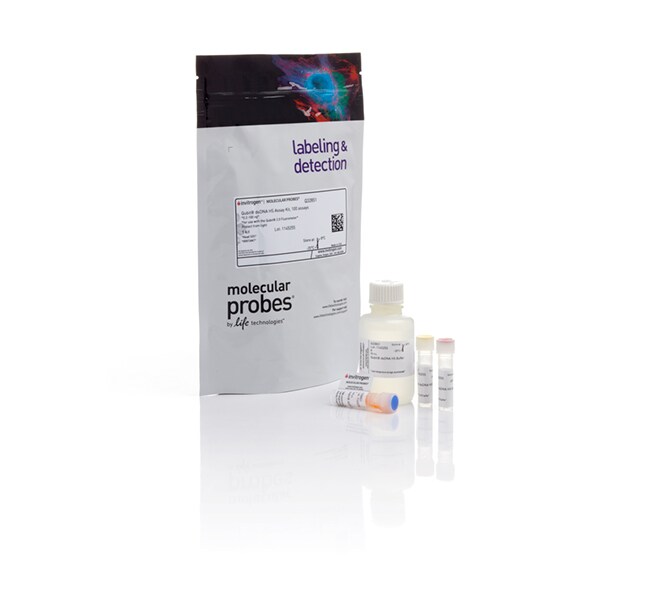
Qubit™ dsDNA BR Assaykit
Invitrogen™

Qubit™ dsDNA BR Assaykit

Für den hochselektiven Nachweis von dsDNA über RNA, auch bei Vorhandensein von Kontaminanten. Die Qubit dsDNA Assay-Kits sind von 10 pg/ul bis 100 ng/ul und von 100 pg/ul bis 1.000 ng/ul genau.
Have Questions?
Ansicht ändernbuttonViewtableView
KatalognummerMengeAssayBestimmungsbereich
Q32851100 AssaysdsDNA-Quantifizierung, hohe Empfindlichkeit0,1 bis 120 ng
Q32850100 AssaysdsDNA-Quantifizierung, breites Spektrum4 bis 2000 ng
Q32854500 AssaysdsDNA-Quantifizierung, hohe Empfindlichkeit0,1 bis 120 ng
Q32853500 AssaysdsDNA-Quantifizierung, breites Spektrum4 bis 2000 ng
Katalognummer Q32851
Preis (EUR)
140,65
Exklusiv online
162,00
Ersparnis 21,35 (13%)
Each
Zum Warenkorb hinzufügen
Menge:
100 Assays
Assay:
dsDNA-Quantifizierung, hohe Empfindlichkeit
Bestimmungsbereich:
0,1 bis 120 ng
Preis (EUR)
140,65
Exklusiv online
162,00
Ersparnis 21,35 (13%)
Each
Zum Warenkorb hinzufügen
Mit Qubit dsDNA-HS (High Sensitivity)- und Qubit dsDNA-BR (Broad Range)-Assay-Kits erzielen Sie eine genaue und präzise Quantifizierung von dsDNA. Diese dsDNA-Quantifizierungskits ermöglichen den schnellen und selektiven Nachweis von DNA-Proben mit niedriger und hoher Abundanz und können dsDNA von ssDNA, RNA, Protein und freien Nukleotiden unterscheiden. Kontaminanten wie Salze, Lösungsmittel oder Detergenzien werden gut toleriert.
Die für den Einsatz mit Qubit Fluorometern konzipierten Qubit dsDNA-HS- und BR-Assay-Kits sind für doppelsträngige DNA (dsDNA) über einzelsträngige DNA (ssDNA), RNA, Protein und freie Nukleotide hochgradig selektiv. Alle Kits enthalten ein konzentriertes Assay-Reagenz, Verdünnungspuffer und vorverdünnte DNA-Standards. Einfach das Reagenz mit dem im Lieferumfang enthaltenen Puffer verdünnen, die Probe zugeben (ein beliebiges Volumen zwischen 1 und 20 µl reicht aus) und die Konzentration mit dem Qubit Fluorometer auslesen.

Qubit dsDNA-HS-Assay-Kit
Das Qubit dsDNA-HS (High Sensitivity)-Assay-Kit bietet beim Einsatz mit dem Qubit Fluorometer eine genaue und selektive Methode für die Quantifizierung empfindlicher DNA-Proben. Je nach Probenvolumen ist das Assay-Kit für die genaue anfängliche DNA-Probenkonzentration von 0,005 bis 120 ng/µl ausgelegt und bietet 0,1 bis 120 ng Nachweisbereich.

Qubit dsDNA-BR-Assay-Kit
Das Qubit dsDNA-BR (Broad Range)-Assay-Kit bietet beim Einsatz mit dem Qubit Fluorometer eine präzise und selektive Methode für die Quantifizierung von DNA-Proben. Je nach Probenvolumen ist das Assay-Kit genau auf die anfängliche DNA-Probenkonzentration von 0,2 bis 2.000 ng/µl ausgelegt und bietet 4−2.000 ng Nachweisbereich.

Anmerkungen
• Qubit dsDNA-HS- und BR-Assay-Kits sind mit jedem Qubit Fluorometer
• verwendbar. Verwenden Sie dazu dünnwandige, durchsichtige 0,5 ml-PCR-Röhrchen (Best.- Nr. Q32856) für das Qubit 4 Fluorometer und 8 × 200 µl-Röhrchenstreifen (Bestell- -Nr. Q33252) für das Qubit Flex Fluorometer.

For Research Use Only. Not for use in diagnostic procedures.
Specifications
AssaydsDNA-Quantifizierung, hohe Empfindlichkeit
Anregung/Emission510/527
Zur Verwendung mit (Geräte)Qubit Fluorometer
Anzahl Reaktionen100 Reaktionen
ProduktlinieQubit
Bestimmungsbereich0,1 bis 120 ng
Menge100 Assays
VersandbedingungRaumtemperatur
NachweisverfahrenFluoreszenz
Unit SizeEach

Häufig gestellte Fragen (FAQ)

I'm seeing other kit-related problems besides the "Standards incorrect" message with my Qubit assay. What do you suggest I try?

Here are several suggestions:

1.View the raw fluorescence value (RFU) for the standards under “Check Standards” or “Check Calibration”. Confirm that the values for the samples fall between the values of the standards (or a little above the highest standard). If they do not, the sample is out of the accurate range of the assay. Refer to the confidence ranges for each assay in the product manuals. The readout in the assay will be to 2 significant figures instead of 3 if the assay sample is out of the high confidence range.
To bring the sample into the accurate range, dilute the sample or use more or less of it (for example, 10 µL instead of 2 µL if the sample reads low).

2.Check for temperature issues: The assay is temperature sensitive and the fluorescent signal can decrease at higher temperatures. Temperature fluctuations between samples, or between samples and standards, can cause problems. Make sure that the buffer and Qubit reagent in DMSO are at room temperature. The buffer and Qubit reagent should be stored at room temperature, not in the refrigerator. Even after 2-3 hours at room temperature, buffer previously stored at 4°C can remain below room temperature. Make sure your samples and working solution are not too warm (including those straight from a centrifuge). Samples kept in the Qubit instrument too long or read multiple times can warm up. If you want to perform multiple readings of a single tube, you should remove the tube from the instrument and let it equilibrate to room temperature for 30 seconds before taking another reading. Also, do not hold tubes in your hand for very long before reading them in the instrument, since this can warm the sample, resulting in a low reading.

3.Ensure that you have prepared the Qubit working solution correctly (1:200 dilution using the buffer provided in the kit). Ensure that you have prepared the standard tubes correctly (10 µL of each standard in 190 µL of the working solution). Ensure that the tubes are filled with at least 200 µL (both standards and samples).

4.Ensure that the reagents and standards you are using are less than 6 months old, and that the standards have been stored correctly. The Qubit reagent stock solution should be protected from light as much as possible.

5.Ensure that you have selected the correct assay on the Qubit Fluorometer for the Qubit assay you are performing.

6.Ensure that the lid is completely closed when reading standards and samples.

7.Use recommended tubes (both so the tube does not obstruct the lid, and for optical clarity). Some types of tubes can have high autofluorescence that will affect the assay.

8.Did you enter the number of microliters of stock you pipetted into the working solution into the Qubit instrument? If so, the reading after giving the Qubit Fluorometer this information is the concentration of your stock solution. If you did not, the reading you got is for the concentration in the assay tube (the tube you put into the Qubit Fluorometer) and not your stock solution.

9.If you are comparing Qubit assay results to concentration obtained by UV absorbance, and the concentration based on absorbance is significantly higher, it may be because of nucleic acid or protein contamination. The Qubit assays are much more specific for DNA, RNA, or protein than absorbance readings.

The value is decreasing over time when using the Qubit Fluorometer. What could be causing this?

Please see our suggestions below:

  • Make sure that you take your reading only after incubating for at least 2 minutes (15 minutes for protein).
  • If you leave the assay tube in the Qubit Fluorometer and take multiple readings, the readings will go down as the tube heats up inside the instrument. If you want to take multiple readings, remove the tube from the instrument, place it in a tube rack, and allow it to equilibrate to room temperature for at least 30 seconds before rereading the tube.
  • You may read the sample up to 3 hours after mixing if it is protected from light. After this time, the reading will not be accurate.
  • Keep standards and sample tubes in the dark and protected from light in between readings.

    Find additional tips, troubleshooting help, and resources within ourNucleic Acid Quantification Support Center.

  • I'm trying to quantify some DNA labeled with a fluorophore. Will this work?

    PicoGreen dye and other fluorescence-based quantification reagents are not recommended for quantifying dye-conjugated nucleic acids. The attached dye molecules can interfere with either binding and/or fluorescence output of the quantification reagents.

    Does DNA length have an effect on the dsDNA assays?

    Strands that are roughly in the 20-mer range or shorter show a lower level of signal. For dsDNA samples that are composed of mostly short strands, the reagent may still be used, but one should use a dsDNA standard that is of comparable length as the sample.

    Find additional tips, troubleshooting help, and resources within our Nucleic Acid Quantification Support Center.

    What is the difference between the Quant-iT PicoGreen DNA, Quant-iT DNA, and Qubit DNA assays?

    The Qubit Fluorometer contains highly optimized algorithms that calculate the concentration of the sample using either the Qubit assays or the Quant-iT DNA assays. The Quant-iT PicoGreen DNA assay may be adapted to the Qubit Fluorometer using the MyQubit firmware. The performance of all of these assays is similar.

    The Quant-iT PicoGreen DNA assay is the most established assay and the most general-purpose (http://tools.thermofisher.com/content/sfs/manuals/PicoGreen-dsDNA-protocol.pdf). It requires the dilution of the standard DNA and buffer but can be adapted for use with either cuvettes, microplates, or the NanoDrop 3300.

    The Quant-iT DNA assays provide a ready-to-use buffer and pre-diluted standard DNA for analyzing a large number of samples (>20 samples) using a 96-well microplate with no further adaptation.

    The Qubit assays (https://www.thermofisher.com/us/en/home/industrial/spectroscopy-elemental-isotope-analysis/molecular-spectroscopy/fluorometers/qubit/qubit-assays/myqubit.html) are intended for low throughput (<20 samples), and are only used on the Qubit Fluorometer.

    Find additional tips, troubleshooting help, and resources within our Nucleic Acid Quantification Support Center.

    Zitierungen und Referenzen (36)

    Zitierungen und Referenzen
    Abstract
    Tn5 transposase and tagmentation procedures for massively scaled sequencing projects.
    Authors:Picelli S, Björklund AK, Reinius B, Sagasser S, Winberg G, Sandberg R
    Journal:Genome Res
    PubMed ID:25079858
    Massively parallel DNA sequencing of thousands of samples in a single machine-run is now possible, but the preparation of the individual sequencing libraries is expensive and time-consuming. Tagmentation-based library construction, using the Tn5 transposase, is efficient for generating sequencing libraries but currently relies on undisclosed reagents, which severely limits development ... More
    High transcript level of fatty acid-binding protein 11 but not of very low-density lipoprotein receptor is correlated to ovarian follicle atresia in a teleost fish (Solea senegalensis).
    Authors:Agulleiro MJ, André M, Morais S, Cerdà J, Babin PJ,
    Journal:Biol Reprod
    PubMed ID:17554079
    'Transcripts encoding a fatty acid-binding protein (FABP), Fabp11, and two isoforms of very low-density lipoprotein receptor (Vldlr; vitellogenin receptor) were characterized from the ovary of Senegalese sole (Solea senegalensis). Phylogenetic analyses of vertebrate FABPs demonstrated that Senegalese sole Fabp11, as zebrafish (Danio rerio) homologous sequences, is part of a newly ... More
    [DNA extraction from coagulated human blood for application in genotyping techniques for human leukocyte antigen and immunoglobulin-like receptors].
    Authors:Cardozo DM, Guelsin GA, Clementino SL, Melo FC, Braga MA, Souza Cd, Moliterno RA, Visentainer JE,
    Journal:Rev Soc Bras Med Trop
    PubMed ID:20209349
    'The objective of this study was to standardize a method for extracting high-quality DNA from samples of coagulated blood. Forty-eight samples of human coagulated blood were used for DNA extraction by means of the EZ-DNA commercial kit (Biological Industries, Beit Haemek, Israel), the Neoscience column kit (One Lambda Inc., San ... More
    Prevalence of Toxoplasma gondii infection in stray and household cats in regions of Seoul, Korea.
    Authors:Lee SE, Kim JY, Kim YA, Cho SH, Ahn HJ, Woo HM, Lee WJ, Nam HW,
    Journal:Korean J Parasitol
    PubMed ID:20877509
    'The principal objective of this study was to investigate the prevalence of toxoplasmosis in household and stray cats in Seoul, Republic of Korea. We collected blood samples from 72 stray and 80 household cats, and all samples were examined by ELISA and nested PCR. The overall positive rates of Toxoplasma ... More
    Detection of autotrophic verrucomicrobial methanotrophs in a geothermal environment using stable isotope probing.
    Authors:Sharp CE, Stott MB, Dunfield PF,
    Journal:Front Microbiol
    PubMed ID:22912630
    Genomic analysis of the methanotrophic verrucomicrobium