Search

Invitrogen™
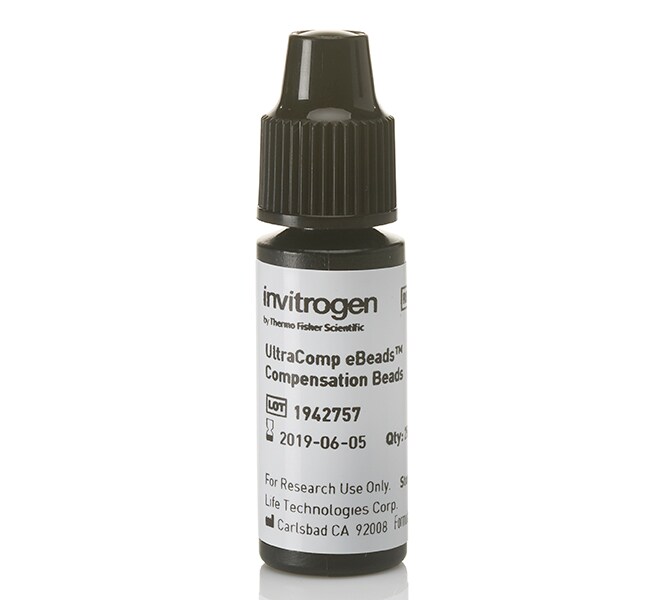
Ultracomp eBeads™ Kompensations-Beads
UltraComp eBeads™ reagieren mit Antikörpern, die von Mäusen, Ratten und Hamstern stammen, und sind unabhängig von Immunglobulin-Leichtketten. Sie wurden fürWeitere Informationen
Have Questions?
Ansicht ändern

| Katalognummer | Menge |
|---|---|
| 01-2222-42 | 100 Tests |
| 01-2222-41 | 25 Tests |
Katalognummer 01-2222-42
Preis (EUR)
416,00
Each
Menge:
100 Tests
Preis (EUR)
416,00
Each
UltraComp eBeads™ reagieren mit Antikörpern, die von Mäusen, Ratten und Hamstern stammen, und sind unabhängig von Immunglobulin-Leichtketten. Sie wurden für die Verwendung bei der Kompensation mit allen Fluorochromen entwickelt, die durch ultraviolette (355 nm), violette (405 nm), blaue (488 nm) grüne (532 nm), gelbgrüne (561 nm) und rote (633 – 640 nm) Laser angeregt werden. Diese Beads sind kugelförmige Partikel, die mit individuellen fluorochromkonjugierten Antikörpern für einfarbige Kompensationskontrollen gefärbt werden können.
Jeder Tropfen der Beads enthält zwei Populationen: eine positive Population, die jeden Mäuse-, Ratten- oder Hamsterantikörper einfängt, und eine negative Population, die nicht mit dem Antikörper reagiert. Wenn ein fluorochromkonjugierter Antikörper den Beads zugefügt wird, führt dies sowohl zu positiven als auch zu negativen Populationen. Diese bimodale Verteilung kann für einfarbige Kompensationskontrollen in Experimenten mit mehrfarbiger Durchflusszytometrie verwendet werden.
UltraComp eBeads sind kompatibel mit allen Fluorochromen, die durch einen ultravioletten (355 nm) oder violetten (405 nm) Laser angeregt werden. Sie müssen mit Standardfärbungspuffern verwendet werden, die PBS oder HBSS, Protein wie BSA oder FKS und Natriumazid enthalten. Es dürfen keine weiteren Zusatzstoffe verwendet werden. Weiterführende Hinweise erhalten Sie von der technischen Kundenbetreuung.
Reaktivität/Spezies
Hamster, Maus, Ratte
Berichtete Anwendung
Durchflusszytometrische Analyse
Jeder Tropfen der Beads enthält zwei Populationen: eine positive Population, die jeden Mäuse-, Ratten- oder Hamsterantikörper einfängt, und eine negative Population, die nicht mit dem Antikörper reagiert. Wenn ein fluorochromkonjugierter Antikörper den Beads zugefügt wird, führt dies sowohl zu positiven als auch zu negativen Populationen. Diese bimodale Verteilung kann für einfarbige Kompensationskontrollen in Experimenten mit mehrfarbiger Durchflusszytometrie verwendet werden.
UltraComp eBeads sind kompatibel mit allen Fluorochromen, die durch einen ultravioletten (355 nm) oder violetten (405 nm) Laser angeregt werden. Sie müssen mit Standardfärbungspuffern verwendet werden, die PBS oder HBSS, Protein wie BSA oder FKS und Natriumazid enthalten. Es dürfen keine weiteren Zusatzstoffe verwendet werden. Weiterführende Hinweise erhalten Sie von der technischen Kundenbetreuung.
Reaktivität/Spezies
Hamster, Maus, Ratte
Berichtete Anwendung
Durchflusszytometrische Analyse
Nur für Forschungszwecke
Specifications
Zur Verwendung mit (Geräte)Durchflusszytometer
Anzahl Tests100 Tests
Menge100 Tests
ProduktlinieeBeads
ProdukttypKompensations-Beads
Unit SizeEach