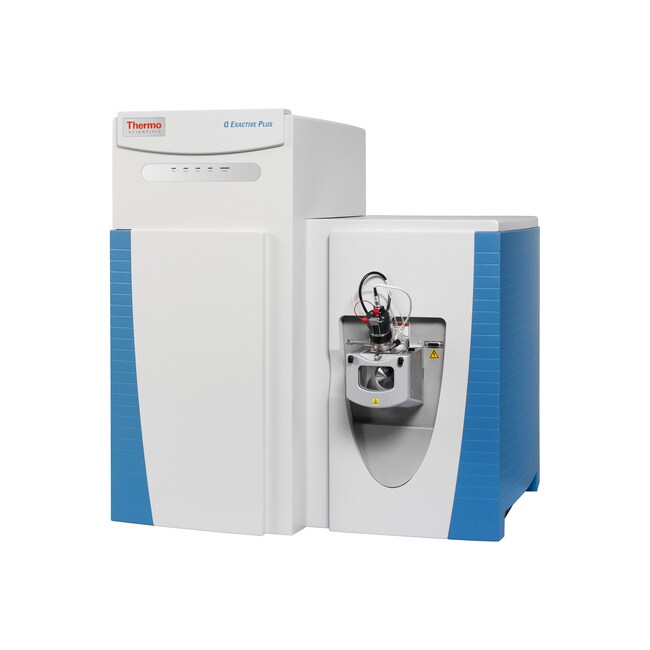
Q Exactive™ BioPharma-Plattform
Das tatsächliche Produkt kann abweichen
Q Exactive™ BioPharma-Plattform
Thermo Scientific™

Q Exactive™ BioPharma-Plattform

Das Thermo Scientific™ Q Exactive™ BioPharma Massenspektrometer bietet dank Orbitrap Massenanalysator eine hervorragende Analyse von intakten Proben, eine Middle-Down-Analyse für Untereinheiten sowie Peptidkartierungen.
Have Questions?
KatalognummerScan-RatenAuflösungMassenbereich
0726055Bis zu 12 Hz280.000 bei m/z 20050 bis 8000 m/z
Katalognummer 0726055
Preis (EUR)
-
Scan-Raten:
Bis zu 12 Hz
Auflösung:
280.000 bei m/z 200
Massenbereich:
50 bis 8000 m/z

Mit der Thermo Scientific™ Q Exactive BioPharma Plattform können Sie eine vollständige BioPharma-Charakterisierung durchführen. Diese bietet verschiedene Betriebsmodi, die für die drei wichtigsten Arbeitsabläufe zur Proteincharakterisierung optimiert sind:

  • Der HMR-Modus (High Mass Range) bietet eine optimierte Analyse intakter Proteine sowohl unter nativen als auch unter denaturierenden Bedingungen und liefert so Spektren höchster Qualität.
  • Der Proteinmodus gewährleistet die Isotopenauflösung von Untereinheiten und erleichtert die Top- und Middle-Down-Sequenzierung.
  • Der Standardmodus führt Peptidkartierungen mit beispielloser Erfassungsgeschwindigkeit, Massengenauigkeit und Spektrumqualität durch.

Die Thermo Scientific™ Q Exactive™ Plus, Q Exactive HF und Q Exactive HF-X Hybrid Quadrupole-Orbitrap™ Massenspektrometer ergänzen die leistungsfähigsten Tischgeräte für das Peptid-Mapping, die es auf dem Markt gibt, mit herausragenden MS-Analysen von denaturierten und nativen Proteinen und Top- und Middle-Down-Analysefunktionen für Untereinheiten. In Kombination mit der Thermo Scientific™ BioPharma Finder™ Software bieten diese eine vollständige integrierte Hardware- und Softwarelösung für die BioPharma-Charakterisierung.

Der Thermo Scientific™ Q Exactive™ BioPharma platform offers distinct operational modes that have been optimized for the top 3 protein characterization workflows:

  • HMR-Modus (High Mass Range) wurde speziell für Arbeitsabläufe mit intakten therapeutischen Proteinen entwickelt und zielt darauf ab, die erforderliche Anwenderfreundlichkeit und Flexibilität zu bieten. Der HMR-Modus ist sowohl für die konventionelle Analyse intakter monoklonaler Antikörper unter denaturierenden Bedingungen als auch für die native MS-Analyse optimiert, die sich ideal für Antikörperkonjugate (ADCs) und andere heterogene Antikörperproben eignet.
  • Der Proteinmodus des Q Exactive HF ist eine leistungsstarke Kombination, die den höchsten Qualitätsstandard für isotopisch aufgelöste Daten eines Tischmassenspektrometers gesetzt hat. Die Dekonvolution von MS-Spektren aus Untereinheiten gestaltet sich einfach und leistungsstark dank der Thermo Scientific™ BioPharma Finder™ Software.
  • Die Peptidkartierung im Standardmodus befindet sich beim Q Exactive BioPharma auf dem neuesten Stand der Technik und stellt den Höhepunkt jahrzehntelanger Führung bei der Entwicklung der datenabhängigen Erfassung (Data Dependent Acquisition, DDA) dar.
Specifications
Dynamischer Bereich> 5000:1
MassengenauigkeitIntern: < 1 ppm RMS; Extern: < 3 ppm RMS unter festgelegten Bedingungen
PolaritätswechselEin vollständiger Zyklus in < 1 s (jeweils ein vollständiger Scan im positiven und negativen Modus bei einer Auflösung von 35.000)
Scan-RatenBis zu 12 Hz
EmpfindlichkeitVollständige MS: 500 fg Buspiron, Signal-Rausch-Verhältnis an der Säule 100:1
SIM: 30 fg Buspiron, Signal-Rausch-Verhältnis an der Säule 100:1
Massenbereich50 bis 8000 m/z
Auflösung280.000 bei m/z 200
TypBioPharma Plattform
Unit SizeEach

Häufig gestellte Fragen (FAQ)

Why is the turbomolecular pump not operating when using Orbitrap Exactive or Q Exactive mass spectrometry instruments?

A turbomolecular pump may be switched off because of one of the following reasons:

- Turbomolecular pump is blocked
- Failure of fans in turbomolecular pump
Each of the above reasons might lead to an overheating of the pump. When overheated, a turbomolecular pump switches off automatically to prevent its destruction. This overheating protection prevents the outbreak of a fire and minimizes the risk of destructing the pump.

If the Exactive Series mass spectrometer does not work as expected, use the Tune software for error diagnosis:
- The instrument status window displays real-time status information for the instrument components. All parameters are arranged in a tree view. In addition to showing numerical values of parameters (for example, pump speeds or component temperatures), the instrument status window uses icons to indicate the statuses of system components.
- The messages window displays real-time information about the statuses of the instrument, the control service, or other programs. It might display additional information.

In case of an overheated turbomolecular pump, shut down the mass spectrometer as described on page 6-8 of the manual (https://assets.thermofisher.com/TFS-Assets/CMD/manuals/man-bre0012255-exactive-series-manbre0012255-en.pdf). To prevent permanent damage to components of the Exactive Series mass spectrometer, Thermo Fisher Scientific recommends that you call a Thermo Fisher Scientific field service engineer.

Find additional tips, troubleshooting help, and resources within our Mass Spectrometry Support Center.

Why is the temperature of UHV chamber higher than expected when using Orbitrap Exactive or Q Exactive mass spectrometry instruments?

The UHV chamber heating control may have failed. During general operation of the mass spectrometer, the temperature of the UHV chamber is not regulated. Only during a system bakeout, electric power is supplied to the heating elements of the UHV chamber. The heating always operates at maximum power. Thus, failure of the heating control does not lead to a dangerous overheating of the mass spectrometer. If the Exactive Series mass spectrometer does not work as expected, use the Tune software for error diagnosis:

- The messages window displays real-time information about the statuses of the instrument, the control service, or other programs. If the heating was terminated, the window displays a corresponding error message.

In case of a failure of the UHV chamber heating control, shut down the mass spectrometer as described on page 6-8 of the manual (https://assets.thermofisher.com/TFS-Assets/CMD/manuals/man-bre0012255-exactive-series-manbre0012255-en.pdf). To prevent permanent damage to components of the Exactive Series mass spectrometer, Thermo Fisher Scientific recommends that you call a Thermo Fisher Scientific field service engineer.

Find additional tips, troubleshooting help, and resources within our Mass Spectrometry Support Center.

When using Orbitrap Exactive or Q Exactive mass spectrometry instruments, why does the tune software show bad vacuum?

Here are possible causes and solutions:
-System was vented because of a main power failure: A main power failure has the same consequence as switching off with the main power circuit breaker switch. If the power is available again, the system is started up automatically: the pumps are switched on and the vacuum is created. If the system has been vented during the mains failure, it is necessary to bake out the system to obtain the operating vacuum. See “Baking Out the System” on page 8-12 of the manual. If the log file of the data system shows a reboot of the system and the pressure reading in the Tune software shows a bad vacuum, this indicates that the system was vented. In case of frequent but short power failures, we recommend that you install an uninterruptible power supply (UPS). If main power failures occur frequently while the system is not attended (for example, in the night), we recommend that you install a power fail detector. - Vacuum leak: Refer to pages 7-5 and 8-12 in the Operator's Manual (https://assets.thermofisher.com/TFS-Assets/CMD/manuals/man-bre0012255-exactive-series-manbre0012255-en.pdf).

Find additional tips, troubleshooting help, and resources within our Mass Spectrometry Support Center.

Why does the metal needle insert in the heated ESI probe frequently clog when using Orbitrap Exactive or Q Exactive mass spectrometry instruments?

Clogging of the H-ESI spray needle is generally caused by the presence of non-volatile components in the injected samples. If the non-volatile components of the samples are not removed during sample preparation, they will be injected onto the column where they will gradually bleed off over time into the detector. They may also be directly introduced by the use of non-volatile buffers in the mobile phase. Non volatile buffers should be avoided in LC-MS analysis because the spray needle will clog frequently and in addition the MS optics will quickly become contaminated.

Clogging issues may be worsened when using a divert valve or bypass valve. This is because when the valve switches to waste the LC flow to the needle is stopped, causing the residual liquid in the hot needle to quickly evaporate. This in turn causes the non-volatile components to deposit on the inner wall of the tubing which will eventually clog it.

When using a divert or bypass valve, the issue may be fully resolved by adding another HPLC pump to supply make-up flow through the needle when the column eluent is bypassed. The second pump is connected to the divert valve or bypass valve so that when the eluent is diverted to waste, clean solvent flows through the needle to help keep it clean. Alternatively, sample preparation procedures should be modified to reduce the amount of non-volatile components in each sample injection.

Find additional tips, troubleshooting help, and resources within our Mass Spectrometry Support Center.

What is High Energy Collision Dissociation (HCD) as it relates to Orbitrap Exactive or Q Exactive mass spectrometry instruments?

The HCD Cell consists of a straight multipole (octapole) device mounted within a metal tube. The metal tube is in turn connected to the C-Trap in direct line of sight.

The voltage offset between the C-Trap and the HCD Cell is used to accelerate the precursor ions into the gas filled cell. Inside the HCD cell, ions collide with the neutral gas causing rotation, stretching and ultimately cleaving bonds to create fragment ions and neutral species, which are subsequently removed by the vacuum system.

The generated fragment or product ions are then pushed back toward the C-Trap and focused before being pushed toward the Orbitrap analyzer.

Find additional tips, troubleshooting help, and resources within our Mass Spectrometry Support Center.