Search


Zitierungen und Referenzen (3)
Invitrogen™
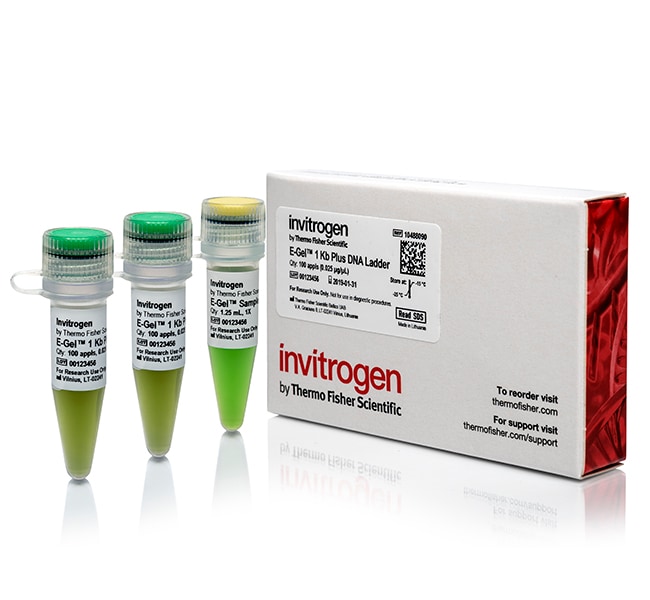
E-Gel™ 1 Kb Plus DNA-Leiter
Die Invitrogen E-Gel 1 bp Plus-DNA-Leiter wurde für die Größenbestimmung und ungefähre Quantifizierung von doppelsträngiger DNA im Bereich von 100Weitere Informationen
| Katalognummer | Menge |
|---|---|
| 10488090 | 100 Anwendungen |
Katalognummer 10488090
Preis (EUR)
287,65
Online Exclusive
316,00Ersparnis 28,35 (9%)
Each
Menge:
100 Anwendungen
Preis (EUR)
287,65
Online Exclusive
316,00Ersparnis 28,35 (9%)
Each
Die Invitrogen E-Gel 1 bp Plus-DNA-Leiter wurde für die Größenbestimmung und ungefähre Quantifizierung von doppelsträngiger DNA im Bereich von 100 bp bis 15.000 bp entwickelt. Die E-Gel 1 Kb Plus-DNA-Leiter besteht aus 18 einzelnen Chromatographie-aufgereinigten DNA-Fragmenten und hat ein Referenzband bei 1.500 bp zur leichten Ausrichtung.
Die E-Gel 1 kb Plus DNA-Leiter ist speziell für eine optimale Leistung auf E-Gel-Agarose-Fertiggelen formuliert.
Besondere Eigenschaften der E-Gel 1 Kb Plus-DNA-Leiter:
• Leistung—optimal für die Verwendung bei E-Gel-Agarose-Gelen
• Scharfe, klare Banden—Chromatographie-aufgereinigte Fragmente für einheitliche und zuverlässige Ergebnisse, bei Raumtemperatur bis zu sechs Monate stabil
• Gebrauchsfertig— mit Ladepuffer vorgemischt
• Komfortabel— mit 1x E-Gel Probenladepuffer
• Präzise— genaue DNA-Menge in jeder Bande
Produktverwendung
Die doppelsträngige DNA-Leiter kann auf 0,8–1 %-igen E-Gel-Agarose-Gelen visualisiert werden. Die Leiter ist mit einer gleichmäßigen Intensität von DNA-Bändern für eine klare Sicht auf jedes Band ausgelegt. Eine genaue DNA-Menge in jedem Band ermöglicht eine ungefähre Quantifizierung von DNA-Proben.
Die E-Gel 1 kb Plus DNA-Leiter ist speziell für eine optimale Leistung auf E-Gel-Agarose-Fertiggelen formuliert.
Besondere Eigenschaften der E-Gel 1 Kb Plus-DNA-Leiter:
• Leistung—optimal für die Verwendung bei E-Gel-Agarose-Gelen
• Scharfe, klare Banden—Chromatographie-aufgereinigte Fragmente für einheitliche und zuverlässige Ergebnisse, bei Raumtemperatur bis zu sechs Monate stabil
• Gebrauchsfertig— mit Ladepuffer vorgemischt
• Komfortabel— mit 1x E-Gel Probenladepuffer
• Präzise— genaue DNA-Menge in jeder Bande
Produktverwendung
Die doppelsträngige DNA-Leiter kann auf 0,8–1 %-igen E-Gel-Agarose-Gelen visualisiert werden. Die Leiter ist mit einer gleichmäßigen Intensität von DNA-Bändern für eine klare Sicht auf jedes Band ausgelegt. Eine genaue DNA-Menge in jedem Band ermöglicht eine ungefähre Quantifizierung von DNA-Proben.
Nur für Forschungszwecke. Nicht zur Verwendung bei diagnostischen Verfahren.
Specifications
Konzentration0,025 µg/µl
GelkompatibilitätE-Gel™ Agarosegele
NukleinsäurestrukturLineare DNA
Menge100 Anwendungen
Sofort einsatzbereitJa
Probenladevolumen1 ml
Haltbarkeit6 Monate
VersandbedingungZugelassen für den Versand bei Raumtemperatur oder auf Trockeneis
TechnologieEinzeln Chromatographie-gereinigte DNA-Fragmente
Volumen (metrisch)2 x 1000 µl
GeltypAgarose
ProdukttypDNA-Leiter
Größenbereich100 bp bis 15000 bp
Unit SizeEach
Inhalt und Lagerung
• 2x 1 ml E-Gel 1 Kb Plus DNA-Leiter
•1 ml 1X E-Gel Probenladepuffer
Lagerung bei Raumtemperatur oder bei 4 °C bis zu 6 Monate.
Längere Lagerung bei -20 °C.
•1 ml 1X E-Gel Probenladepuffer
Lagerung bei Raumtemperatur oder bei 4 °C bis zu 6 Monate.
Längere Lagerung bei -20 °C.
Häufig gestellte Fragen (FAQ)
Can I know the sequences of Invitrogen DNA ladders?
Are Invitrogen DNA ladders composed of linear or circular/supercoiled DNA?
Are Invitrogen DNA ladders composed of single-stranded or double-stranded DNA fragments?
I'm seeing anomalous migration of my DNA ladder. What happened?
What is the difference between the TrackIt DNA Ladders and other DNA ladders?
Zitierungen und Referenzen (3)
Zitierungen und Referenzen
Abstract
Computational prediction and experimental validation of novel markers for detection of STEC O157:H7.
Journal:World J Gastroenterol
PubMed ID:21528067
'To identify and assess the novel makers for detection of Shiga toxin producing Escherichia coli (STEC) O157:H7 with an integrated computational and experimental approach.'
Determination of the mode of action of enterolysin A, produced by Enterococcus faecalis B9510.
Journal:J Appl Microbiol
PubMed ID:23639072
The current study aimed to visualize the damage caused by enterolysin A to the cells of sensitive strains and to find out cleavage site within the peptidoglycan moiety of bacterial cell walls.
High isoprenoid flux Escherichia coli as a host for carotenoids production.
Journal:Methods Mol Biol
PubMed ID:22144352
A noncarotenogenic microbe E. coli was engineered for high production of carotenoids. To increase the isoprenoid flux, the chromosomal native promoters of the rate-controlling steps (dxs, idi and ispDispF) in the isoprenoid pathway were replaced with a strong bacteriophage T5 promoter (P(T5)) by using the ?-Red recombinase system in combination