Search


Zitierungen und Referenzen (38)
Gibco™
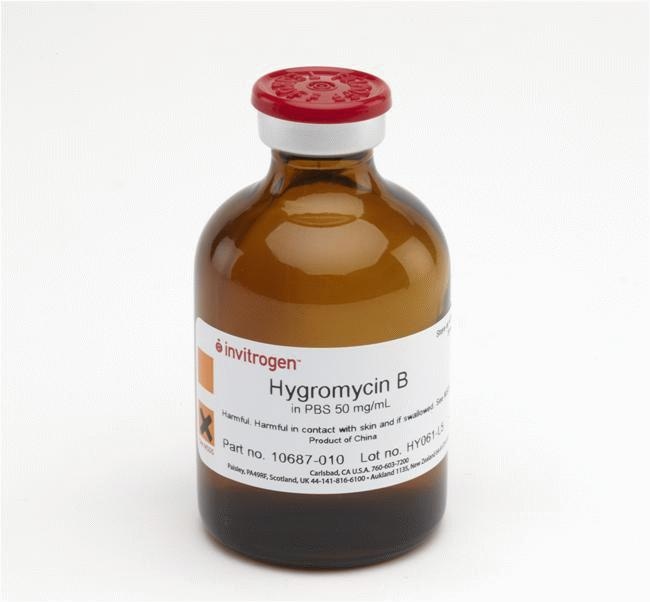
Hygromycin B (50 mg/ml)
Hygromycin B ist ein wasserlösliches Antibiotikum, das aus dem Bakterium Streptomyces hydroscopicus extrahiert wurde. Gibco™ Hygromycin B wird als selektivesWeitere Informationen
| Katalognummer | Menge |
|---|---|
| 10687010 | 20 mL |
Katalognummer 10687010
Preis (EUR)
387,65
Online Exclusive
400,00Ersparnis 12,35 (3%)
Each
Menge:
20 mL
Preis (EUR)
387,65
Online Exclusive
400,00Ersparnis 12,35 (3%)
Each
Hygromycin B ist ein wasserlösliches Antibiotikum, das aus dem Bakterium Streptomyces hydroscopicus extrahiert wurde. Gibco™ Hygromycin B wird als selektives Antibiotikum gegen Bakterien im Konzentrationsbereich von 200 bis 500 μg/ml verwendet. Dieses Produkt wird als 50 mg/ml-Lösung geliefert.
Die Resistenz gegen Hygromycin B basiert auf dem E. coli Hygromycin-Resistenzgen (Hyg oder hph). Hygromycin B hat einen anderen Wirkungsmechanismus als die selektiven Reagenzien Geneticin™, Blasticidin S oder Zeocin™ und ist daher eine exzellente Wahl für duale Selektionsexperimente (siehe Selektive Antibiotika).
Weitere Optionen und weitere Informationen
Wir bieten eine breite Palette von Antibiotika und Antimykotika in Pulver- und Flüssigformaten an.
Sehen Sie sich die vollständige Liste an, oder suchen Sie nach Produkten für:
• Kontaminationskontrolle
• Eukaryotische und bakterielle Selektion
Siehe empfohlene Arbeitskonzentrationen für selektive Antibiotika.
Erfahren Sie mehr über die Verwendung von Antibiotika und Antimykotika in der Zellkultur und lesen Sie die Richtlinien für die Dekontamination von Kulturen.
Die Resistenz gegen Hygromycin B basiert auf dem E. coli Hygromycin-Resistenzgen (Hyg oder hph). Hygromycin B hat einen anderen Wirkungsmechanismus als die selektiven Reagenzien Geneticin™, Blasticidin S oder Zeocin™ und ist daher eine exzellente Wahl für duale Selektionsexperimente (siehe Selektive Antibiotika).
Weitere Optionen und weitere Informationen
Wir bieten eine breite Palette von Antibiotika und Antimykotika in Pulver- und Flüssigformaten an.
Sehen Sie sich die vollständige Liste an, oder suchen Sie nach Produkten für:
• Kontaminationskontrolle
• Eukaryotische und bakterielle Selektion
Siehe empfohlene Arbeitskonzentrationen für selektive Antibiotika.
Erfahren Sie mehr über die Verwendung von Antibiotika und Antimykotika in der Zellkultur und lesen Sie die Richtlinien für die Dekontamination von Kulturen.
Nur für Forschungszwecke. Nicht zur Verwendung bei diagnostischen Verfahren.
Specifications
Konzentration50 mg/mL
KulturtypSäugetierzellkultur, Insektenzellkultur
Zur Verwendung mit (Anwendung)Eukaryotische Auswahl⁄Erzeugung stabiler Zelllinien
Menge20 mL
VersandbedingungRaumtemperatur
FormFlüssig
ProdukttypAntibiotikum
SterilitätSteril
Unit SizeEach
Inhalt und Lagerung
Lagerbedingungen: 2 bis 8 °C
Versandbedingungen: Umgebungstemperatur
Versandbedingungen: Umgebungstemperatur
Häufig gestellte Fragen (FAQ)
Which of your antibiotics (Geneticin, Zeocin, Hygromycin B, Blasticidin, and Puromycin) can be used together for stable selection in mammalian cells?
What are the recommended concentrations of antibiotics to use for selection in prokaryotes and eukaryotes?
What is the range of specific activity of Hygromycin B?
What solvent is used to prepare your Hygromycin B solution? How should it be stored?
What is the mode of action on the following antibiotics: Blasticidin, Geneticin (G418), Hygromycin, and Zeocin?
Zitierungen und Referenzen (38)
Zitierungen und Referenzen
Abstract
WAF1, a potential mediator of p53 tumor suppression.
Journal:Cell
PubMed ID:8242752
The ability of p53 to activate transcription from specific sequences suggests that genes induced by p53 may mediate its biological role as a tumor suppressor. Using a subtractive hybridization approach, we identified a gene, named WAF1, whose induction was associated with wild- type but not mutant p53 gene expression in
CC chemokine receptor 5-mediated signaling and HIV-1 Co-receptor activity share common structural determinants. Critical residues in the third extracellular loop support HIV-1 fusion.
Journal:J Biol Chem
PubMed ID:9242636
'There is a close correspondence between the ability of RANTES and macrophage inflammatory proteins 1alpha and 1beta to activate CC chemokine receptor 5 (CCR5) and the ability to inhibit CCR5-dependent membrane fusion mediated by the envelope glycoprotein of human immunodeficiency virus (HIV), type 1. This finding suggests that some of
Dimerization of a selectin and its ligand stabilizes cell rolling and enhances tether strength in shear flow.
Journal:Proc Natl Acad Sci U S A
PubMed ID:11526223
'Selectins mediate rolling of leukocytes by rapid formation and dissociation of selectin-ligand bonds, which are assumed to require high mechanical strength to prevent premature dissociation by the forces applied in shear flow. This assumption is based largely on the observation that increasing wall shear stress increases only modestly the dissociation
Reconstitution of stretch-activated cation channels by expression of the alpha-subunit of the epithelial sodium channel cloned from osteoblasts [published erratum appears in Proc Natl Acad Sci U S A 1997 Apr 15;94(8):4233]
Journal:Proc Natl Acad Sci U S A
PubMed ID:9023374
'Osteoblasts respond to repetitive strain by activating stretch- activated, nonselective cation channels (SA-CAT) and increasing matrix protein production. SA-CAT channels are thought to be responsible for mechano-transduction in osteoblasts, although the molecular identity of the SA-CAT channel has previously been unknown. We have demonstrated that both the UMR-106 osteoblast-like cell
Genetic analysis of the herpes simplex virus type 1 UL20 protein domains involved in cytoplasmic virion envelopment and virus-induced cell fusion.
Journal:J Virol
PubMed ID:15220406
'The herpes simplex virus type 1 UL20 protein (UL20p) is an important determinant for cytoplasmic virion morphogenesis and virus-induced cell fusion. To delineate the functional domains of the UL20 protein, we generated a panel of single and multiple (cluster) alanine substitutions as well as UL20p carboxyl-terminal truncations. The UL20 mutant