Search


Zitierungen und Referenzen (2)
Invitrogen™
Platinum™ Taq DNA-Polymerase
Die Invitrogen Platinum Taq DNA-Polymerase ist eine praktische, zuverlässige und thermostabile „Hot-Start“-DNA-Polymerase für PCR-Anwendungen, die eine höhere Spezifität als dieWeitere Informationen
Have Questions?
Ansicht ändern

| Katalognummer | Anzahl Reaktionen |
|---|---|
| 10966083 | 5000 Reaktionen |
| 10966018 | 120 Reaktionen |
| 10966026 | 300 Reaktionen |
| 10966034 | 600 Reaktionen |
Katalognummer 10966083
Preis (EUR)
5.870,65
온라인 행사
6.180,00Ersparnis 309,35 (5%)
Each
Anzahl Reaktionen:
5000 Reaktionen
Preis (EUR)
5.870,65
온라인 행사
6.180,00Ersparnis 309,35 (5%)
Each
Die Invitrogen Platinum Taq DNA-Polymerase ist eine praktische, zuverlässige und thermostabile „Hot-Start“-DNA-Polymerase für PCR-Anwendungen, die eine höhere Spezifität als die Taq DNA-Polymerase bietet. Die „Hot-Start“-Eigenschaft des Enzyms entsteht durch thermolabile monoklonale Antikörper, die bewirken, dass die Taq DNA-Polymerase so lange inaktiv bleibt, bis der erste Schritt der PCR-Denaturierung erfolgt. Dadurch wird die Extension von unspezifisch hybridisierten Primern verhindert und somit die Produktausbeute verbessert.
Einsatz der Platinum Taq DNA-Polymerase
Die Hot-Start-Eigenschaft der Platinum Taq DNA-Polymerase ermöglicht ein praktisches Ansetzen der Reaktion bei Raumtemperatur. Genau wie bei der Taq DNA-Polymerase hat die Platinum Taq DNA-Polymerase eine Template-unabhängige terminale Transferase-Aktivität, durch die ein 3'-Desoxyadenosin an die Produktenden angehängt wird, und eine 5'→3'-Exonuklease-Aktivität. PCR-Produkte, die mit Platinum Taq DNA-Polymerase hergestellt wurden, können ohne Protokollanpassungen in den gleichen Downstream-Prozessen verwendet werden. Verwenden Sie Platinum Taq DNA-Polymerase für die Amplifikation von DNA komplexer Genom-, Virus- und Plasmid-Templates sowie in der RT-PCR.
Hinweis: Für eine hervorragende PCR-Leistung empfehlen wir das Enzym der nächsten Generation: Platinum II Taq Hot-Start DNA-Polymerase. Die Platinum II Taq Hot-Start DNA-Polymerase wurde für das universelle Primer-Annealing und eine schnelle, einfache PCR mithilfe der einzigartigen Kombination aus innovativem Puffer, leistungsstarker Taq DNA-Polymerase und führender Heißstart-Technologie entwickelt.
Einsatz der Platinum Taq DNA-Polymerase
Die Hot-Start-Eigenschaft der Platinum Taq DNA-Polymerase ermöglicht ein praktisches Ansetzen der Reaktion bei Raumtemperatur. Genau wie bei der Taq DNA-Polymerase hat die Platinum Taq DNA-Polymerase eine Template-unabhängige terminale Transferase-Aktivität, durch die ein 3'-Desoxyadenosin an die Produktenden angehängt wird, und eine 5'→3'-Exonuklease-Aktivität. PCR-Produkte, die mit Platinum Taq DNA-Polymerase hergestellt wurden, können ohne Protokollanpassungen in den gleichen Downstream-Prozessen verwendet werden. Verwenden Sie Platinum Taq DNA-Polymerase für die Amplifikation von DNA komplexer Genom-, Virus- und Plasmid-Templates sowie in der RT-PCR.
Hinweis: Für eine hervorragende PCR-Leistung empfehlen wir das Enzym der nächsten Generation: Platinum II Taq Hot-Start DNA-Polymerase. Die Platinum II Taq Hot-Start DNA-Polymerase wurde für das universelle Primer-Annealing und eine schnelle, einfache PCR mithilfe der einzigartigen Kombination aus innovativem Puffer, leistungsstarker Taq DNA-Polymerase und führender Heißstart-Technologie entwickelt.
Nur für Forschungszwecke. Nicht für die Diagnostik bestimmt.
Specifications
Exonukleaseaktivität5' – 3'
Wiedergabetreue (vs. Taq)1X
FormatTube
Hot-StartIntegrierter Heißstart
Anzahl Reaktionen5000 Reaktionen
Überhang3'-A
PolymerasePlatinum Taq DNA-Polymerase
ProdukttypDNA-Polymerase
Menge5000 Reaktionen
ReaktionsformatSeparate Komponenten
VersandbedingungZugelassen für den Versand auf Nass- oder Trockeneis
Größe (Endprodukt)5 kb oder weniger
AusgangsmaterialDNA
Zur Verwendung mit (Anwendung)Heißstart-PCR
GC-Rich PCR PerformanceNiedrig
ReaktionsgeschwindigkeitStandard
Unit SizeEach
Inhalt und Lagerung
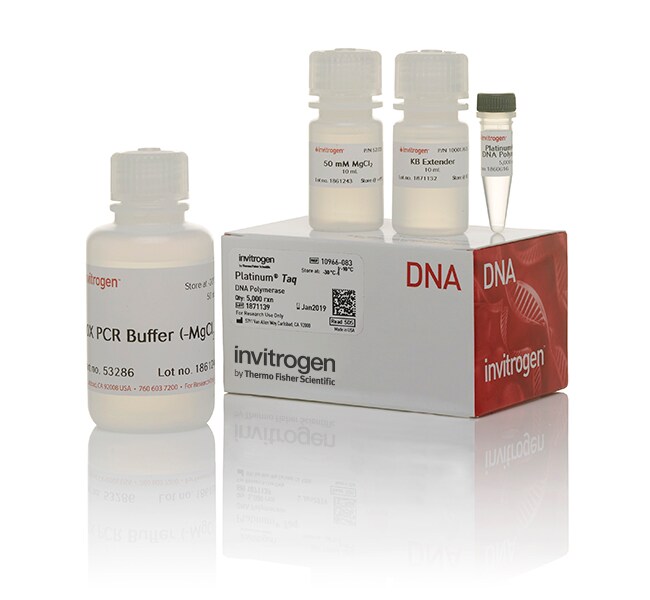
Jedes Packung enthält:
• 1.000 µl Platinum™ Taq DNA-Polymerase
• 50 ml 10x PCR-Puffer (kein MgCl2)
• 10 ml 50 mM MgCl2
• 10 ml KB Extender
In einem Tiefkühlgerät ohne Abtauautomatik bei -30 °C bis -10 °C lagern.
• 1.000 µl Platinum™ Taq DNA-Polymerase
• 50 ml 10x PCR-Puffer (kein MgCl2)
• 10 ml 50 mM MgCl2
• 10 ml KB Extender
In einem Tiefkühlgerät ohne Abtauautomatik bei -30 °C bis -10 °C lagern.
Häufig gestellte Fragen (FAQ)
Can I purchase just the 10X PCR buffer that comes with Platinum Taq?
My oligonucleotide does not appear to be the right length when I checked by gel electrophoresis. Why is this?
The primers I am using worked for PCR initially, but over time, have stopped working. What happened?
I don't see a pellet in my oligo tube order. Should I ask for a replacement?
There is a ball-shaped pellet at the bottom of my oligo tube. What is this and can I still use my oligo?
Zitierungen und Referenzen (2)
Zitierungen und Referenzen
Abstract
Characterization of four murine homologs of the human ov-serpin monocyte neutrophil elastase inhibitor MNEI (SERPINB1).
Journal:J Biol Chem
PubMed ID:12189154
'The human ov-serpin monocyte neutrophil elastase inhibitor (MNEI) is encoded by a single gene SERPINB1. It is a highly efficient inhibitor of neutrophil granule proteases. Four murine genes with high sequence identity with MNEI were identified and fully sequenced, and these were named EIA, EIB, EIC, and EID. EIA, EIB
Dynamin 2 mutations associated with human diseases impair clathrin-mediated receptor endocytosis.
Journal:Hum Mutat
PubMed ID:19623537
Dynamin 2 (DNM2) is a large GTPase involved in the release of nascent vesicles during endocytosis and intracellular membrane trafficking. Distinct DNM2 mutations, affecting the middle domain (MD) and the Pleckstrin homology domain (PH), have been identified in autosomal dominant centronuclear myopathy (CNM) and in the intermediate and axonal forms