Search


Zitierungen und Referenzen (3)
Gibco™
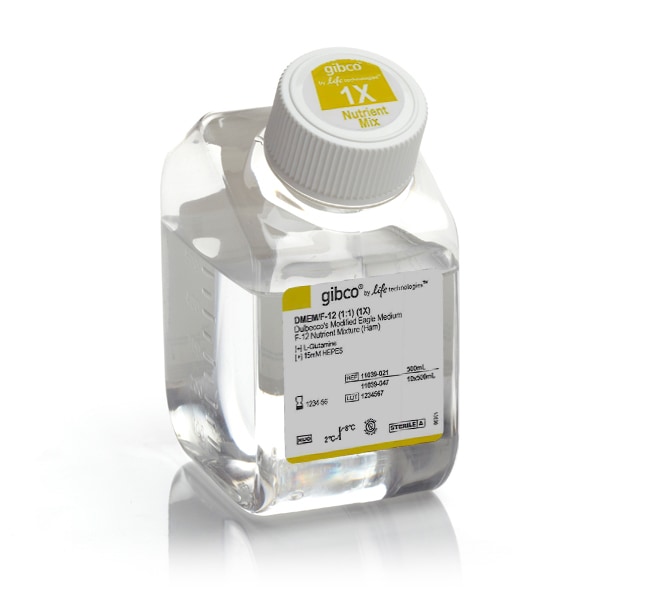
DMEM/F-12, HEPES, ohne Phenolrot
DMEM/F-12 (Dulbecco's Modified Eagle Medium/Nährstoffmischung F-12) ist ein weit verbreitetes Basismedium für die Unterstützung des Wachstums vieler verschiedener Säugerzellen. ErfolgreichWeitere Informationen
Have Questions?
Ansicht ändern

| Katalognummer | Menge |
|---|---|
| 11039021 | 500 mL |
| 11039047 | 10 x 500 mL |
Katalognummer 11039021
Preis (EUR)
37,65
Online exclusive
41,52Ersparnis 3,87 (9%)
Each
Menge:
500 mL
Preis (EUR)
37,65
Online exclusive
41,52Ersparnis 3,87 (9%)
Each
DMEM/F-12 (Dulbecco's Modified Eagle Medium/Nährstoffmischung F-12) ist ein weit verbreitetes Basismedium für die Unterstützung des Wachstums vieler verschiedener Säugerzellen. Erfolgreich in DMEM/F-12 kultivierte Zellen umfassen MDCK, Gliazellen, Fibroblasten, menschliche Endothel-Zellen und Ratten-Fibroblasten. Wir führen verschiedene DMEM/F-12-Modifikationen für eine Vielzahl von Zellkulturanwendungen. Finden Sie die richtige Zusammensetzung mithilfe des Medien-Auswahlwerkzeuges.
Dieses DMEM/F-12 wird wie folgt modifiziert:
Die vollständige Zusammensetzung ist verfügbar.
Verwendung von DMEM/F-12
DMEM/F-12 ist eine 1:1-Mischung aus DMEM- und Ham's F-12. Diese Formulierung kombiniert die hohen Konzentrationen von Glukose, Aminosäuren und Vitaminen von DMEM mit dem breiten Spektrum verschiedener Komponenten von F-12. DMEM/F-12 enthält keine Proteine, Lipide oder Wachstumsfaktoren. Aus diesem Grund kann bei DMEM/F-12 eine Supplementierung, gewöhnlicherweise mit 10 % fötalem Rinderserum (FBS), erforderlich sein. DMEM/F-12 verwendet ein Natriumbikarbonat-Puffersystem und erfordert daher eine CO–2-Umgebung von 5 bis 10 %, um den physiologischen pH-Wert aufrechtzuerhalten.
cGMP-konformes Herstellungs- und Qualitätssystem
Um eine kontinuierliche Versorgung zu gewährleisten, produzieren wir DMEM an zwei separaten Standorten in Grand Island, NY, USA und Schottland, Großbritannien. Beide Standorte erfüllen die cGMP-Fertigungsanforderungen und sind ISO 13485-zertifiziert und bei der FDA als Hersteller medizinischer Geräte registriert.
Dieses DMEM/F-12 wird wie folgt modifiziert:
| Mit | Ohne |
| • L-Glutamin | • Phenolrot |
| • HEPES |
Die vollständige Zusammensetzung ist verfügbar.
Verwendung von DMEM/F-12
DMEM/F-12 ist eine 1:1-Mischung aus DMEM- und Ham's F-12. Diese Formulierung kombiniert die hohen Konzentrationen von Glukose, Aminosäuren und Vitaminen von DMEM mit dem breiten Spektrum verschiedener Komponenten von F-12. DMEM/F-12 enthält keine Proteine, Lipide oder Wachstumsfaktoren. Aus diesem Grund kann bei DMEM/F-12 eine Supplementierung, gewöhnlicherweise mit 10 % fötalem Rinderserum (FBS), erforderlich sein. DMEM/F-12 verwendet ein Natriumbikarbonat-Puffersystem und erfordert daher eine CO–2-Umgebung von 5 bis 10 %, um den physiologischen pH-Wert aufrechtzuerhalten.
cGMP-konformes Herstellungs- und Qualitätssystem
Um eine kontinuierliche Versorgung zu gewährleisten, produzieren wir DMEM an zwei separaten Standorten in Grand Island, NY, USA und Schottland, Großbritannien. Beide Standorte erfüllen die cGMP-Fertigungsanforderungen und sind ISO 13485-zertifiziert und bei der FDA als Hersteller medizinischer Geräte registriert.
Nur für Forschungszwecke. Nicht zur Verwendung bei diagnostischen Verfahren.
Specifications
ZelllinieMDCK, Gliazellen, Fibroblasten, humane endotheliale Zellen und Ratten-Fibroblasten
Konzentration1 X
Fertigungsqualität, HerstellungsqualitätcGMP-compliant under the ISO 13485 standard
ProduktlinieGibco
ProdukttypDMEM (Dulbecco's Modified Eagle Medium)/F-12
Menge500 mL
Haltbarkeit12 Monate ab Herstellungsdatum
VersandbedingungRaumtemperatur
KlassifikationOhne Stoffe tierischen Ursprungs
FormFlüssig
Serum LevelStandard-Serumzugabe
SterilitätSteril gefiltert
Sterilization MethodSterile-filtered
Mit AdditivenHoher Glukosegehalt, Glutamin, HEPES
Ohne AdditiveKein Phenolrot
Unit SizeEach
Inhalt und Lagerung
Lagerbedingungen: 2 °C bis 8 °C (vor Licht schützen)
Versandbedingungen: Haltbarkeit bei
Raumtemperatur: 12 Monate ab Herstellungsdatum
Versandbedingungen: Haltbarkeit bei
Raumtemperatur: 12 Monate ab Herstellungsdatum
Häufig gestellte Fragen (FAQ)
Do you offer DMEM/F12 medium without folic acid?
How long can I keep my media after supplementing with serum?
My medium was shipped at room temperature but it is supposed to be stored refrigerated. Is it okay?
How can I remove mycoplasma contamination from my cell culture medium?
I see a decrease in growth of my culture. What should I do?
Zitierungen und Referenzen (3)
Zitierungen und Referenzen
Abstract
A comparison between different human hepatocyte models reveals profound differences in net glucose production, lipid composition and metabolism in vitro.
Journal:Experimental cell research
PubMed ID:38499143
Identification of a contractile-responsive element in the cardiac alpha-myosin heavy chain gene.
Journal:J Biol Chem
PubMed ID:8537395
The mechanisms by which the cardiac-specific alpha-myosin heavy chain (alpha-MHC) gene responds to contractile activity was studied in cultured cardiomyocytes and in vivo. Deletion analysis of the alpha-MHC promoter transiently transfected into neonatal rat cardiomyocytes localized the contractile-responsive element within -80 to -40 base pairs of the transcriptional start site.
Activation of the canonical bone morphogenetic protein (BMP) pathway during lung morphogenesis and adult lung tissue repair.
Journal:PLoS One
PubMed ID:22916109
Signaling by Bone Morphogenetic Proteins (BMP) has been implicated in early lung development, adult lung homeostasis and tissue-injury repair. However, the precise mechanism of action and the spatio-temporal pattern of BMP-signaling during these processes remains inadequately described. To address this, we have utilized a transgenic line harboring a BMP-responsive eGFP-reporter