Search


Zitierungen und Referenzen (9)
Gibco™
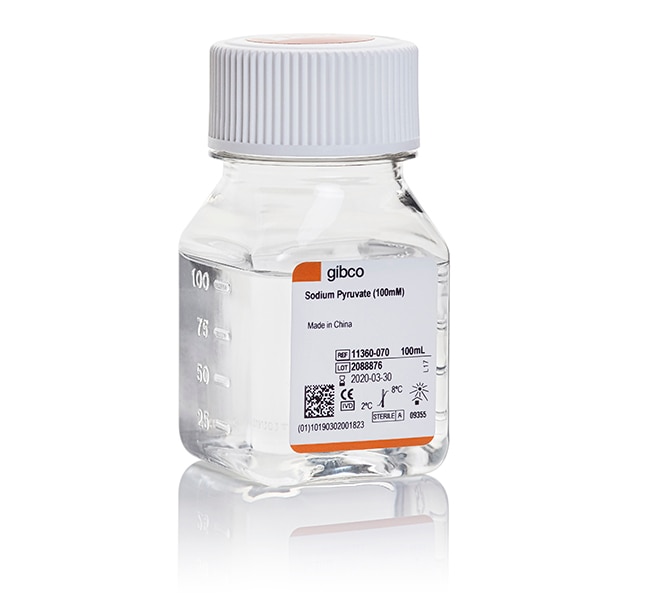
Natriumpyruvat (100 mM)
Natriumpyruvat wird Zellkulturmedien häufig als Kohlenstoffquelle neben Glucose hinzugefügt. Da Zellen Natriumpyruvat als intermediäre Metaboliten im Glykolysepfad erzeugen, ist esWeitere Informationen
| Katalognummer | Menge |
|---|---|
| 11360070 | 100 ml |
Katalognummer 11360070
Preis (EUR)
17,65
온라인 행사
18,72Ersparnis 1,07
Each
Menge:
100 ml
Preis (EUR)
17,65
온라인 행사
18,72Ersparnis 1,07
Each
Natriumpyruvat wird Zellkulturmedien häufig als Kohlenstoffquelle neben Glucose hinzugefügt. Da Zellen Natriumpyruvat als intermediäre Metaboliten im Glykolysepfad erzeugen, ist es kein notwendiger Zusatz aller Zellkulturen. Wenn die Zellen allerdings in einem Medium mit Natriumpyruvat-Zusatz kultiviert wurden, empfehlen wir, den Zusatz fortzusetzen, da die Zellen ohne Natriumpyruvat langsamer wachsen könnten. Gibco™ Natriumpyruvat (100 mM) ist formuliert als 11 g pro Liter Wasser. Die Endkonzentration von Natriumpyruvat, das in den meisten Zellkulturmedien verwendet wird, beträgt 1 mM.
cGMP-konformes Herstellungs- und Qualitätssystem an zwei Standorten
Gibco™ Natriumpyruvatlösung wird in einem cGMP-konformen Werk in Grand Island, New York, hergestellt. Die Einrichtung ist von der US-Arzneimittelbehörde FDA als Hersteller von Medizinprodukten zugelassen und nach ISO 13485-zertifiziert. Zur Gewährleistung einer kontinuierlichen Lieferfähigkeit bieten wir auch eine identische Gibco™ Natriumpyruvatlösung an, die an unserem Standort in Schottland (11360-039) hergestellt wird. Diese Einrichtung ist von der US-Arzneimittelbehörde FDA als Hersteller von Medizinprodukten zugelassen und ISO 13485-zertifiziert.
cGMP-konformes Herstellungs- und Qualitätssystem an zwei Standorten
Gibco™ Natriumpyruvatlösung wird in einem cGMP-konformen Werk in Grand Island, New York, hergestellt. Die Einrichtung ist von der US-Arzneimittelbehörde FDA als Hersteller von Medizinprodukten zugelassen und nach ISO 13485-zertifiziert. Zur Gewährleistung einer kontinuierlichen Lieferfähigkeit bieten wir auch eine identische Gibco™ Natriumpyruvatlösung an, die an unserem Standort in Schottland (11360-039) hergestellt wird. Diese Einrichtung ist von der US-Arzneimittelbehörde FDA als Hersteller von Medizinprodukten zugelassen und ISO 13485-zertifiziert.
Für In-vitro-Diagnostik.
Specifications
ZelltypSäugetierzellen
Konzentration100 mM
Menge100 ml
Haltbarkeit12 Monate
VersandbedingungRaumtemperatur
FormFlüssig
ProdukttypNatriumpyruvat
SterilitätSteril gefiltert
Sterilization MethodSterile-filtered
Unit SizeEach
Inhalt und Lagerung
Lagerbedingungen: 2 bis 8 °C. Vor Licht schützen.
Versandbedingungen: Haltbarkeit bei
Raumtemperatur: 12 Monate ab Herstellungsdatum
Versandbedingungen: Haltbarkeit bei
Raumtemperatur: 12 Monate ab Herstellungsdatum
Häufig gestellte Fragen (FAQ)
For how long is Sodium Pyruvate (100 mM) stable at 2-8 degrees C after opening the bottle?
How is your sodium pyruvate supplied?
What is the purpose of sodium pyruvate in media?
Zitierungen und Referenzen (9)
Zitierungen und Referenzen
Abstract
A comparison between different human hepatocyte models reveals profound differences in net glucose production, lipid composition and metabolism in vitro.
Journal:Experimental cell research
PubMed ID:38499143
Effects of an indole derivative on cell proliferation, transfection, and alternative splicing in production of lentiviral vectors by transient co-transfection.
Journal:PloS one
PubMed ID:38833479
Lentiviral vectors derived from human immunodeficiency virus type I are widely used to deliver functional gene copies to mammalian cells for research and gene therapies. Post-transcriptional splicing of lentiviral vector transgene in transduced host and transfected producer cells presents barriers to widespread application of lentiviral vector-based therapies. The present study
Metabolism of 4 beta -hydroxycholesterol in humans.
Journal:J Biol Chem
PubMed ID:12077124
'One of the major oxysterols in the human circulation is 4 beta-hydroxycholesterol formed from cholesterol by the drug-metabolizing enzyme cytochrome P450 3A4. Deuterium-labeled 4 beta-hydroxycholesterol was injected into two healthy volunteers, and the apparent half-life was found to be 64 and 60 h, respectively. We have determined earlier the half-lives
Delivery of proteins into living cells by reversible membrane permeabilization with streptolysin-O.
Journal:Proc Natl Acad Sci U S A
PubMed ID:11248053
'The pore-forming toxin streptolysin O (SLO) can be used to reversibly permeabilize adherent and nonadherent cells, allowing delivery of molecules with up to 100 kDa mass to the cytosol. Using FITC-labeled albumin, 10(5)-10(6) molecules were estimated to be entrapped per cell. Repair of toxin lesions depended on Ca(2+)-calmodulin and on
Use of human tissue explants to study human infectious agents.
Journal:Nat Protoc
PubMed ID:19197269
The study of human cell-cell and cell-pathogen interactions that occur in the context of complex tissue cytoarchitecture is critical for deciphering the mechanisms of many normal and pathogenic processes. This protocol describes methods for culturing and infecting explants of human tissues to study the pathogenesis of human infectious agents and