Search


Zitierungen und Referenzen (90)
Invitrogen™
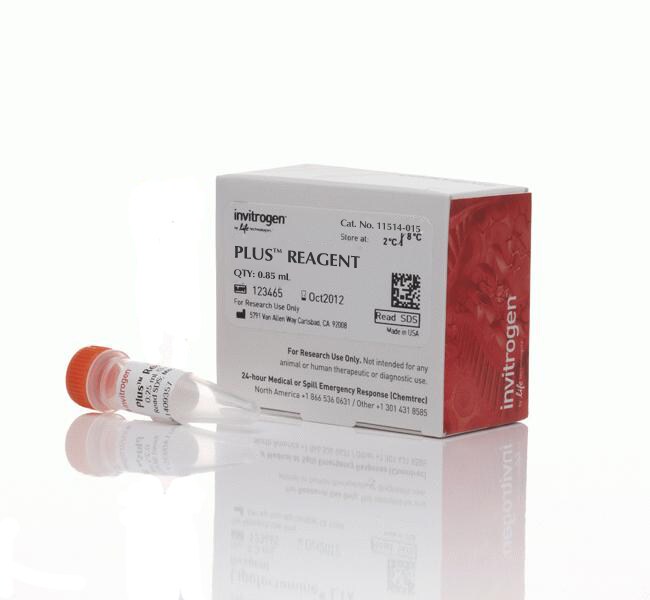
PLUS™ Reagenz
Das PLUS™ Reagenz wird in Verbindung mit unterschiedlichen Transfektion-Reagenzien, wie dem Lipofectamine™ Reagenz, zur Verbesserung der Transfektionseffizienz in adhärenten ZelllinienWeitere Informationen
| Katalognummer | Menge |
|---|---|
| 11514015 | 0,85 mL |
Katalognummer 11514015
Preis (EUR)
719,65
Offre exceptionnelle en ligne
750,00Ersparnis 30,35 (4%)
0.85 mL
Menge:
0,85 mL
Preis (EUR)
719,65
Offre exceptionnelle en ligne
750,00Ersparnis 30,35 (4%)
0.85 mL
Das PLUS™ Reagenz wird in Verbindung mit unterschiedlichen Transfektion-Reagenzien, wie dem Lipofectamine™ Reagenz, zur Verbesserung der Transfektionseffizienz in adhärenten Zelllinien verwendet.
Verwendung des PLUS™ Reagenz
Einige Kunden beobachten, dass bei Verwendung des PLUS™ Reagenz weniger Optimierung der DNA-Konzentration erforderlich ist, um hohe Transfektionsleistung zu erzielen. Unter Zusatz von PLUS™ Reagenz kann es zu einer Halbierung der benötigten Mengen an DNA und Lipid kommen, verglichen mit ausschließlich Lipid. Das PLUS™ Reagenz wurde speziell zur Erweiterung des Angebots an transfizierbaren Zelltypen entwickelt. Bei der Verwendung mit Lipofectamine™ Reagenz wurde gezeigt, dass das PLUS™ Reagenz die Transfektion von BHK-21, NIH 3T3 und andere Zelllinien verbessert.
Verwendung des PLUS™ Reagenz
Einige Kunden beobachten, dass bei Verwendung des PLUS™ Reagenz weniger Optimierung der DNA-Konzentration erforderlich ist, um hohe Transfektionsleistung zu erzielen. Unter Zusatz von PLUS™ Reagenz kann es zu einer Halbierung der benötigten Mengen an DNA und Lipid kommen, verglichen mit ausschließlich Lipid. Das PLUS™ Reagenz wurde speziell zur Erweiterung des Angebots an transfizierbaren Zelltypen entwickelt. Bei der Verwendung mit Lipofectamine™ Reagenz wurde gezeigt, dass das PLUS™ Reagenz die Transfektion von BHK-21, NIH 3T3 und andere Zelllinien verbessert.
Nur für Forschungszwecke. Nicht zur Verwendung bei diagnostischen Verfahren.
Specifications
Zur Verwendung mit (Anwendung)Transfektion
Hochdurchsatz-KompatibilitätNicht mit hohen Durchsatz kompatibel (manuell)
ProduktliniePLUS
ProdukttypReagenz
Menge0,85 mL
Serum-kompatibelJa
VersandbedingungNasseis
ZelltypEtablierte Zelllinien, Stammzellen, Primärzellen, schwer transfizierbare Zellen
Format6-Well-Platte, 12-Well-Platte, 24-Well-Platte, 48-Well-Platte, 96-Well-Platte, Kolben
ProbentypPlasmid-DNA, RNAi-Plasmide (shRNA, miR)
Transfection TechniqueLipid-basierte Transfektion
Unit Size0.85 mL
Inhalt und Lagerung
Enthält ein Fläschchen (0,85 ml) PLUS™ Reagenz. Bei 4 °C lagern. Nicht einfrieren.
Häufig gestellte Fragen (FAQ)
I accidentally left my lipid reagent at room temperature. Can I still use it?
Do you offer a reagent for the transfection of endothelial cells?
Can I use the PLUS Reagent with Lipofectamine RNAiMAX?
Why do I have to dilute my DNA in medium before adding the PLUS Reagent? Can I just add them together?
What is the PLUS Reagent?
Zitierungen und Referenzen (90)
Zitierungen und Referenzen
Abstract
c-Jun is a JNK-independent coactivator of the PU.1 transcription factor.
Journal:J Biol Chem
PubMed ID:9988737
The ETS domain transcription factor PU.1 is necessary for the development of monocytes and regulates, in particular, the expression of the monocyte-specific macrophage colony-stimulating factor (M-CSF) receptor, which is critical for monocytic cell survival, proliferation, and differentiation. The bZIP transcription factor c-Jun, which is part of the AP-1 transcription factor
Receptor-selective effects of endogenous RGS3 and RGS5 to regulate mitogen-activated protein kinase activation in rat vascular smooth muscle cells.
Journal:J Biol Chem
PubMed ID:12006602
Regulators of G protein signaling (RGS) proteins compose a highly diverse protein family best known for inhibition of G protein signaling by enhancing GTP hydrolysis by Galpha subunits. Little is known about the function of endogenous RGS proteins. In this study, we used synthetic ribozymes targeted to RGS2, RGS3, RGS5,
A
Journal:J Biol Chem
PubMed ID:11973330
The large size (six membrane-spanning repeats in each of four domains) and asymmetric architecture of the voltage-dependent Na+ channel has hindered determination of its structure. With the goal of determining the minimum structure of the Na+ channel permeation pathway, we created two stable cell lines expressing the voltage-dependent rat skeletal
Vesicle-associated membrane protein-2/synaptobrevin binding to synaptotagmin I promotes O-glycosylation of synaptotagmin I.
Journal:J Biol Chem
PubMed ID:12048209
Synaptotagmin I (Syt I), an evolutionarily conserved integral membrane protein of synaptic vesicles, is now known to regulate Ca2+-dependent neurotransmitter release. Syt I protein should undergo several post-translational modifications before maturation and subsequent functioning on synaptic vesicles (e.g. N-glycosylation and fatty acylation in vertebrate Syt I), because the apparent molecular
Extracellular Export of Sphingosine Kinase-1 Enzyme. SPHINGOSINE 1-PHOSPHATE GENERATION AND THE INDUCTION OF ANGIOGENIC VASCULAR MATURATION.
Journal:J Biol Chem
PubMed ID:11741921
The enzyme sphingosine kinase (SK) catalyzes the formation of sphingosine 1-phosphate (S1P), a bioactive lipid that acts extracellularly on G protein-coupled receptors of the S1P(1)/EDG-1 subfamily. Although S1P is formed in the cytosol of various cells, S1P release is not understood and is controversial because this lipid mediator is also