Search


Zitierungen und Referenzen (185)
Invitrogen™
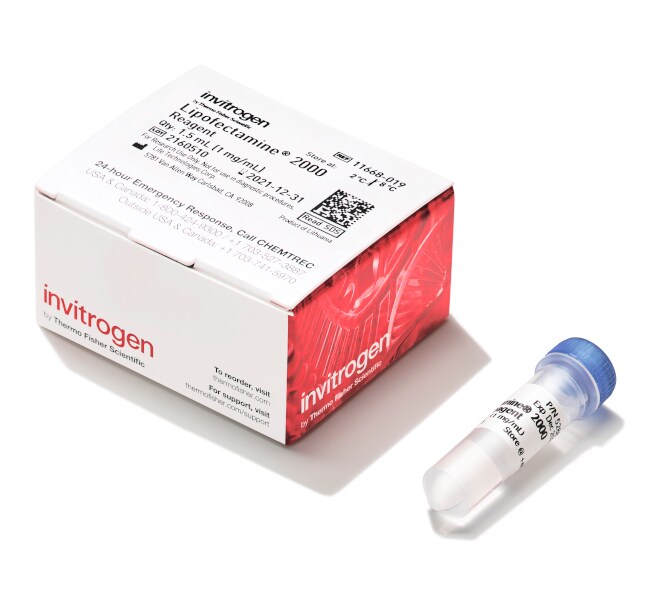
Lipofectamine™ 2000 Transfektionsreagenz
Lipofectamine™ 2000 ist ein vielseitiges Transfektionsreagenz, das nachweislich eine Vielzahl adhärenter Zelllinien sowie Zelllinien in Suspension transfektiert. Forscher verwenden dasWeitere Informationen
Have Questions?
Ansicht ändern

| Katalognummer | Menge |
|---|---|
| 11668019 | 1,5 ml |
| 11668500 | 15 ml |
| 11668027 | 0,75 mL |
| 11668030 | 0,3 ml |
Katalognummer 11668019
Preis (EUR)
1.212,00
Each
Menge:
1,5 ml
Preis (EUR)
1.212,00
Each
Lipofectamine™ 2000 ist ein vielseitiges Transfektionsreagenz, das nachweislich eine Vielzahl adhärenter Zelllinien sowie Zelllinien in Suspension transfektiert. Forscher verwenden das Lipofectamine™ 2000 Reagenz für siRNA- und shRNA-basierte Gen-Knockdown Experimente sowie für Untersuchungen der Genexpression.
Vorteile von With Lipofectamine™ 2000 Transfektionsreagenz:
• Eine außergewöhnlich hohe Transfektionseffizienz im breitesten Bereich an Zelllinien und den höchsten Grad der Expression rekombinanter Proteine (siehe Tabelle)
• Hervorragende Leistung für die Kotransfektion von siRNA- und Plasmid-DNA
• Nachgewiesene Wirksamkeit bei Vorhandensein von Serum – Macht den Austausch von Medien nach der Transfektion unnötig
• Zuverlässige Leistung für Anwendungen mit hohem Durchsatz
• Die beste Wahl für die Schaffung stabiler Zelllinien
Ein leistungsstarkes Transfektionsreagenz für Genexpression und Gen-Silencing
Lipofectamine™ 2000 Transfektionsreagenz funktioniert effektiv mit allen üblichen Zelllinien sowie mit vielen anspruchsvollen Zelllinien und kann in Medien mit oder ohne Serum verwendet werden. Beim Gen-Silencing bietet die höchst effiziente Wirkung von Lipofectamine™ 2000-Transfektionsreagenz mehr Gen-Knockdowns, mit denen überzeugende Ergebnisse möglich sind. Lipofectamine™ 2000-Transfektionsreagenz ist in Anbetracht seiner Effektivität bei der Transfektion von siRNA- und Plasmid-DNA die erste Wahl für die Kotransfektion. Lipofectamine™ 2000 Transfektionsreagenz ist einfach in der Anwendung – Einfach mit Nukleinsäure mischen und zur Zellkultur hinzufügen.
Ideal für Arbeiten mit hohem Durchsatz
Lipofectamine™ 2000 Transfektionsreagenz ist durch seine Einfachheit und Schnelligkeit, in Kombination mit seiner hohen Transfektionseffizienz, für die transiente Proteinexpression oder für RNAi-Transfektionen mit hohem Durchsatz die beste Lösung. Für automatisierte oder robotergesteuerte Systeme, die für diese Anwendungen eingesetzt werden, lassen sich Transfektionsbedingungen leicht herstellen.
Vorteile von With Lipofectamine™ 2000 Transfektionsreagenz:
• Eine außergewöhnlich hohe Transfektionseffizienz im breitesten Bereich an Zelllinien und den höchsten Grad der Expression rekombinanter Proteine (siehe Tabelle)
• Hervorragende Leistung für die Kotransfektion von siRNA- und Plasmid-DNA
• Nachgewiesene Wirksamkeit bei Vorhandensein von Serum – Macht den Austausch von Medien nach der Transfektion unnötig
• Zuverlässige Leistung für Anwendungen mit hohem Durchsatz
• Die beste Wahl für die Schaffung stabiler Zelllinien
Ein leistungsstarkes Transfektionsreagenz für Genexpression und Gen-Silencing
Lipofectamine™ 2000 Transfektionsreagenz funktioniert effektiv mit allen üblichen Zelllinien sowie mit vielen anspruchsvollen Zelllinien und kann in Medien mit oder ohne Serum verwendet werden. Beim Gen-Silencing bietet die höchst effiziente Wirkung von Lipofectamine™ 2000-Transfektionsreagenz mehr Gen-Knockdowns, mit denen überzeugende Ergebnisse möglich sind. Lipofectamine™ 2000-Transfektionsreagenz ist in Anbetracht seiner Effektivität bei der Transfektion von siRNA- und Plasmid-DNA die erste Wahl für die Kotransfektion. Lipofectamine™ 2000 Transfektionsreagenz ist einfach in der Anwendung – Einfach mit Nukleinsäure mischen und zur Zellkultur hinzufügen.
Ideal für Arbeiten mit hohem Durchsatz
Lipofectamine™ 2000 Transfektionsreagenz ist durch seine Einfachheit und Schnelligkeit, in Kombination mit seiner hohen Transfektionseffizienz, für die transiente Proteinexpression oder für RNAi-Transfektionen mit hohem Durchsatz die beste Lösung. Für automatisierte oder robotergesteuerte Systeme, die für diese Anwendungen eingesetzt werden, lassen sich Transfektionsbedingungen leicht herstellen.
Nur für Forschungszwecke. Nicht zur Verwendung bei diagnostischen Verfahren.
Specifications
Zur Verwendung mit (Anwendung)Transfektion
Hochdurchsatz-KompatibilitätGeeignet für hohe Durchsätze
ProduktlinieLipofectamine
ProdukttypTransfektionsreagenz
Menge1,5 ml
Serum-kompatibelJa
VersandbedingungZugelassen für den Versand bei Raumtemperatur oder auf nassem Eis
ZelltypEtablierte Zelllinien, Stammzellen, Primärzellen, schwer transfizierbare Zellen
Format6-Well-Platte, 12-Well-Platte, 24-Well-Platte, 48-Well-Platte, 96-Well-Platte, Kolben
ProbentypPlasmid-DNA, synthetische siRNA, RNAi-Plasmide (shRNA, miR)
Transfection TechniqueLipid-basierte Transfektion
Unit SizeEach
Inhalt und Lagerung
Enthält ein Fläschchen (1,5 ml) Lipofectamine™ 2000 Reagenz Bei 2–8 °C lagern. Nicht einfrieren.
Häufig gestellte Fragen (FAQ)
I transfected GFP into cells using Lipofectamine 2000 and saw a light granular orange background fluorescence. What could be causing this?
I accidentally left my lipid reagent at room temperature. Can I still use it?
Can I use Lipofectamine RNAiMAX to co-transfect siRNA with plasmid DNA?
Can I use Lipofectamine 2000 to co-transfect plasmids and siRNA?
For how long is the Lipofectamine 2000:DNA complex stable?
Zitierungen und Referenzen (185)
Zitierungen und Referenzen
Abstract
Role of tyrosine kinase Jak2 in prolactin-induced differentiation and growth of mammary epithelial cells.
Journal:J Biol Chem
PubMed ID:11821424
Genetic studies in mice have established a critical role for prolactin receptors and transcription factor Stat5 in mammary gland differentiation. However, the enzymatic coupling between prolactin receptors and Stat5 in this process has not been established. In addition to Jak2, several other tyrosine kinases reportedly also are associated with prolactin
Confirmation by FRET in individual living cells of the absence of significant amyloid beta -mediated caspase 8 activation.
Journal:Proc Natl Acad Sci U S A
PubMed ID:12409609
When cells are exposed to death-inducing molecules such as tumor necrosis factor-alpha or Fas, caspase 8 is activated and cleaves an apoptotic facilitator, Bid, that is a member of the Bcl-2 family. After additional modification, the C-terminal moiety of Bid is translocated to the mitochondria and induces the release of
AMP-activated Kinase Inhibits the Epithelial Na+ Channel through Functional Regulation of the Ubiquitin Ligase Nedd4-2.
Journal:J Biol Chem
PubMed ID:16844684
'We recently found that the metabolic sensor AMP-activated kinase (AMPK) inhibits the epithelial Na(+) channel (ENaC) through decreased plasma membrane ENaC expression, an effect requiring the presence of a binding motif in the cytoplasmic tail of the beta-ENaC subunit for the ubiquitin ligase Nedd4-2. To further examine the role of
Mammalian cell penetration, siRNA transfection, and DNA transfection by supercharged proteins.
Journal:Proc Natl Acad Sci U S A
PubMed ID:19307578
'Nucleic acid reagents, including small interfering RNA (siRNA) and plasmid DNA, are important tools for the study of mammalian cells and are promising starting points for the development of new therapeutic agents. Realizing their full potential, however, requires nucleic acid delivery reagents that are simple to prepare, effective across many
Dynamic fluorescent imaging of human immunodeficiency virus type 1 gag in live cells by biarsenical labeling.
Journal:J Virol
PubMed ID:15767407
'Human immunodeficiency virus type 1 (HIV-1) Gag is the primary structural protein of the virus and is sufficient for particle formation. We utilized the recently developed biarsenical-labeling method to dynamically observe HIV-1 Gag within live cells by adding a tetracysteine tag (C-C-P-G-C-C) to the C terminus of Gag in both