Search


Zitierungen und Referenzen (2)
Invitrogen™
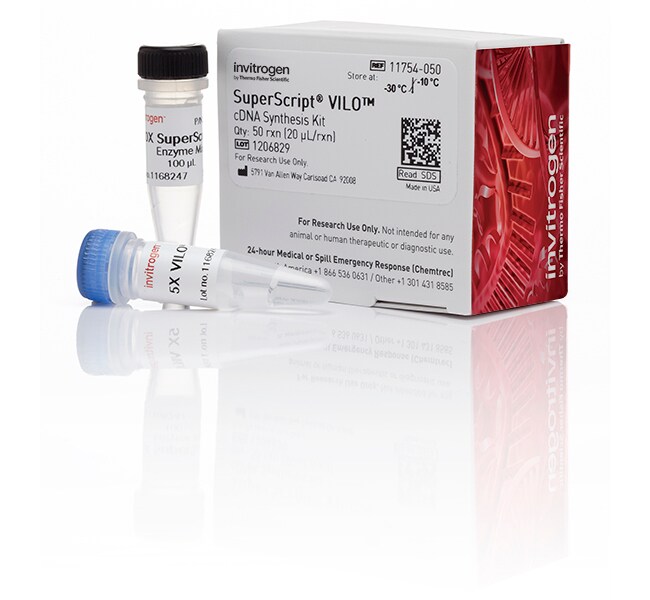
SuperScript™ VILO™ cDNA-Synthesekit
Das SuperScript VILO cDNA-Synthese-Kit wurde entwickelt, um Erststrang-cDNA für zweistufige RT-qPCR-Anwendungen zu erzeugen. Das Kit wird in einem 2-Röhrchen-Format mitWeitere Informationen
Have Questions?
Ansicht ändern

| Katalognummer | Anzahl Reaktionen |
|---|---|
| 11754250 | 250 Reaktionen |
| 11754050 | 50 Reaktionen |
Katalognummer 11754250
Preis (EUR)
3.915,00
Each
Anzahl Reaktionen:
250 Reaktionen
Preis (EUR)
3.915,00
Each
Das SuperScript VILO cDNA-Synthese-Kit wurde entwickelt, um Erststrang-cDNA für zweistufige RT-qPCR-Anwendungen zu erzeugen. Das Kit wird in einem 2-Röhrchen-Format mit dem VILO Reaktionsgemisch und einem Enzymgemisch in separaten Röhrchen geliefert. Die Enzymmischung enthält SuperScript III Reverse Transkriptase (RT), eine gentechnisch veränderte MMLV-RT mit verringerter RNase H-Aktivität und verbesserter Thermostabilität für eine hocheffiziente cDNA-Synthese. Das Kit kann für die Synthese von cDNA über einen großen Bereich von ursprünglicher RNA hinweg verwendet werden.
Hinweis: Für eine hervorragende cDNA-Synthese in zweistufigen RT-qPCR-Anwendungen empfehlen wir den SuperScript IV VILO Master Mix oder den SuperScript IV VILO Master Mix mit ezDNase-Enzym. Der Master Mix bietet alle für die cDNA-Synthese erforderlichen Reaktionskomponenten in einem praktischen Einzelröhrchen-Format. Hebt die bewährte VILO Technologie mit der hochprozessiven und thermostabilen SuperScript IV RT und dem weiter optimierten Puffer auf das nächste Level. Der Master Mix ermöglicht in kürzerer Zeit und bei höheren Temperaturen eine effiziente cDNA-Synthese und bietet selbst bei suboptimalem Reinheitsgrad oder knappen Templates eine hervorragende cDNA-Ausbeute und Empfindlichkeit.
Hinweis: Für eine hervorragende cDNA-Synthese in zweistufigen RT-qPCR-Anwendungen empfehlen wir den SuperScript IV VILO Master Mix oder den SuperScript IV VILO Master Mix mit ezDNase-Enzym. Der Master Mix bietet alle für die cDNA-Synthese erforderlichen Reaktionskomponenten in einem praktischen Einzelröhrchen-Format. Hebt die bewährte VILO Technologie mit der hochprozessiven und thermostabilen SuperScript IV RT und dem weiter optimierten Puffer auf das nächste Level. Der Master Mix ermöglicht in kürzerer Zeit und bei höheren Temperaturen eine effiziente cDNA-Synthese und bietet selbst bei suboptimalem Reinheitsgrad oder knappen Templates eine hervorragende cDNA-Ausbeute und Empfindlichkeit.
Nur für Forschungszwecke. Nicht zur Verwendung bei diagnostischen Verfahren.
Specifications
EndprodukttypErststrang-cDNA
FormatKit
Anzahl Reaktionen250 Reaktionen
Optimale Reaktionstemperatur42 °C
Menge250 Reaktionen
ReaktionsformatMaster Mix
ReagenztypReverse Transkription
Reverse TranskriptaseSuperScript III
Ribonuklease-H-AktivitätKeine
VersandbedingungTrockeneis
Größe (Endprodukt)Bis 10 kb
AusgangsmaterialRNA
VerfahrenReverse Transkription
NachweisverfahrenPrimer-Sonde
Zur Verwendung mit (Anwendung)Real-Time PCR (qPCR)
GC-Rich PCR PerformanceHoch
Reaktionsgeschwindigkeit60 min
Unit SizeEach
Inhalt und Lagerung
• 5X VILO Reaction Mix mit Random-Primern, dNTPs und MgCl2
• 10X SuperScript III Enzymmischung, die SuperScript III RT, RNaseOUT Rekombinanten Ribonuklease Inhibitor und proprietäres Helferprotein enthält
Im Gefriergerät lagern (–5 bis -30 °C).
• 10X SuperScript III Enzymmischung, die SuperScript III RT, RNaseOUT Rekombinanten Ribonuklease Inhibitor und proprietäres Helferprotein enthält
Im Gefriergerät lagern (–5 bis -30 °C).
Häufig gestellte Fragen (FAQ)
How long can I store the cDNA from my reverse transcription step?
What is the difference between SuperScript III RT and the RT in the SuperScript VILO kit?
How much of the first-strand cDNA reaction should I load for PCR?
Zitierungen und Referenzen (2)
Zitierungen und Referenzen
Abstract
T cells modulate Epstein-Barr virus latency phenotypes during infection of humanized mice.
Journal:
PubMed ID:24390326
Human B cells, the main target of Epstein-Barr virus (EBV), can display several types of latent viral protein expression, denoted 0, I, IIa, IIb, or III. Of these, only type III expression induces proliferation of cells in vitro. These latency types are present at specific stages of infection and are
Decrease of miR-146b-5p in monocytes during obesity is associated with loss of the anti-inflammatory but not insulin signaling action of adiponectin.
Journal:PLoS One
PubMed ID:22393448
Low adiponectin, a well-recognized antidiabetic adipokine, has been associated with obesity-related inflammation, oxidative stress and insulin resistance. Globular adiponectin is an important regulator of the interleukin-1 receptor-associated kinase (IRAK)/NF?B pathway in monocytes of obese subjects. It protects against inflammation and oxidative stress by inducing IRAK3. microRNA (miR)-146b-5p inhibits NF?B-mediated inflammation