Search


Zitierungen und Referenzen (110)
Gibco™
DMEM, hoher Glukosegehalt
DMEM (Dulbecco's Modified Eagle Medium) ist ein weit verbreitetes Basismedium zur Wachstumsunterstützung vieler verschiedener Säugetierzellen. Zu den erfolgreich in DMEMWeitere Informationen
Have Questions?
Ansicht ändern

| Katalognummer | Menge |
|---|---|
| 11965092 | 500 mL |
| 11965084 | 1.000 mL |
| 11965175 | 10 l |
Katalognummer 11965092
Preis (EUR)
27,90
Each
Menge:
500 mL
Preis (EUR)
27,90
Each
DMEM (Dulbecco's Modified Eagle Medium) ist ein weit verbreitetes Basismedium zur Wachstumsunterstützung vieler verschiedener Säugetierzellen. Zu den erfolgreich in DMEM kultivierten Zellen gehören primäre Fibroblasten, Neuronen, Gliazellen, nicht proliferierende und ausdifferenzierte Nabelschnurzellen (HUVEC) sowie Zellen der glatten Muskulatur sowie Zelllinien wie HeLa, 293, COS-7 und PC-12. Life Technologies bietet eine Vielzahl von DMEM-Modifikationen für eine Vielzahl von Zellkulturanwendungen. Finden Sie die richtige Zusammensetzung mithilfe des Medien-Auswahlwerkzeuges.
Die vollständige Zusammensetzung ist verfügbar.
Verwendung von DMEM
DMEM unterscheidet von anderen Medien durch seine vierfach höhere Konzentration an Aminosäuren und Vitaminen gegenüber dem originalen Eagle's Minimal Essential Medium. Die Formulierung für DMEM wurde ursprünglich mit einer niedrigen Glukosekonzentration (1 g/l) und mit Natriumpyruvat entwickelt, wird aber häufig mit höheren Glukose-Konzentrationen sowie mit oder ohne Natriumpyruvat eingesetzt. DMEM enthält keine Proteine, Lipide oder Wachstumsfaktoren. Aus diesem Grund ist bei DMEM eine Supplementierung, meist mit 10 % fötalem Kälberserum (FKS), erforderlich. DMEM verwendet ein Natriumbikarbonat-Puffersystem (3,7 g/l) und erfordert daher eine 5 bis 10%ige CO–2-Umgebung, um den physiologischen pH-Wert aufrechtzuerhalten.
cGMP-konformes Herstellungs- und Qualitätssystem
DMEM wird in einer cGMP-konformen Einrichtung in Grand Island, New York, hergestellt. Die Einrichtung ist von der US-Arzneimittelbehörde FDA als Hersteller von Medizinprodukten zugelassen und nach ISO 13485-zertifiziert. Zur Gewährleistung einer ununterbrochenen Versorgungskette bietet Life Technologies ein identisches DMEM-Produkt aus unserem Betrieb in Schottland an (41965-039). Diese Einrichtung ist von der US-Arzneimittelbehörde FDA als Hersteller von Medizinprodukten zugelassen und ISO 13485-zertifiziert.
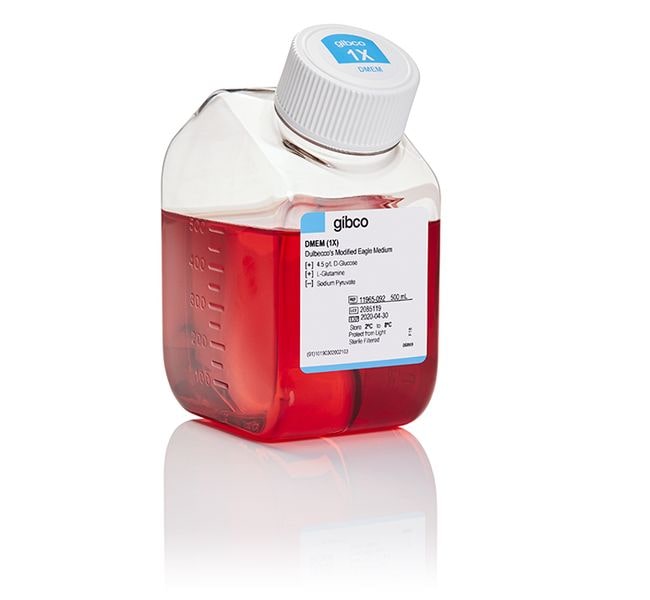
Dieses DMEM wurde wie folgt modifiziert:
| Mit | Ohne | |
| • Hoher Glukosegehalt | • Natriumpyruvat | |
| • L-Glutamin | • HEPES | |
| • Phenolrot |
Die vollständige Zusammensetzung ist verfügbar.
Verwendung von DMEM
DMEM unterscheidet von anderen Medien durch seine vierfach höhere Konzentration an Aminosäuren und Vitaminen gegenüber dem originalen Eagle's Minimal Essential Medium. Die Formulierung für DMEM wurde ursprünglich mit einer niedrigen Glukosekonzentration (1 g/l) und mit Natriumpyruvat entwickelt, wird aber häufig mit höheren Glukose-Konzentrationen sowie mit oder ohne Natriumpyruvat eingesetzt. DMEM enthält keine Proteine, Lipide oder Wachstumsfaktoren. Aus diesem Grund ist bei DMEM eine Supplementierung, meist mit 10 % fötalem Kälberserum (FKS), erforderlich. DMEM verwendet ein Natriumbikarbonat-Puffersystem (3,7 g/l) und erfordert daher eine 5 bis 10%ige CO–2-Umgebung, um den physiologischen pH-Wert aufrechtzuerhalten.
cGMP-konformes Herstellungs- und Qualitätssystem
DMEM wird in einer cGMP-konformen Einrichtung in Grand Island, New York, hergestellt. Die Einrichtung ist von der US-Arzneimittelbehörde FDA als Hersteller von Medizinprodukten zugelassen und nach ISO 13485-zertifiziert. Zur Gewährleistung einer ununterbrochenen Versorgungskette bietet Life Technologies ein identisches DMEM-Produkt aus unserem Betrieb in Schottland an (41965-039). Diese Einrichtung ist von der US-Arzneimittelbehörde FDA als Hersteller von Medizinprodukten zugelassen und ISO 13485-zertifiziert.
Für die Verwendung in der Forschung oder die Weiterverarbeitung. Nicht zur Diagnosestellung oder direkten Anwendung bei Menschen oder Tieren geeignet.
Specifications
ZelllinieHeLa, 293, Cos-7 und PC-12
ZelltypPrimäre Fibroblasten, Neuronen, Gliazellen, HUVECs und glatte Muskelzellen
Konzentration1 X
KulturmilieuCO2
Zur Verwendung mit (Anwendung)Säugetierzellkultur
FormatBottle
Glucosekonzentration4500 mg/L
Fertigungsqualität, HerstellungsqualitätcGMP-compliant under the ISO 13485 standard
ProduktlinieGibco
ProdukttypDMEM (Dulbecco's Modified Eagle Medium)
Menge500 mL
Haltbarkeit12 Monate ab Herstellungsdatum
VersandbedingungRaumtemperatur
KlassifikationOhne Stoffe tierischen Ursprungs
Culture TypeMammalian Cell Culture
FormFlüssig
Serum LevelStandard-Serumzugabe
SterilitätSteril gefiltert
Sterilization MethodSterile-filtered
Mit AdditivenHoher Glukosegehalt, Glutamin, Phenolrot
Ohne AdditiveKeine HEPES, Ohne Natriumpyruvat
Unit SizeEach
Inhalt und Lagerung
Lagerbedingungen: 2 °C bis 8 °C (vor Licht schützen)
Versandbedingungen: Haltbarkeit bei
Raumtemperatur: 12 Monate ab Herstellungsdatum
Versandbedingungen: Haltbarkeit bei
Raumtemperatur: 12 Monate ab Herstellungsdatum
Häufig gestellte Fragen (FAQ)
How stable are the Photoreactive Amino Acids in DMEM-LM?
What is the osmolality of DMEM, high glucose (Cat. No. 11965xxx)?
What is the manganese concentration in DMEM? Do you offer manganese-free DMEM?
How long can I keep my media after supplementing with serum?
My medium was shipped at room temperature but it is supposed to be stored refrigerated. Is it okay?
Zitierungen und Referenzen (110)
Zitierungen und Referenzen
Abstract
Regulation of cortical dendrite development by Slit-Robo interactions.
Journal:Neuron
PubMed ID:11779471
Slit proteins have previously been shown to regulate axon guidance, branching, and neural migration. Here we report that, in addition to acting as a chemorepellant for cortical axons, Slit1 regulates dendritic development. Slit1 is expressed in the developing cortex, and exposure to Slit1 leads to increased dendritic growth and branching.
Identification of a novel redox-sensitive gene, Id3, which mediates angiotensin II-induced cell growth.
Journal:Circulation
PubMed ID:12021231
BACKGROUND: Reactive oxygen species, such as superoxide (O(2)(-)), are involved in the abnormal growth of various cell types. Angiotensin II (Ang II) is one of the most potent inducers of oxidative stress in the vasculature. The molecular events involved in Ang II-induced proliferation of vascular smooth muscle cells (VSMCs) are
Interaction of CED-6/GULP, an adapter protein involved in engulfment of apoptotic cells with CED-1 and CD91/low density lipoprotein receptor-related protein (LRP).
Journal:J Biol Chem
PubMed ID:11729193
The prompt clearance of cells undergoing apoptosis is critical during embryonic development, normal tissue turnover, as well as inflammation and autoimmunity. The molecular details of the engulfment of apoptotic cells are not fully understood. ced-6 and its human homologue gulp, encode an adapter protein, whose function in engulfment is highly
A comparison between different human hepatocyte models reveals profound differences in net glucose production, lipid composition and metabolism in vitro.
Journal:Experimental cell research
PubMed ID:38499143
Cathepsin L and cathepsin B mediate reovirus disassembly in murine fibroblast cells.
Journal:J Biol Chem
PubMed ID:11986312
'After attachment to receptors, reovirus virions are internalized by endocytosis and exposed to acid-dependent proteases that catalyze viral disassembly. Previous studies using the cysteine protease inhibitor E64 and a mutant cell line that does not support reovirus disassembly suggest a requirement for specific endocytic proteases in reovirus entry. This study