Search


Zitierungen und Referenzen (2)
Invitrogen™
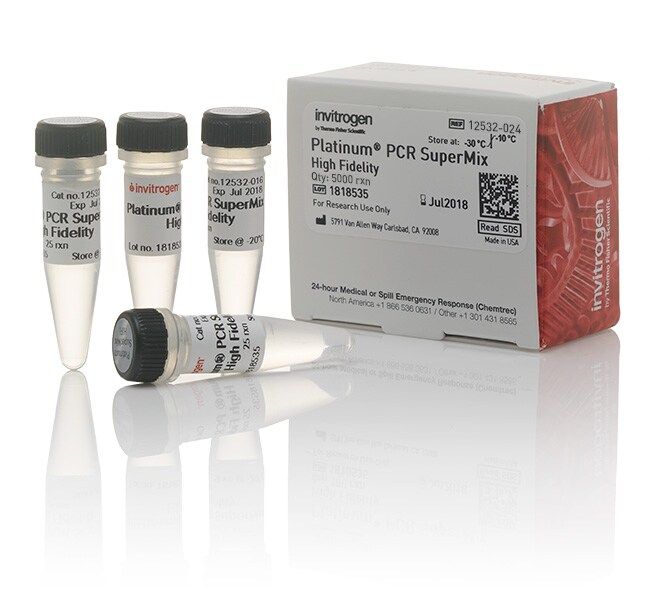
Platinum™ PCR SuperMix High Fidelity
Platin™ PCR SuperMix, High Fidelity, ist eine gebrauchsfertige Mischung aus DNA-Polymerase, Salzen, Magnesium und dNTPs für die effiziente PCR-Amplifikation. DurchWeitere Informationen
Have Questions?
Ansicht ändern

| Katalognummer | Anzahl Reaktionen |
|---|---|
| 12532024 | 5000 Reaktionen |
| 12532016 | 100 Reaktionen |
Katalognummer 12532024
Preis (EUR)
17.900,00
Each
Anzahl Reaktionen:
5000 Reaktionen
Preis (EUR)
17.900,00
Each
Platin™ PCR SuperMix, High Fidelity, ist eine gebrauchsfertige Mischung aus DNA-Polymerase, Salzen, Magnesium und dNTPs für die effiziente PCR-Amplifikation. Durch die Zugabe von Template und Primer wird die Vorbereitungszeit halbiert (siehe Abbildung). Platinum™ PCR SuperMix, High Fidelity bietet folgende Vorteile:
• Sechs Mal höhere Genauigkeit als Taq DNA-Polymerase
• Amplifikation von Fragmenten bis zu 15 kb
• Herstellung von Produkten mit stumpfen und 3-A'-Enden, wobei jedoch die meisten Enden 3-A'-Überhänge haben werden
• Minimierte PCR-Optimierung
Verwendung von Platinum™ PCR SuperMix, hohe Wiedergabetreue
Platinum™ PCR SuperMix, hohe Wiedergabetreue, ist für DNA-Amplifikationsanwendungen mit hoher Spezifität und Wiedergabetreue wie Klonierung oder Mutagenese bestimmt. Die hohe Wiedergabetreue wird erzielt durch eine Mischung aus Taq DNA-Polymerase und der Pyrococcus-Spezies GB-D-Polymerase mit Korrekturlese-Funktion. Durch Anti-Taq-Antikörper wird eine hohe Spezifität erreicht, was eine automatische „Heißstart“-PCR ermöglicht. Diese Hot-Start-Fähigkeit erhöht die Spezifität und Ausbeute und ermöglicht den Reaktionsaufbau bei Zimmertemperatur.
• Sechs Mal höhere Genauigkeit als Taq DNA-Polymerase
• Amplifikation von Fragmenten bis zu 15 kb
• Herstellung von Produkten mit stumpfen und 3-A'-Enden, wobei jedoch die meisten Enden 3-A'-Überhänge haben werden
• Minimierte PCR-Optimierung
Verwendung von Platinum™ PCR SuperMix, hohe Wiedergabetreue
Platinum™ PCR SuperMix, hohe Wiedergabetreue, ist für DNA-Amplifikationsanwendungen mit hoher Spezifität und Wiedergabetreue wie Klonierung oder Mutagenese bestimmt. Die hohe Wiedergabetreue wird erzielt durch eine Mischung aus Taq DNA-Polymerase und der Pyrococcus-Spezies GB-D-Polymerase mit Korrekturlese-Funktion. Durch Anti-Taq-Antikörper wird eine hohe Spezifität erreicht, was eine automatische „Heißstart“-PCR ermöglicht. Diese Hot-Start-Fähigkeit erhöht die Spezifität und Ausbeute und ermöglicht den Reaktionsaufbau bei Zimmertemperatur.
Nur für Forschungszwecke. Nicht für die Diagnostik bestimmt.
Specifications
Wiedergabetreue (vs. Taq)6X
Hot-StartIntegrierter Heißstart
Anzahl Reaktionen5000 Reaktionen
ÜberhangGemischt
PolymerasePlatinum Taq DNA-Polymerase High Fidelity
Menge5000 Reaktionen
ReaktionsformatSuperMix oder Master Mix
VersandbedingungNass- oder Trockeneis
Größe (Endprodukt)15 kb oder weniger
Konzentration1.1X
Zur Verwendung mit (Anwendung)Heißstart-PCR, PCR mit hoher Wiedergabetreue
GC-Rich PCR PerformanceNiedrig
ReaktionsgeschwindigkeitStandard
Unit SizeEach
Inhalt und Lagerung
• 4× 56,25 ml Platinum PCR SuperMix High Fidelity
Lagerung in einem nicht frostfreien Tiefkühlgerät bei -20 °C.
Lagerung in einem nicht frostfreien Tiefkühlgerät bei -20 °C.
Häufig gestellte Fragen (FAQ)
What is the difference between Platinum technology and AccuPrime technology?
Can I use MgCl2 instead of MgSO4 with Platinum Taq High Fidelity enzyme?
If I do PCR using the Platinum PCR SuperMix High Fidelity, can I use DNA-RNA chimeric oligos such as 5'-AGGCTTggau (lower case letters for RNA bases)?
Zitierungen und Referenzen (2)
Zitierungen und Referenzen
Abstract
Identifying genes of agronomic importance in maize by screening microsatellites for evidence of selection during domestication.
Journal:Proc Natl Acad Sci U S A
PubMed ID:12105270
'Crop species experienced strong selective pressure directed at genes controlling traits of agronomic importance during their domestication and subsequent episodes of selective breeding. Consequently, these genes are expected to exhibit the signature of selection. We screened 501 maize genes for the signature of selection using microsatellites or simple sequence repeats
Pattern of diversity in the genomic region near the maize domestication gene tb1.
Journal:Proc Natl Acad Sci U S A
PubMed ID:14701910
Domesticated maize and its wild ancestor (teosinte) differ strikingly in morphology and afford an opportunity to examine the connection between strong selection and diversity in a major crop species. The tb1 gene largely controls the increase in apical dominance in maize relative to teosinte, and a region of the tb1