Search


Zitierungen und Referenzen (3)
Gibco™
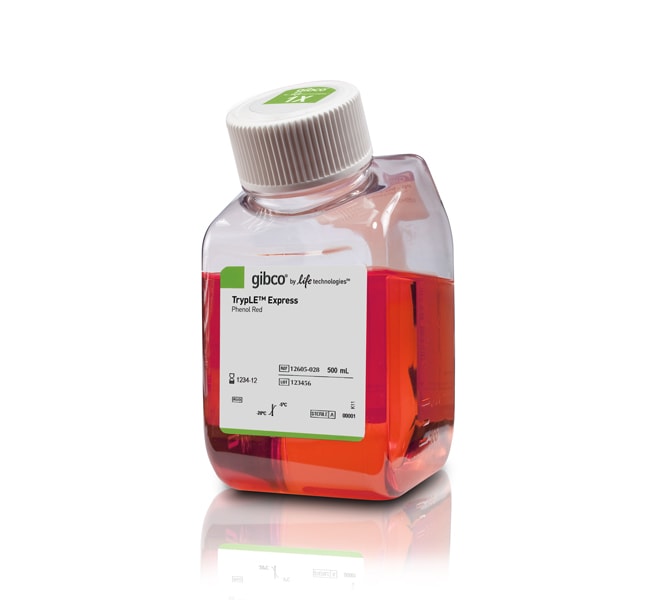
TrypLE™ Express Enzym (1x), Phenolrot
TrypLE Express ist ein rekombinantes Enzym nicht tierischen Ursprungs, das zur Dissoziation einer Vielzahl adhärenter Säugetierzellen verwendet wird. Diese umfassenWeitere Informationen
Have Questions?
Ansicht ändern

| Katalognummer | Menge |
|---|---|
| 12605028 | 500 ml |
| 12605010 | 100 ml |
| 12605036 | 20 x 100 mL |
Katalognummer 12605028
Preis (EUR)
119,65
Online Exclusive
137,00Ersparnis 17,35 (13%)
Each
Menge:
500 ml
Preis (EUR)
119,65
Online Exclusive
137,00Ersparnis 17,35 (13%)
Each
TrypLE Express ist ein rekombinantes Enzym nicht tierischen Ursprungs, das zur Dissoziation einer Vielzahl adhärenter Säugetierzellen verwendet wird. Diese umfassen CHO, HEK 293, A549, primäre menschliche Keratinozyten und embryonale Stammzellen. TrypLE Express spaltet Peptid-Bindungen am C-terminalen Ende von Lysin und Arginin und kann als direkter Ersatz für Trypsin eingesetzt werden. Seine außergewöhnliche Reinheit erhöht die Spezifität und reduziert Zellschädigungen, die durch andere Enzyme verursacht werden, die in einigen Trypsin-Extrakten vorhanden sind.
Wir bieten eine Vielzahl von TrypLE-Zusammensetzungen für eine Vielzahl von Zellkulturanwendungen.
Im Vergleich zu Trypsin und anderen Dissoziationsreagenzien ist Gibco TrypLE Express:
Schonend zu Zellen
• Stabil bei Raumtemperatur
• Anwenderfreundlich
• Ohne Stoffe tierischen Ursprungs
Die Zusammensetzung von TrypLE-Lösungen ist verfügbar, obwohl wir die Enzymkonzentration vertraulich behandeln.
Gute Zellverträglichkeit
Die außergewöhnliche Reinheit von TrypLE Express erhöht die Spezifität durch die Wirkung eines einzelnen Enzyms. Dadurch werden Schäden durch Spaltung von mehreren Enzymen in Trypsin und anderen Extrakten reduziert.
Stabil bei Raumtemperatur
TrypLE Express ist bei Raumtemperatur stabil und gebrauchsfertig. TrypLE Express bleibt bei Raumtemperatur oder 2 bis 8 °C 24 Monate lang stabil und ermöglicht damit eine problemlose Lagerung und praktische Handhabung.
Anwenderfreundlich
TrypLE Express kann Trypsin direkt in vorhandenen Protokollen ersetzen. Darüber hinaus kann TrypLE Express allein durch Verdünnung inaktiviert werden; Trypsin-Inhibitoren wie FKS sind nicht erforderlich.
Ohne Stoffe tierischen Ursprungs
Im Gegensatz zu Schweinetrypsin ist TrypLE Express ohne tierische Bestandteile.
cGMP-Herstellungs- und Qualitätssystem
Um eine kontinuierliche Versorgung zu gewährleisten, stellen wir Gibco TrypLE Express an zwei separaten Standorten in Grand Island, NY, und Schottland, Großbritannien, her. Beide Standorte erfüllen die cGMP-Fertigungsanforderungen und sind ISO 13485-zertifiziert und bei der FDA als Hersteller medizinischer Geräte registriert.
Wir bieten eine Vielzahl von TrypLE-Zusammensetzungen für eine Vielzahl von Zellkulturanwendungen.
Im Vergleich zu Trypsin und anderen Dissoziationsreagenzien ist Gibco TrypLE Express:
Schonend zu Zellen
• Stabil bei Raumtemperatur
• Anwenderfreundlich
• Ohne Stoffe tierischen Ursprungs
Diese Version von TrypLE Express wurde wie folgt modifiziert:
| Mit |
• Phenolrot |
• EDTA |
Die Zusammensetzung von TrypLE-Lösungen ist verfügbar, obwohl wir die Enzymkonzentration vertraulich behandeln.
Gute Zellverträglichkeit
Die außergewöhnliche Reinheit von TrypLE Express erhöht die Spezifität durch die Wirkung eines einzelnen Enzyms. Dadurch werden Schäden durch Spaltung von mehreren Enzymen in Trypsin und anderen Extrakten reduziert.
Stabil bei Raumtemperatur
TrypLE Express ist bei Raumtemperatur stabil und gebrauchsfertig. TrypLE Express bleibt bei Raumtemperatur oder 2 bis 8 °C 24 Monate lang stabil und ermöglicht damit eine problemlose Lagerung und praktische Handhabung.
Anwenderfreundlich
TrypLE Express kann Trypsin direkt in vorhandenen Protokollen ersetzen. Darüber hinaus kann TrypLE Express allein durch Verdünnung inaktiviert werden; Trypsin-Inhibitoren wie FKS sind nicht erforderlich.
Ohne Stoffe tierischen Ursprungs
Im Gegensatz zu Schweinetrypsin ist TrypLE Express ohne tierische Bestandteile.
cGMP-Herstellungs- und Qualitätssystem
Um eine kontinuierliche Versorgung zu gewährleisten, stellen wir Gibco TrypLE Express an zwei separaten Standorten in Grand Island, NY, und Schottland, Großbritannien, her. Beide Standorte erfüllen die cGMP-Fertigungsanforderungen und sind ISO 13485-zertifiziert und bei der FDA als Hersteller medizinischer Geräte registriert.
Nur für Forschungszwecke. Nicht zur Verwendung bei diagnostischen Verfahren.
Specifications
ZelltypSäugetierzellen
ChelatbildnerEDTA
Konzentration1X
KulturtypAdhärente Zellkultur
OsmolalitätÜberprüfen und notieren
ProduktlinieGibco
Menge500 ml
BemerkungenStabil bei Raumtemperatur
Haltbarkeit24 Monate
VersandbedingungRaumtemperatur
QuelleOhne Stoffe tierischen Ursprungs
Getestet aufIn-vitro-Bioassay
KlassifikationOhne Stoffe tierischen Ursprungs
FormFlüssig
ProdukttypReagenz zur Zellkulturdissoziation
SterilitätSteril gefiltert
Mit AdditivenPhenolrot, EDTA
Unit SizeEach
Inhalt und Lagerung
Lagerbedingungen: 15 bis 30 °C, vor Licht schützen
Alternative Lagerbedingungen: 2 bis 8 °C oder –5 bis –20 °C
Versandbedingungen: Haltbarkeit bei
Raumtemperatur: 24 Monate ab Herstellungsdatum
Alternative Lagerbedingungen: 2 bis 8 °C oder –5 bis –20 °C
Versandbedingungen: Haltbarkeit bei
Raumtemperatur: 24 Monate ab Herstellungsdatum
Häufig gestellte Fragen (FAQ)
How can I assess residual TrypLE reagent remaining after my downstream processing steps?
Does TrypLE Express Enzyme have a His-tag?
Is there an upper limit for the amount of time cells can be incubated with TrypLE Express Enzyme, TrypLE Select Enzyme, or CTS TrypLE Select Enzyme for dissociation?
For your TrypLE products, how does the enzyme get inactivated?
What is the difference between TrypLE Express Enzyme, with and without phenol red? What does the phenol red do?
Zitierungen und Referenzen (3)
Zitierungen und Referenzen
Abstract
Directed differentiation of pancreatic δ cells from human pluripotent stem cells.
Journal:Nature communications
PubMed ID:39068220
Dysfunction of pancreatic δ cells contributes to the etiology of diabetes. Despite their important role, human δ cells are scarce, limiting physiological studies and drug discovery targeting δ cells. To date, no directed δ-cell differentiation method has been established. Here, we demonstrate that fibroblast growth factor (FGF) 7 promotes pancreatic
Non-viral-mediated gene transfer of OX40 ligand for tumor immunotherapy.
Journal:Frontiers in immunology
PubMed ID:39007148
BACKGROUND: Immune checkpoint blockade (ICB) is rapidly becoming a standard of care in the treatment of many cancer types. However, the subset of patients who respond to this type of therapy is limited. Another way to promote antitumoral immunity is the use of immunostimulatory molecules, such as cytokines or T
A simple tool to improve pluripotent stem cell differentiation.
Journal:Nat Methods
PubMed ID:23584186
We describe a method to help overcome restrictions on the differentiation propensities of human pluripotent stem cells. Culturing pluripotent stem cells in dimethylsulfoxide (DMSO) activates the retinoblastoma protein, increases the proportion of cells in the early G1 phase of the cell cycle and, in more than 25 embryonic and induced