Search


Zitierungen und Referenzen (5)
Gibco™
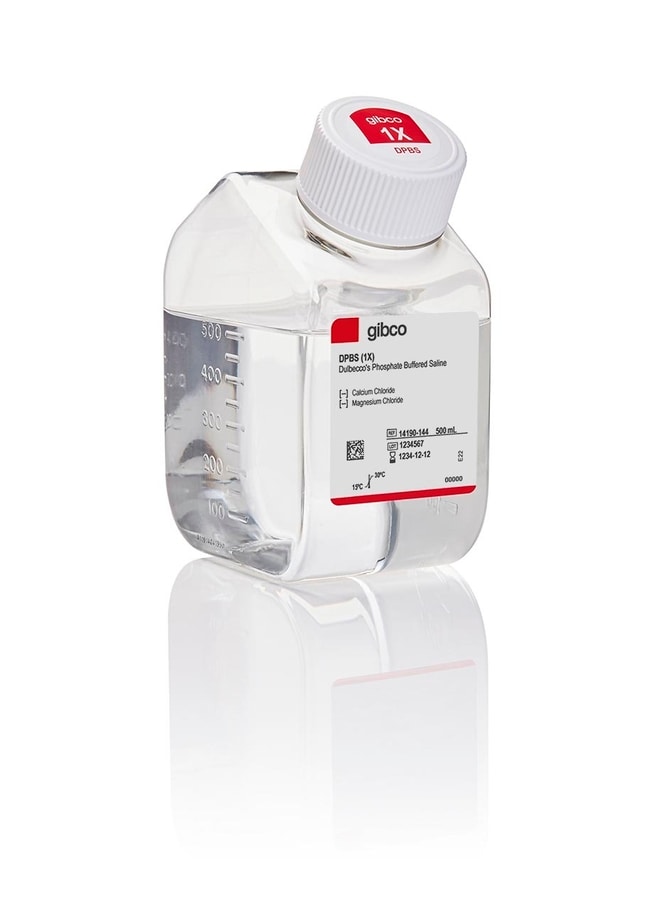
DPBS, ohne Kalzium, ohne Magnesium
Dulbecco's Balanced Salt Solution (DPBS) ist eine ausgewogene Salzlösung für eine Vielzahl von Zellkulturanwendungen wie z. B. das Waschen vonWeitere Informationen
Have Questions?
Ansicht ändern

| Katalognummer | Menge | Verpackung |
|---|---|---|
| 14190144 | 500 mL | Flasche |
| 14190086 auch als 14190-086 bezeichnet | 100 mL | Flasche |
| 14190185 auch als 14190-185 bezeichnet | 20 mL x 100 mL | Flasche |
| 14190094 auch als 14190-094 bezeichnet | 500 mL | Flasche |
| 14190250 | 10 x 500 mL | Flasche |
| 14190169 auch als 14190-169 bezeichnet | 10 x 500 mL | Flasche |
| 14190136 | 1.000 mL | Flasche |
| 14190342 | 5 l | Beutel |
| 14190359 | 10 l | Beutel |
| 14190240 auch als 14190-240 bezeichnet | 10 l | Beutel |
| 14190367 | 20 l | Beutel |
Katalognummer 14190144
Preis (EUR)
30,65
キャンペーン価格
33,49Ersparnis 2,84 (8%)
Each
Menge:
500 mL
Verpackung:
Flasche
Preis (EUR)
30,65
キャンペーン価格
33,49Ersparnis 2,84 (8%)
Each
Dulbecco's Balanced Salt Solution (DPBS) ist eine ausgewogene Salzlösung für eine Vielzahl von Zellkulturanwendungen wie z. B. das Waschen von Zellen vor der Dissoziation, den Transport von Zellen bzw. Gewebeproben, das Verdünnen von Zellen für Zählvorgänge und die Reagenzienvorbereitung. Zum Ausspülen von Chelatoren aus der Kultur vor der Zelldissoziation sind Zusammensetzungen ohne Calcium und Magnesium erforderlich.
Wir bieten eine Vielzahl an Gibco™ DPBS-Formulierungen für viele verschiedene Zellkulturanwendungen an.
Die vollständige Formulierung ist verfügbar.
cGMP-konformes Fertigungs- und Qualitätssystem
Gibco™ DPBS wird in einer cGMP-konformen Einrichtung in Grand Island, New York (USA), hergestellt. Die Einrichtung ist von der US-Arzneimittelbehörde FDA als Hersteller von Medizinprodukten zugelassen und nach ISO 13485-zertifiziert. Um eine kontinuierliche Versorgung zu gewährleisten, bieten wir ein identisches Gibco™ DPBS Produkt an, das an unserem Standort in Schottland hergestellt wurde (14190-240). Diese Einrichtung ist von der US-Arzneimittelbehörde FDA als Hersteller von Medizinprodukten zugelassen und ISO 13485-zertifiziert.
Wir bieten eine Vielzahl an Gibco™ DPBS-Formulierungen für viele verschiedene Zellkulturanwendungen an.
Dieses DPBS wird wie folgt modifiziert:
| Ohne |
| • Calcium |
| • Magnesium |
| • Phenolrot |
Die vollständige Formulierung ist verfügbar.
cGMP-konformes Fertigungs- und Qualitätssystem
Gibco™ DPBS wird in einer cGMP-konformen Einrichtung in Grand Island, New York (USA), hergestellt. Die Einrichtung ist von der US-Arzneimittelbehörde FDA als Hersteller von Medizinprodukten zugelassen und nach ISO 13485-zertifiziert. Um eine kontinuierliche Versorgung zu gewährleisten, bieten wir ein identisches Gibco™ DPBS Produkt an, das an unserem Standort in Schottland hergestellt wurde (14190-240). Diese Einrichtung ist von der US-Arzneimittelbehörde FDA als Hersteller von Medizinprodukten zugelassen und ISO 13485-zertifiziert.
For Research Use or Further Manufacturing. Not for diagnostic use or direct administration into humans or animals.
Specifications
Chemischer Name oder MaterialDulbeccos phosphatgepufferte Salzlösung (DPBS)
FarbeKlar
EnthältOhne Natriumpyruvat
Fertigungsqualität, HerstellungsqualitätcGMP-compliant under the ISO 13485 standard
Osmolalität270 bis 300 mOsm/kg
VerpackungFlasche
Empfohlene LagerungLagerbedingungen: 15 °C bis 30 °C
Versandbedingungen: Raumtemperatur
Haltbarkeit: 36 Monate ab Herstellungsdatum
Versandbedingungen: Raumtemperatur
Haltbarkeit: 36 Monate ab Herstellungsdatum
SterilitätSteril gefiltert
Konzentration1X
Zur Verwendung mit (Anwendung)Säugetierzellkultur
Physikalische FormFlüssig
ProduktlinieGibco
Menge500 mL
LösungstypPhosphatgepufferte Saline von Dulbecco
pH7,0 bis 7,3
Unit SizeEach
Häufig gestellte Fragen (FAQ)
What procedures are recommended for the preparation of beta amyloid-containing samples?
What is the shelf life of DPBS after it has been opened?
What is the shelf life of DPBS (Cat. No. 14190136)?
Does Diploid Growth Serum-Reduced Medium (SRM) contain L-glutamine?
Do I have to adjust my infection parameters when using Diploid Production Serum-Free Medium (SFM)?
Zitierungen und Referenzen (5)
Zitierungen und Referenzen
Abstract
A comparison between different human hepatocyte models reveals profound differences in net glucose production, lipid composition and metabolism in vitro.
Journal:Experimental cell research
PubMed ID:38499143
Effects of an indole derivative on cell proliferation, transfection, and alternative splicing in production of lentiviral vectors by transient co-transfection.
Journal:PloS one
PubMed ID:38833479
Lentiviral vectors derived from human immunodeficiency virus type I are widely used to deliver functional gene copies to mammalian cells for research and gene therapies. Post-transcriptional splicing of lentiviral vector transgene in transduced host and transfected producer cells presents barriers to widespread application of lentiviral vector-based therapies. The present study
Macrophage foam cell formation with native low density lipoprotein.
Journal:J Biol Chem
PubMed ID:12118008
'This investigation has elucidated a mechanism for development of macrophage foam cells when macrophages are incubated with native low density lipoprotein (LDL). LDL is believed to be the main source of cholesterol that accumulates in monocyte-derived macrophages within atherosclerotic plaques, but native LDL has not previously been shown to cause
Microfluidic single-cell real-time PCR for comparative analysis of gene expression patterns.
Journal:Nat Protoc
PubMed ID:22481529
'Single-cell quantitative real-time PCR (qRT-PCR) combined with high-throughput arrays allows the analysis of gene expression profiles at a molecular level in approximately 11 h after cell sample collection. We present here a high-content microfluidic real-time platform as a powerful tool for comparatively investigating the regulation of developmental processes in single
Efficient intracellular assembly of papillomaviral vectors.
Journal:J Virol
PubMed ID:14694107
Although the papillomavirus structural proteins, L1 and L2, can spontaneously coassemble to form virus-like particles, currently available methods for production of L1/L2 particles capable of transducing reporter plasmids into mammalian cells are technically demanding and relatively low-yield. In this report, we describe a simple 293 cell transfection method for efficient