Search


Zitierungen und Referenzen (8)
Gibco™
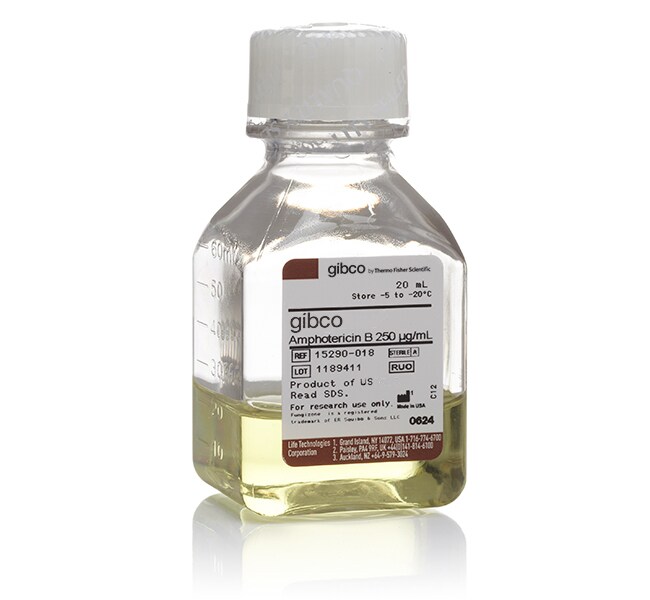
Amphotericin B
Amphotericin B ist die generische Version von Fungizone. „Fungizone“ ist eine Marke von E.R. Squibb & Sons, LLC. Amphotericin BWeitere Informationen
Have Questions?
Ansicht ändern

| Katalognummer | Menge |
|---|---|
| 15290018 | 20 ml |
| 15290026 | 50 ml |
Katalognummer 15290018
Preis (EUR)
24,65
온라인 행사
25,87Ersparnis 1,22 (5%)
Each
Menge:
20 ml
Preis (EUR)
24,65
온라인 행사
25,87Ersparnis 1,22 (5%)
Each
Amphotericin B ist die generische Version von Fungizone. „Fungizone“ ist eine Marke von E.R. Squibb & Sons, LLC. Amphotericin B ist ein Antimykotikum, das von Streptomyces nodosus produziert wird. Es verhindert das Wachstum von Pilzen durch die Erhöhung der Durchlässigkeit der fungalen Plasmamembran. Es bindet aktiv an Sterole und führt zur Bildung von Poren. Es wird zur Verhinderung von Kontaminationen von Zellkulturen durch Hefen und multizelluläre Pilze verwendet. Gibco Amphotericin B enthält 250 µg Amphotericin B und 205 µg Natriumdesoxycholat pro ml destilliertem Wasser. Die empfohlene Arbeitskonzentration liegt zwischen 0,25 und 2,50 µg/ml.
cGMP-Herstellung an zwei Standorten
Für die Kontinuität der Lieferkette stellen wir Gibco Amphotericin B an zwei separaten Standorten in Grand Island, NY und Schottland, Großbritannien, her. Beide Standorte erfüllen die cGMP-Fertigungsanforderungen und sind ISO 13485-zertifiziert und bei der FDA als Hersteller medizinischer Geräte registriert.
cGMP-Herstellung an zwei Standorten
Für die Kontinuität der Lieferkette stellen wir Gibco Amphotericin B an zwei separaten Standorten in Grand Island, NY und Schottland, Großbritannien, her. Beide Standorte erfüllen die cGMP-Fertigungsanforderungen und sind ISO 13485-zertifiziert und bei der FDA als Hersteller medizinischer Geräte registriert.
Nur für Forschungszwecke. Nicht zur Verwendung bei diagnostischen Verfahren.
Specifications
Konzentration0,25 bis 2,5 μg/ml
Zur Verwendung mit (Anwendung)Zur Prävention von Zellkulturkontaminationen
ProduktlinieFungizone
Menge20 ml
Haltbarkeit12 Monate
VersandbedingungTrockeneis
FormFlüssig
ProdukttypAntimykotikum
SterilitätSteril gefiltert
Unit SizeEach
Inhalt und Lagerung
Lagerbedingungen: -5 bis -20 °C
Versandbedingungen: Gefroren auf Trockeneis
Haltbarkeit: 12 Monate ab Herstellungsdatum
Versandbedingungen: Gefroren auf Trockeneis
Haltbarkeit: 12 Monate ab Herstellungsdatum
Häufig gestellte Fragen (FAQ)
How many freeze/thaw cycles do you recommend for Amphotericin B?
What is the stability of Amphotericin B when stored at 4 degrees C?
What is the difference between Fungizone and Amphotericin B?
How can I decontaminate my cultures?
What antibiotics do you offer to help control or eliminate cell culture contamination?
Zitierungen und Referenzen (8)
Zitierungen und Referenzen
Abstract
Use of human tissue explants to study human infectious agents.
Journal:Nat Protoc
PubMed ID:19197269
The study of human cell-cell and cell-pathogen interactions that occur in the context of complex tissue cytoarchitecture is critical for deciphering the mechanisms of many normal and pathogenic processes. This protocol describes methods for culturing and infecting explants of human tissues to study the pathogenesis of human infectious agents and
Specific inhibition of ICAM-1 expression mediated by gene targeting with Triplex-forming oligonucleotides.
Journal:J Biol Chem
PubMed ID:12080053
Selected sequences in the DNA double helix can be specifically recognized by oligonucleotides via hydrogen bonding interactions. The resulting triple helix can modulate DNA metabolism and especially interfere with transcription in a gene-specific manner. To explore the potential of triplex-forming oligonucleotides (TFOs) as gene repressors, a TFO was designed to
Endogenous G Protein-coupled Receptor Kinase 6 Regulates M3 Muscarinic Acetylcholine Receptor Phosphorylation and Desensitization in Human SH-SY5Y Neuroblastoma Cells.
Journal:J Biol Chem
PubMed ID:11856737
We have previously shown that overexpression of G protein-coupled receptor kinase 6 (GRK6) enhanced the phosphorylation and desensitization of the endogenously expressed M(3) muscarinic acetylcholine (mACh) receptor in human SH-SY5Y neuroblastoma cells. In this study we have examined the potential role of endogenous GRK6 in the regulation of M(3) mACh
CD40-mediated Activation of NF-kappa B in Airway Epithelial Cells.
Journal:J Biol Chem
PubMed ID:12122011
We have reported previously that airway epithelial cells (AEC) express CD40 and that activation of this molecule stimulates the expression of inflammatory mediators, including the chemokine RANTES (regulated on activation normal T cell expressed and secreted). Because NF-kappaB regulates the expression of many inflammatory mediators, such as RANTES, we utilized
A Dynamic Variation of Pulmonary ACE2 Is Required to Modulate Neutrophilic Inflammation in Response to
Journal:J Immunol
PubMed ID:31645418
'Angiotensin-converting enzyme 2 (ACE2) is a potent negative regulator capable of restraining overactivation of the renin-angiotensin system, which contributes to exuberant inflammation after bacterial infection. However, the mechanism through which ACE2 modulates this inflammatory response is not well understood. Accumulating evidence indicates that infectious insults perturb ACE2 activity, allowing for